search
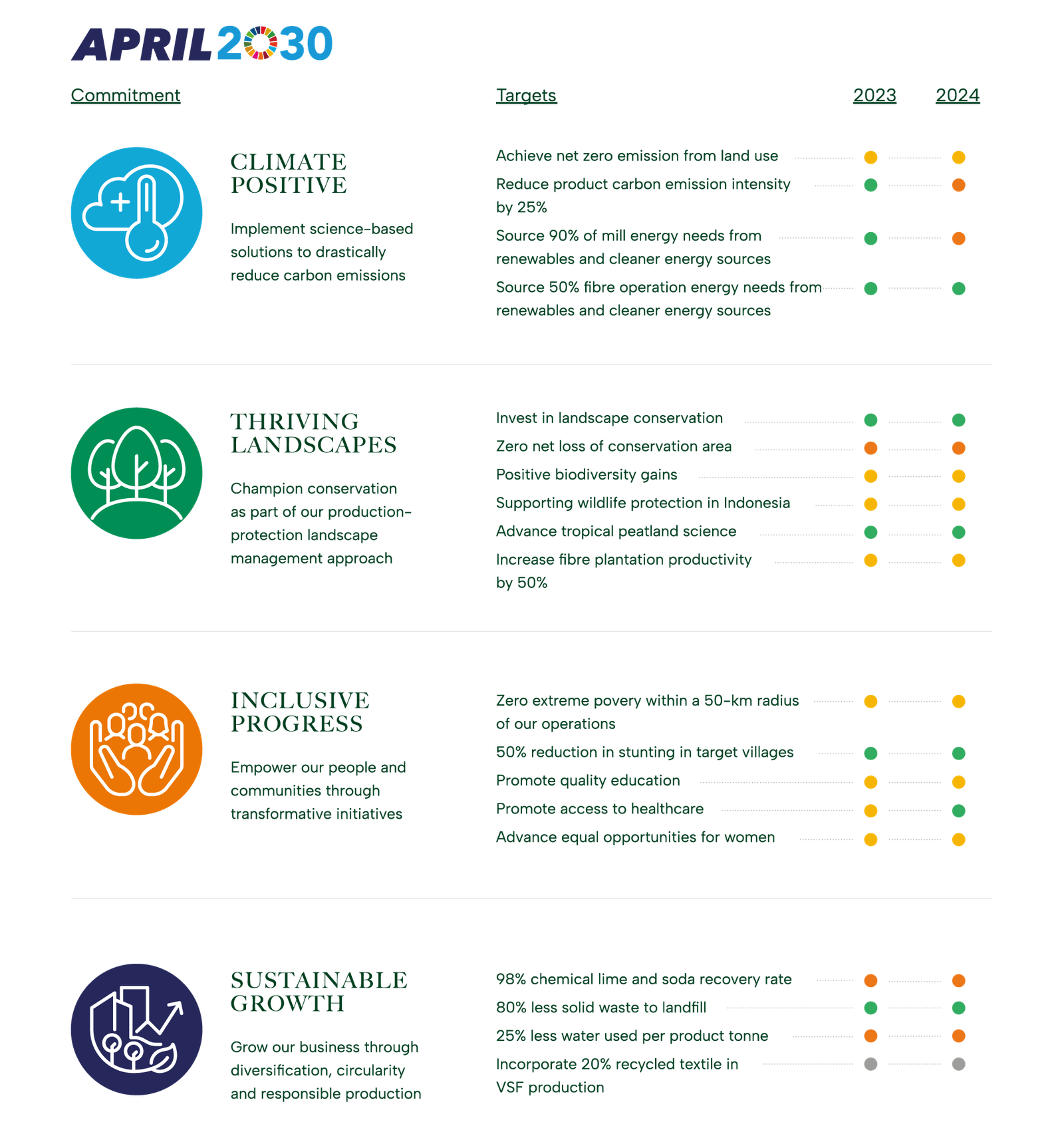
Targets Status and Overview
svg+xml;charset=utf — APRIL Asia
open — APRIL Asia

Read the full message

Dear Stakeholder,

We hope this letter finds you well as we all cope with the challenges of living with COVID-19. The global pandemic continues to test our resolve as a business on many fronts. And while we address the urgency of protecting the health and well-being of our employees and communities, we also believe that staying the course and maintaining a long-term view on sustainability is crucial.

Continued investment in climate, nature and sustainable development assumes even greater urgency if we are to achieve a strong recovery. As challenging as the current situation is, it presents businesses with an opportunity, if seized decisively, to boldly transform the future for the better.

Today our company, APRIL Group, together with our shareholders, management and employees, announces APRIL2030. This is our commitment to deliver a positive impact on climate, nature and people while growing as a sustainable producer of renewable fiber-based products.

By 2030 we will achieve net zero emissions from our land use and carbon emissions reductions in our production processes, measurable gains in nature, and zero extreme poverty in our communities while transforming our business for sustainable growth.

APRIL2030 supports the achievement of the Sustainable Development Goals at the national level in Indonesia and more importantly at the village level in the province of Riau where our operations are located. No company’s sustainability vision can be truly enduring if communities are left behind. As a company based in a developing economy, the responsibility to function more sustainably while still delivering essential progress for communities is greater than ever.

APRIL2030 builds on the commitments embedded in our Sustainable Forest Management Policy (SFMP 2.0) and on the progress made in its implementation over the last five years. To be clear, we will continue to adhere to these commitments under the independent scrutiny and guidance of the Stakeholder Advisory Committee (SAC) and with scientific advice from the Independent Peat Expert Working Group (IPEWG).

As we seek to contribute to global conversations on our collective future and support the Indonesian government in achieving its climate and development targets, we are determined to ensure the next decade is about further transformation. We are therefore expanding our commitments to include:

  • Achieving net zero emissions from land use
  • Reducing product carbon emissions intensity by 25%
  • Sourcing most of our energy needs from renewables and cleaner energy
  • Investing in the protection, conservation and restoration of nature through our production-protection approach, guaranteeing millions of dollars per year of funding for nature
  • Ensuring zero net loss of protected areas, while achieving measurable gains in biodiversity and other ecosystem benefits
  • Achieving zero extreme poverty in our communities, boosting education, improving access to essential healthcare and championing equal opportunity for women
  • Advancing tropical peatland science by contributing to global knowledge and best practice
  • Embracing circularity in our business, including sourcing up to 20% of our cellulosic fiber for viscose from recycled textiles

As a company we’ve always preferred to be marked by our actions more than by our pledges. So today we also announce a number of concrete initiatives that immediately propel us into the delivery of APRIL2030:

  • Extended Commitment to Forest Conservation and Restoration: As we strive to meet our pledge to conserve a hectare of forest for every hectare of plantation (1 for 1), we are extending our commitment on conservation and restoration to also support other initiatives through partnerships and collaboration. Going forward, we will set aside funding per tonne of fiber used in production that will guarantee about $10 million per year for investment in nature.
  • Supporting Wildlife Protection: Related to targets on forest protection and biodiversity gains, we will support wildlife protection and conservation in Indonesia, including endangered species, through partnerships and collaboration, and we are in advanced discussions for a cooperation on this important area with the Wildlife Conservation Society. This is in addition to the ongoing work on conservation and restoration with long-time partner Fauna & Flora International. We are passionate about protecting the wildlife in our conservation and restoration areas and beyond. More details on these partnerships will be communicated in the coming months.
  • Tropical Peatland Science Hub: Our Riau Ecosystem Restoration (RER) project has been steadily progressing, protecting 150,693 ha of peatland forests that are home to more than 700 species and store at least 688 million tonnes of carbon. We have completed the establishment of a new Eco-Research Camp on the Kampar Peninsula that will serve as a tropical peatland science hub for national and international scientists and academics, and also for stakeholders who wish to experience ecosystem restoration work on the ground.
  • 20MW solar panels by 2025: To immediately kick off our shift to renewable energy sources, as part of our commitment to reduce our carbon emissions, we will be installing 20MW solar panels in our mill and fiber operations starting in 2021. When completed in 2025, this will be one of the largest, private sector, solar panel installations in Indonesia.

We recognise that climate change knows no boundaries between developed and developing nations. We support science-based target setting and have signed up with the Science-Based Target Initiative (SBTi) to learn and contribute to the network, particularly in the land use sector. We also believe science-based target setting for nature is the only way forward as we support forest conservation in Indonesia.

Reflecting on the lessons of the past decade, we all know that addressing the greatest challenges of our time requires collective action. We fully believe that only by working in the field with the communities and local stakeholders can we gain a genuine understanding of their realities, and together develop practical solutions and drive lasting change. We need to harness our passion beyond advocacy and towards the pursuit of  pragmatic solutions on the ground. Only by challenging our own positions and being open to working together can we turn this period into a decade of action for all.

There have been spirited discussions internally about whether we are really ready to do this at a time when new uncertainties are still evolving globally. In the end, we decided that it’s now or never. It will take courage, but that is how meaningful change is achieved. We’ve always believed in the positive interdependence between sustainability and development, and APRIL2030 will continue to advance this integration of goals for people, climate, nature and sustainable growth.

We invite you to learn more about the details of our commitments and targets for the next decade at https://april2030.aprilasia.com and welcome your feedback.

Yours sincerely,

Anderson Tanoto, Director
Wang Bo, President, APRIL Group
Bey Soo Khiang, Chairman, APRIL Group

Why did APRIL launch its APRIL2030 targets and commitments?

When we unveiled our APRIL2030 commitments and targets in 2020, we highlighted that it was an opportunity to play our part in achieving a lower carbon economy and to make a positive impact on climate, nature and people by 2030.  

Five years on, we have delivered on what we said we would do, while demonstrating that business growth and sustainability transformation can go hand-in-hand as an effective business strategy. 

While our expanded production capacity has made meeting some of our original APRIL2030 targets more challenging, it has also demonstrated the ability of the private sector to stretch ambitions and adapt to changing economic or market conditions. 

Our growth has put us in position to support the decarbonisation of our operations, the extension of our investments in nature and biodiversity, and driven inclusivity and lifted-up local communities, while growing our business sustainably.

How did the company arrive at its targets?

We started with the recognition of the global imperatives – to achieve the 2030 development agenda, meet climate targets of keeping global warming below 1.5 degrees C, and support the call for greater protection for nature. These were the bases for the key commitment pillars: Climate Positive, Thriving Landscapes, Inclusive Progress, and Sustainable Growth.

We then reviewed industry benchmarks and also consulted closely with our leadership team so we could define the level of ambition for the targets. These targets needed to be on par with global and national ambitions, and challenging for our company, while also achievable. The draft targets were then presented to our operational management teams in an internal workshop for review and validation. 

Finally, we conferred with our advisors and key stakeholders for their inputs.

Once the targets were set, we then identified the key metrics and established the baselines using 2019 data for assurance by KPMG PRI. So all in all we have four commitment pillars, 18 targets and 35 indicators.

Are the APRIL2030 commitments aligned with the goals of the Indonesian government?

APRIL2030 aims to support the Indonesian government in achieving its climate, biodiversity conservation and development goals. Given our operational presence, our support is mainly through implementation on the ground at the district and village levels.

How do the APRIL2030 targets support the SDGs?

APRIL2030 supports the achievement of the Sustainable Development Goals at the national level in Indonesia and more importantly at the village level in the province of Riau. In 2018, we worked with PwC Singapore on a process to identify our priority SDGs and have selected 4 as Core (SDGs 12, 13, 15 and 17) and three as Catalytic (SDGs 3, 4, 6) priorities. The alignment of our targets against relevant SDG targets are presented here.

Does APRIL2030 replace SFMP 2.0?

APRIL2030 builds on our Sustainable Forest Management Policy (SFMP) 2.0 and on the progress made in its implementation over the last five years. We will continue to adhere to these commitments, with our performance reviewed and reported on by the Stakeholder Advisory Committee and an independent assurance party.

How did APRIL establish baselines for its targets?

For each of the 18 targets under the four commitment pillars, we defined performance indicators, resulting in 35 performance metrics for the whole of APRIL2030. In order to measure progress against the targets, we established the baseline for most of the indicators using 2019 data. These baselines were independently verified by KPMG PRI Canada as being fit for purpose and accurate.

Who is responsible for achieving these targets? Where does accountability lie within the company?

APRIL2030 is owned at all levels of APRIL. The senior leadership team has been part of the process from the beginning, setting the levels of ambition, providing strategic guidance, and committing the necessary resources from the development phase in 2019 through to implementation by 2030.

Each commitment pillar has a Champion who is a senior member of management and each Champion has formed working groups for the key targets. These working groups develop action plans that are part of operational plans. In practice, APRIL2030 targets are embedded in individual KPIs and in the regular monitoring and reporting done within our company.

How does APRIL track its progress?

Reporting on the performance against the targets is part of ongoing operational monitoring and reporting, as well as progress reporting in our annual Sustainability Report. In addition, we published an interim progress report in 2025.

Are APRIL's carbon emissions targets achievable?

Achieving net zero emissions from land use and the 25% reduction in product emissions intensity is challenging but we are committed to meeting these targets.

We support science-based target setting and have been measuring our GHG emissions in our peatland plantations and, more recently, in our mineral soil plantations through the four GHG eddy covariance towers that we have installed. Using the primary data that we have generated and other inputs, we have measured our carbon footprint (scopes 1 and 3).

We continue to employ a range of emissions reduction and mitigation strategies both in our forestry and manufacturing operations to achieve our targets, including, for example, more continuous improvements in responsible peatland management, increased conservation and restoration initiatives, and shift to renewable energy sources.

How will APRIL achieve its mill emissions reduction targets?

We aim to reduce our product carbon emissions by using more biomass fuels and reducing energy consumption per tonne of product manufactured. We are targeting 90% of mill energy from renewables.

We will source 50% of our fibre operations energy needs from renewables and cleaner energy sources. We are already implementing B30 diesel which is 30% renewable biofuel, and we are converting some of our log transport trucks to natural gas engines as a test towards a lower emission future. Achieving our mill emission targets involves using a higher percentage of biomass and reducing the mill’s energy needs to become more efficient.

Is APRIL2030 binding on long-term and short-term or open market suppliers?

APRIL2030 covers our own operations and our supply partners. We are also engaging our value chain in support of our 2030 targets, and we hope to encourage and influence others to pursue the same level of ambition.

Why hasn't APRIL addressed fire prevention in its APRIL2030 targets?

Fire prevention and management is already embedded in our operations. Our Fire Free Village Program has proven its effectiveness over the past five years and continues to be scaled through the Fire Free Alliance. With this operational infrastructure firmly in place, we can focus on other areas of importance through APRIL2030.

How will APRIL advance tropical peatland science?

In 2021, we completed the construction of an Eco Camp for our Restorasi Ekosistem Riau programme which also serves as the Tropical Peatland Science Hub. We want to encourage and support tropical peatland science research by national and international scientists and academics. We also welcome stakeholders who wish to experience ecosystem restoration work on the ground.

This is part of our commitment to peatland conservation and advancing the scientific understanding of tropical peat-swamp forest landscapes. It builds on existing research infrastructure, including access to greenhouse gas towers and ongoing research on carbon dynamics, hydrology and subsidence. It also complements the work already being undertaken by our Independent Peat Expert Working Group.

In 2024, as part of our APRIL2030 commitments, we strengthened our ongoing partnerships and collaborations, participated in scientific conferences and dialogues, and published scientific papers that advanced tropical peatland science. As of December 2024, APRIL’s scientists have engaged in 242 collaborations, participated in 77 conferences, and contributed to 14 publications on peatland science.

Why does APRIL continue to plant on peatland under APRIL2030?

A large proportion of our forestry plantation concessions are on peatland ecosystems and we have an obligation to manage this landscape responsibly. Evidence shows responsible management of peatland landscapes are crucial in preventing unmitigated emissions particularly from lack of proper water management, burning and continued encroachment of natural forests. 

Our experience also demonstrates that the key is in maintaining a balance between production, protection and social needs on the landscape. We have been investing heavily in science to guide our peatland management practices for both plantations and conservation/restoration areas.

How can APRIL say it is climate positive when the company still operates on peatland?

We acknowledge that there are greenhouse gas emissions from peatland operations, so in recent years we have been generating primary data using the latest science to measure our emissions. This is helping to determine what levers we can pull to reduce our emissions. 

At a landscape level, we know that responsible peatland management is key to emissions mitigation. This means proactive fire prevention and best-in-class water management. These have resulted in our peatland landscape being one of the better, if not the best managed in the region. 

We also commit to mitigating any emissions through our conservation and restoration projects, starting with our Restorasi Ekosistem Riau project which restores more than 150,000 hectares of peatland forest on Riau’s Kampar Peninsula.

svg+xml;charset=utf — APRIL Asia
sustainable growth — APRIL Asia

Method

Waste disposed is recorded through various means of measurement including estimation of weight by waste type. Particular waste types as described above are measured as a wet waste and converted to a bone dry (BD) weight. The wet waste weight is multiplied by the consistency of each waste type to determine the BD. The consistency is predetermined by the lab.

Baseline
71kg/T

Performance 2022

On Track

sustainable growth — APRIL Asia

Method

The DPTW utilisation rate and % of textile waste per tonne of product will be based on R&D lab/pilot/demo procedures.

Baseline
0%

Performance 2022

In Development

sustainable growth — APRIL Asia

Method

Water consumption per tonne of product is calculated based on water consumed in the production of saleable pulp, paper, viscose staple fiber and viscose yarn measured by flow meters, via calculation and water balances divided by the production figures for saleable pulp, paper, viscose staple fibre and viscose yarn.

Baseline
28 m3/T

Performance 2022

Not Progressing

sustainable growth — APRIL Asia

Method

Soda content within the liquor cycle and losses are determined by means of mass balance based on daily lab analysis.

Lime volume in the lime kiln and losses are determined by means of lime make-up.

The recovery rate is calculated net of the percentage of make-up amounts added. The annual figure is based on the average monthly recovery rate.

Baseline
96%

Performance 2022

Not Progressing

inclusive progress — APRIL Asia

Method

Number of Mill and Nursery contractor calculated based on Man Power data which grouped by gender level calculated as a monthly average.

Baseline
2571

inclusive progress — APRIL Asia

Method

The number of own and supply partners employees is calculated based on year-end Man Power data which is grouped by gender. The identification of leadership position refer to employees’ grade D2 or Manager level and above.

Baseline
55 women employees in leadership positions

Performance 2022

Progressing

inclusive progress — APRIL Asia

Method

Women’s effective participation is identified from the participation list for each program. Percentage of female participation is calculated by the number of women participating divided by the total participants.

Baseline
34%

Performance 2022

Progressing

inclusive progress — APRIL Asia

Method

In development

Baseline
In development

Performance 2022

Progressing

inclusive progress — APRIL Asia

Method

In development

Baseline
In development

Performance 2022

Progressing

inclusive progress — APRIL Asia

Method

In development

Baseline
In development

Performance 2022

Progressing

inclusive progress — APRIL Asia

Method

We engaged third party to conduct assessment in APRIL-supported schools using the framework that was developed by Research Triangle Institute (RTI) and USAID.

Baseline
In development

Performance 2022

Progressing

inclusive progress — APRIL Asia

Method

Poverty mapping is identified through:

  1. Desktop analysis using National Statistics, Village Potential Statistics, SMERU Poverty Map.
  2. On-the-ground verification through FGD, village transect walk, interview with community.

Baseline
3%

Performance 2022

Progressing

thriving landscapes — APRIL Asia

Method

Peer-reviewed scientific journal publication standards

Baseline
1

Performance 2022

On Track

thriving landscapes — APRIL Asia

Method

Documentation of Participation (presentation of papers or posters) in national and international dialogues, workshops and conferences

Baseline
6

Performance 2022

On Track

thriving landscapes — APRIL Asia

Method

Number of scientists from universities and research institutions that have collaborated with APRIL on peatland management during the calendar year

Baseline
9

Performance 2022

On Track

thriving landscapes — APRIL Asia

Method

Wood deliveries (excluding open market supply) to the mill are used as a basis to calculate MAI (Tonnes/ Ha/Yr). The MAI is based on the 3 year area weighted rolling average growth for all closed compartments.

Baseline
20T/ha/yr

Performance 2022

On Track

thriving landscapes — APRIL Asia

Method

Methodology to be developed specific to animal species and does not include plants. Qualifying initiatives may vary widely in nature but must have the animal protection as the primary objective.

Partnerships will be developed and documented in line with an overarching strategy prioritizing stakeholders and threats specific to the country of Indonesia assessed.

Performance 2022

Progressing

thriving landscapes — APRIL Asia

Method

May include various initiatives relating to conservation of RTE species to be defined in a priority list, initiatives may be conducted solely or in collaboration with other stakeholders.

Baseline
2

thriving landscapes — APRIL Asia

Method

Methodology to be developed to measure change in ecosystem services and values over time (carbon sequestration, water provision, resource provision including fish and honey)

Baseline
not yet developed

thriving landscapes — APRIL Asia

Method

Reports for reforestation of previously encroached and degraded area including all areas where assisted natural regeneration, planting or enrichment planting of species that improve habitat value have taken place during the year but excludes natural regeneration.

Baseline
275 ha

Performance 2022

Progressing

thriving landscapes — APRIL Asia

Method

Area within conservation is derived from land bank which is based on land cover analysis and is updated annually to capture any boundary changes, land use changes or measurement data.

Baseline
0 ha Net loss

Performance 2022

Not Progressing

thriving landscapes — APRIL Asia

Method

Landscape conservation funding includes restoration and conservation costs associated with the RER as well as the allocation of a proportion of the costs related to APRIL’s maintenance of conservation values under its production-protection model. The allocation is based on proportionate amount of each cost that is related to conservation and restoration.

The wood volume is based on wood delivered to the Mill.

Baseline
USD$0.7 per tonne of plantation fiber

Performance 2022

On Track

climate positive 1 — APRIL Asia

Method

Mill

Calculate from the records of fuel types used the amount consumed in boilers to generate power, heat and steam including energy use for mobile & including transportation. Each of the fuel types are converted to energy expressed by Giga Joule Lower Heating Value (GJ LHV) following the IPCC guidelines.

Baseline: 87%

Performance 2022

On Track

Forest Operations

Calculate from the records of fuel types the quantity consumed by major categories of forest management activities by Fiber operations.

This covers energy used for Forest operations, infrastructure including wood transport from estate to mill; When a blend of fuel types is used (such as B20) the contribution to renewable and cleaner energy targets is calculated separately for each fuel rather than considering the blend as a cleaner fuel type.

Baseline: 19%

Performance 2022

Progressing

climate positive 1 — APRIL Asia

Method

APRIL follows the international GHG protocol as developed by WRI/WBCSD to develop its emissions profile. The total emissions measured as emissions intensity is calculated based on tonnes of Scope 1 and 2 Mill Greenhouse Gas Emissions per tonne of product (paper, pulp and viscose). The emissions boundary scope covers gate-to-gate (wood processing in wood yard until pulp, paper and viscose production) of the three main GHGs: CO2, CH4, and N2O.

Baseline
0.55 tCO2e/product tonne

Performance 2022

On Track

climate positive 1 — APRIL Asia

Method

To quantify the total GHG emission and removals across APRIL’s land bank from land use, APRIL follows the GHG Protocol Agricultural Guidance and IPCC Guidelines for Agricultural, Forestry, and Other Land Use. To detect the land cover change within the look-back period, i.e. 20 years APRIL utilized the remotely sensed data.

The GHG emission will be calculated as the total of carbon stock changes in woody biomass and soil organic carbon and include all major carbon fluxes such as peat decomposition, plantation growth and harvesting, and fires.

To quantify the amount of carbon unit to balance the emission, the Verified Carbon Standard (VCS), the Climate, Community and Biodiversity Standards (CCB), or other internationally accepted standard will be used.

Performance 2022

Progressing

This site is registered on wpml.org as a development site. Switch to a production site key to remove this banner.