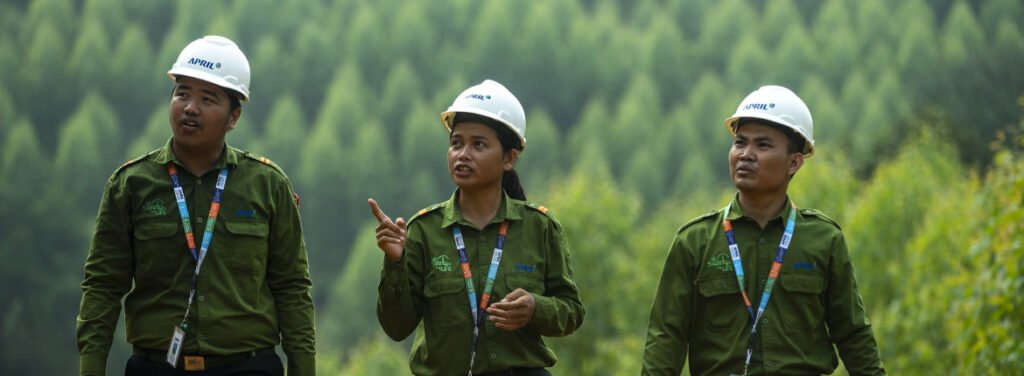
Sustainable Forest Management
APRIL’s plantation forests support our Production-Protection model by serving as buffer zones that help protect dedicated conservation and restoration areas.
Upholding Commitments
APRIL continues to uphold our no deforestation commitment enshrined in our Sustainability Policy. We pledge no development in high conservation value (HCV) forests, ensuring their protection is part of our integrated landscape management approach. These areas have been identified under HCV-HCSA assessments (HCV-High Carbon Stock Approach). This commitment extends to our own concessions, long-term supply partners, and open market suppliers.
Due to our comprehensive no-deforestation commitments, we have the necessary practices and systems in place to comply with the upcoming European Union Deforestation
Regulation (EUDR) and other sustainability-related regulatory frameworks.
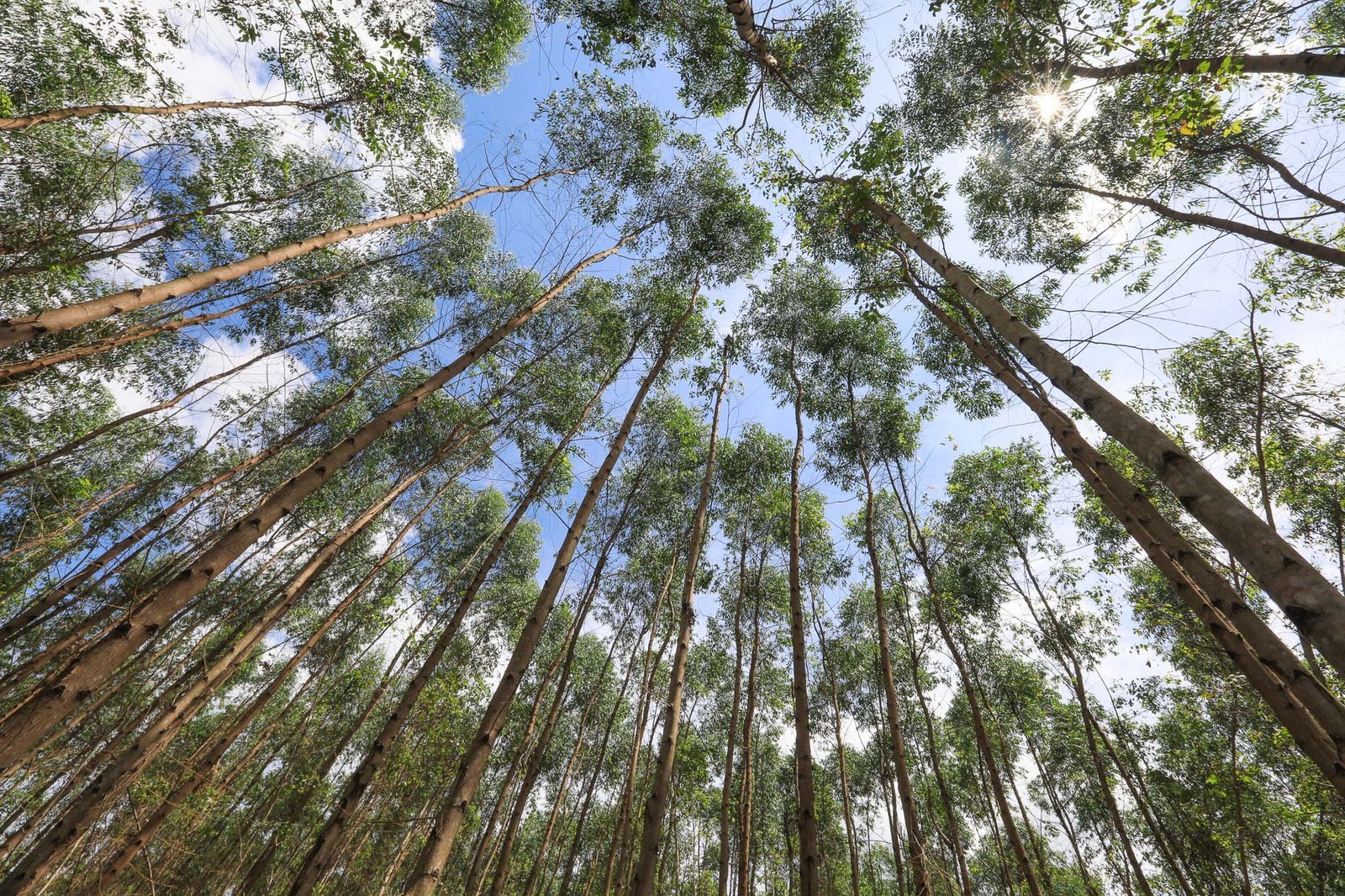
SUSTAINABLE FORESTRY
1-for-1 Progress
Conservation areas within our concessions and those of our long-term supply partners both contribute to our 1-for-1 commitment, conserving one hectare of forest for every hectare of plantation we manage. In 2025, our conservation and restoration areas were equal to 76% of our planted area. This is supported by our integrated Production-Protection approach considers economic, social, and environmental goals in the pursuit of sustainable forest management. Our approach entails protecting High Conservation Value (HCV) areas and enhancing ecosystem integrity and biodiversity, while promoting economic growth and job creation through sustainable plantations.
Forest Management
- An Integrated Approach
- Livelihood Plantations
- Innovating to Boost Productivity
- Reducing the Incidence of Fires
An Integrated Approach
Our Production-Protection approach to sustainable forest management balances economic, social, and environmental considerations. It enables us to protect High Conservation Value (HCV) areas that strengthen ecosystem-wide integrity and biodiversity, while simultaneously stimulating economic growth through sustainable plantation production. Job creation across our land bank builds more prosperous local communities, while dedicated conservation areas are sheltered by our plantation forests, which act as a buffer zone to safeguard against any potential encroachment or illegal activity.

Livelihood Plantations
Within our land bank, over 40,000 hectares of our licensed concessions are used for our livelihood plantations programme, run in partnership with local communities. Here, community members earn revenue for each harvest rotation of commercial Acacia and Eucalyptus plantations. Some of these areas are used for rubber and oil palm plantations, with community members marketing these sustainably harvested crops. Beyond cultivating and selling timber and non-timber forest products, community members are also able to grow crops in these concessions, contributing to food security.

Innovating to Boost Productivity
Our R&D team is tasked with increasing fibre plantation productivity by 50% by 2030, to meet an important target in our Thriving Landscapes commitment. The team explores ways to adopt site-specific management plans that leverage Silviculture to optimise tree health and Precision Forestry, where advanced technologies enable us to gather site-specific data. We also boost productivity through an Integrated Pest and Disease Management strategy and Genetic Improvement work focused on ethically breeding Eucalyptus and Acacia trees with desirable genetic traits.

Reducing the Incidence of Fires
Fires can derail our biodiversity and conservation efforts, and endanger the health and lives of staff and local communities. To prevent them, we have a strict No-Burn policy in place for our own and our suppliers’ land management. We also run an educational Fire Free Village Programme (FFVP) for local community members to raise awareness about sustainable forestry management practices.
Established in 2014, the FFVP helps to promote a deep understanding of the environmental and social consequences of fire, empowering communities to become active participants in fire prevention efforts. A total of 42 villages in five districts in Riau Province are participating in the program, covering a total area of more than 900,000 ha.
Again, technology plays a pivotal role. We’ve made substantial investments in fire detection and suppression technology, including satellite imaging and CCTV towers at our forest plantations.

Responsible Wood Sourcing
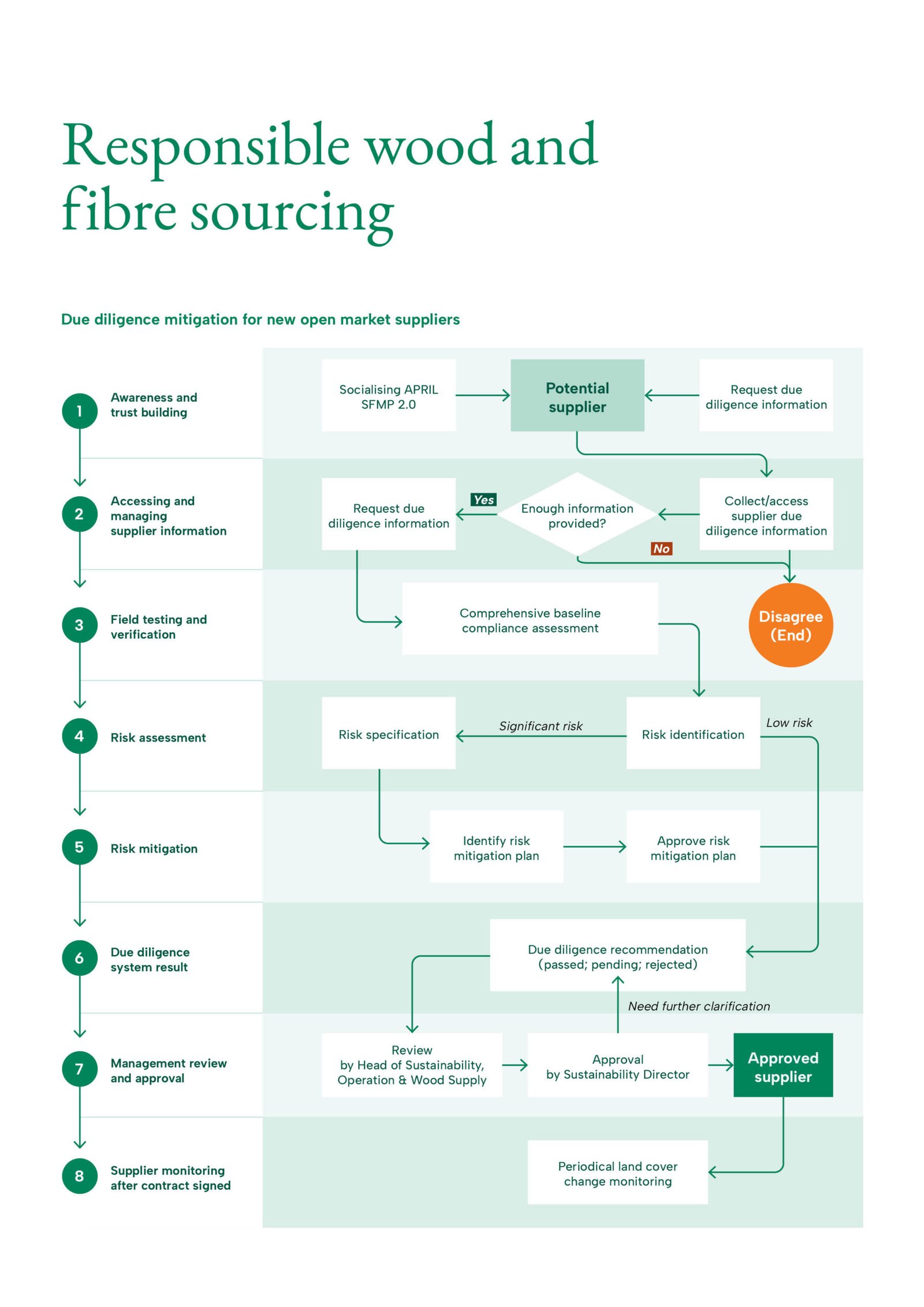
All suppliers must adhere to our Sustainability Policy commitments, our Wood and Fibre Sourcing Policy, and the RGE Code of Procurement Ethics, to ensure that all wood and fibre originate from responsibly managed plantations free of environmental and social risks.
APRIL assesses our supply to ensure compliance with the provisions of these policies, and all wood sourced undergoes comprehensive due diligence using our Integrated Management System (IMS), including supply sourced from our own concessions and long-term supply partners, who are also subject to our Supplier Compliance Procedure for supply sourced from open market suppliers.
All suppliers must complete self-assessments and conduct desktop reviews of key documents, including certificates, legal licences, land-use and land-cover data. All suppliers must also commit to protection and conservation of forested areas and responsible peatland management.
In the event of policy breaches, we constructively engage the supplier to resolve and prevent further non-compliances through a corrective action plan. We track the implementation and results of these plans, using a robust and transparent monitoring mechanism.
Landscape Monitoring
All APRIL and supplier concessions are monitored for deforestation through satellite imagery and drones for aerial observation. Our on-the-ground verification teams identify, verify, and document land cover changes. Our remote sensing analysts conduct surveys every fortnight to detect instances of land cover change. This covers our entire managed area for APRIL and supply partners entities, and those of our open market suppliers on a spot check basis.

NEWSROOM
Updates
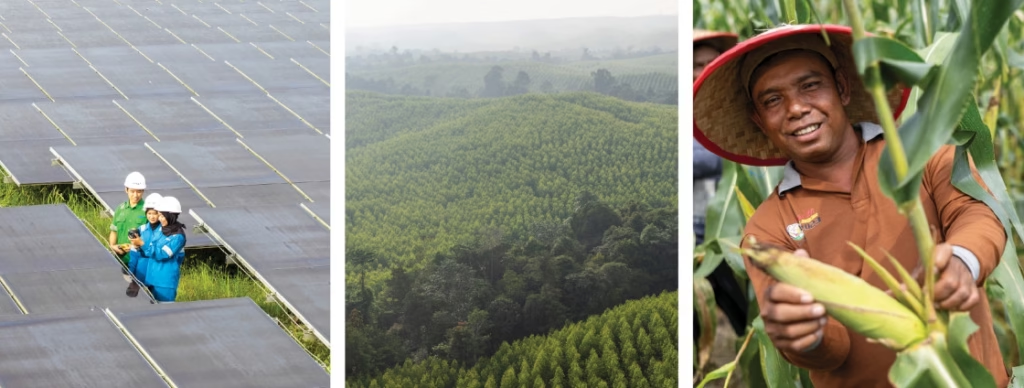
10 Ways APRIL Advanced Climate, Nature and Community Progress in 2025
Sustainability Report 2025
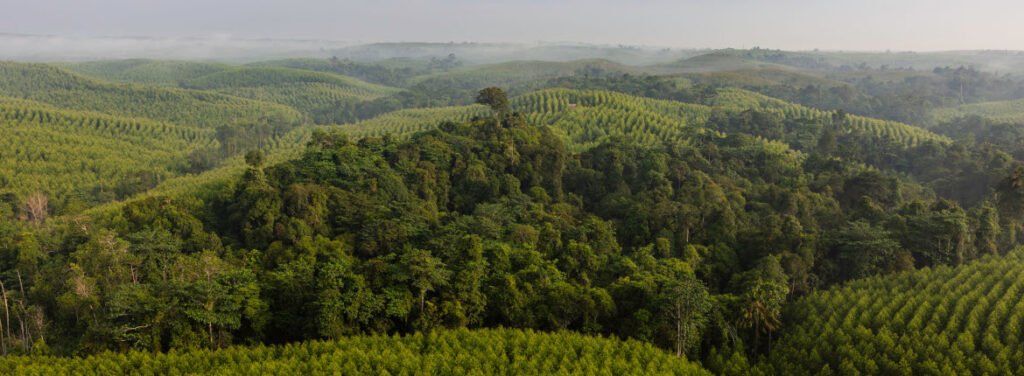
Update on Wood Sourcing Policies and Open Market Wood Sourcing
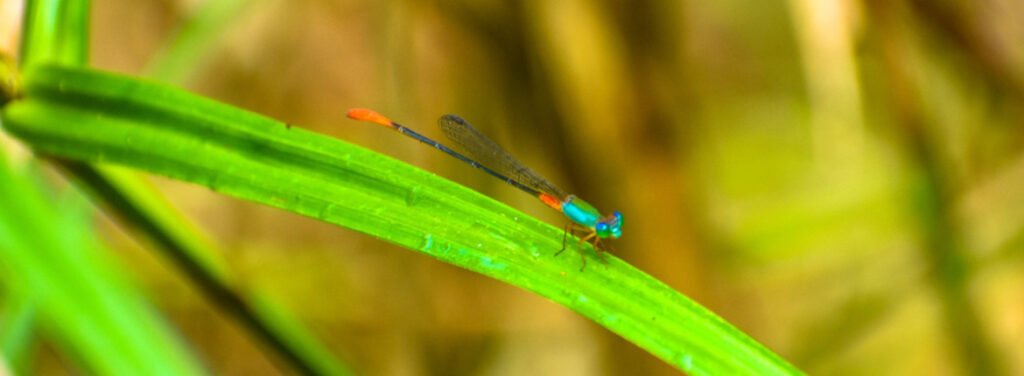
A Damselfly Discovery and a Decade of Science in Sumatra’s Peat Forests
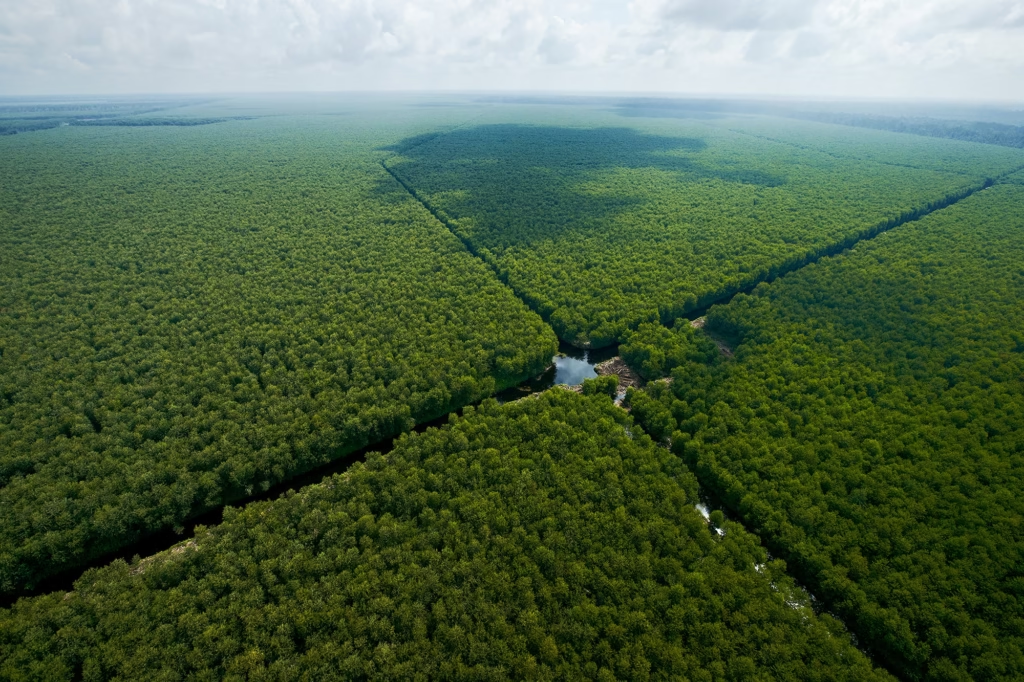
APRIL Group Declares Fire Danger Period in Riau Concessions Areas

Meet the team: How Dian Atma Sitanggang helped build APRIL’s R&D lab
Strengthening Impact: APRIL Group publishes 2025 Sustainability report