
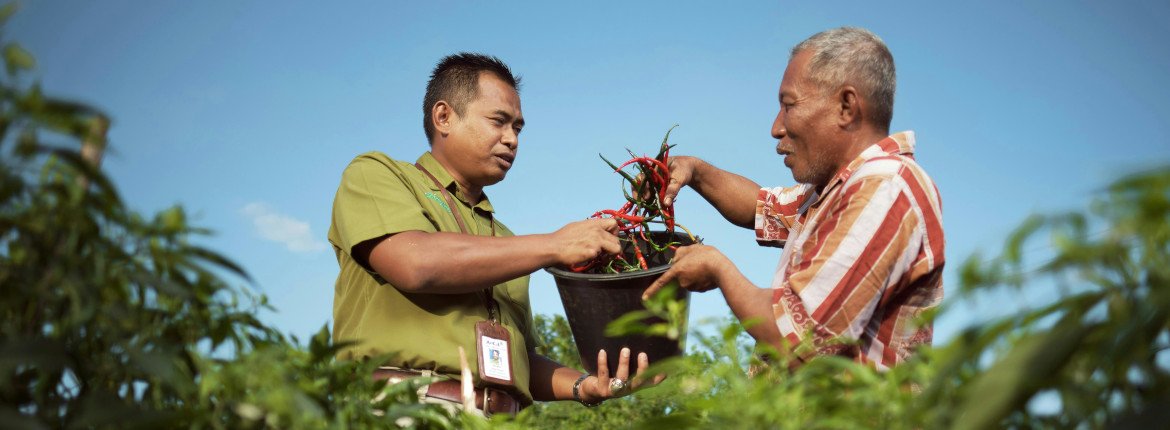
Following a strategy of integrating APRIL2030 into our business operations, the APRIL2030 Steering Committee appointed business unit heads as Champions of each of the commitment pillars – Climate Positive, Thriving Landscapes, Inclusive Progress and Sustainable Growth.
This is the third in a series that shares the perspectives of these Champions who, since its launch in 2020, have led the integration of the APRIL2030 targets and performance indicators in forestry, manufacturing and other aspects of APRIL’s operations.
Sihol Parulian Aritonang, President Director of PT Riau Andalan Pulp and Paper, the operating arm of APRIL Group, is the Champion for the Inclusive Progress pillar, and explains how APRIL is empowering people and communities on its pathway to achieving its APRIL2030 commitments and targets.
Q. APRIL has long worked with local communities, pre-dating its APRIL2030 agenda. What is the company’s motivation for pursuing these ambitious targets?
Our operations are embedded within these communities – impacting more than 200 villages where many of our employees, contractors and suppliers live. So, our connections with these communities run deep and APRIL’s leadership has always believed that the company has a responsibility as a leading business in the region to go the extra mile to help uplift these communities.For the company, Inclusive Progress is not only about securing a social license to operate and creating an enabling environment for our operations. But more importantly, our community development work is a true implementation of the ‘Good for Community’ element of APRIL’s 5Cs philosophy, which is based on our commitment to operate in a way that is good for community, country, climate, customer and company.
Our Community Development team numbers over 60 people, but much of the on-the-ground delivery is done by our estate teams who day in day out manage the industrial forest plantations. That’s important because it gives those workers a positive and ongoing engagement with local people.”
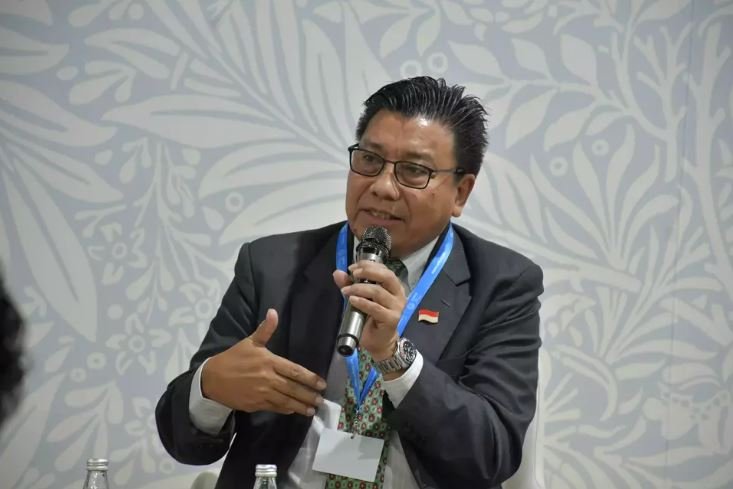
Sihol Parulian Aritonang, President Director of PT Riau Andalan Pulp and Paper, speaking at COP29 in Azerbajan last year.
Q. There is so much that APRIL could do to help communities. How did it decide on the particular commitments in APRIL2030?
“The APRIL2030 commitments were chosen for their potential to really impact communities and achieve transformational change by 2030. Our aim is for true empowerment, not programmes that will foster dependency on the company. That led us to focus on education quality, maternal and infant health, extreme poverty eradication and women’s empowerment.
Each of those areas, which are of course interconnected, touches on fundamental constraints holding people back. Our theory of change is that by helping to release those constraints, it will break the poverty cycle and empower people and communities to achieve their potential”.
Q. Take healthcare first: what has been your focus?
“Our first aim is to ensure that the healthcare facilities around our operational areas meet national standards, and that they are actually used by community members. We now have five healthcare centers meeting these minimum service standards, which is a starting point. This is an ongoing initiative. We signed the first ever public private partnership with the Ministry of Health in Indonesia in this area in 2022.
Our larger aim is to improve early detection of childhood disease and maternal health conditions, and we are working to ensure that a total of 29 healthcare centers will have sufficient capability to carry out early detection. The scheme rests on the assumption that early detection means better health outcomes and more efficient healthcare interventions over the long-term.
This has three components: the procurement of diagnostic equipment, training for medical personnel on diagnostics, and improving the rate of referrals from local health centres to hospitals. It all starts with healthcare.”
Q. APRIL’s initiative – supporting local government efforts – to address stunting has made positive progress. Can you talk to the outcomes that have been achieved so far?
“We have set an ambitious target of halving the rate of stunting in target villages against the 28% baseline we established in 2020. So far, our work supporting local government has contributed to a decrease in stunting rates to 13.6%. Among our target villages, the number with a stunting rate of 14% or less, has increased from 16 in 2019 to 74 in 2024.
We have set out to work in partnership with local authorities so that we can multiply our impact. Our program strategy is adapted from the advocacy model developed and tested in other provinces of Indonesia by Tanoto Foundation. Four local districts have introduced new regulations aimed at reducing stunting and three have allocated more budget to addressing the issue. But we have also made our own on-the-ground interventions.
As part of this initiative, we provide food supplements and education to families whose economic situation makes their children vulnerable to stunting, reaching around 16,000 children in 74 villages in the past year. We are also delivering training at village children’s healthcare centres on how to prepare nutritious meals using local ingredients, which is in turn passed on to parents.”
Q. How have APRIL’s education programs developed as a result of your APRIL2030 agenda?
“APRIL2030 has further boosted our long-term focus on education. We have significantly increased the number of elementary schools involved in our programme from 60 to 172 in the past four years. And we have continued our focus on improving reading and numeracy skills among students.
Prior to the launch of our APRIL2030 targets in 2020 we were primarily focused on primary or elementary education. But in line with our aim for transformational impact, we’ve extended this to secondary schools. We are working with around 50 junior high schools in 2025.”
Q. How effective are your efforts to improve numeracy and literacy rates among students?
“Numeracy and literacy rates are increasing at the schools we are supporting. The percentage of students reaching the national assessment standard (Rapor Pendidikan) for numeracy grew from 28.3% in 2021 to 55.7% in 2023. The increase in literacy went up from 52.7% to 67%. Our aim is for the schools that we partner with to at least meet national standards, and if possible, to exceed them.”
Q. What are the barriers to success for these programmes?
“Take our efforts to eradicate extreme poverty. We discovered from our early pilot programmes that the poorest within our neighbouring communities – the ones that needed help most – were actually more likely not to accept it. Patient work with people helped us to understand they were afraid that the programmes would fail, and they would shoulder the blame.
Our response was to develop well-designed programmes with intensive facilitation and technical assistance that would give them the confidence to participate.
Another barrier was having the right information to target out interventions effectively. To that end, we conducted a survey of the poorest 7,700 households in the villages surrounding our plantations to validate government poverty data and identify those in most need.
The door-to-door survey took 9 months to complete, but it now means we can identify the 1,913 households living below the extreme poverty threshold across 123 villages. That means we can target our anti-poverty work much more precisely.”
Q. The Inclusive Progress pillar includes targets for your own workforce. Forestry is a traditionally male-oriented industry. How are you encouraging more women into the industry and to become leaders and managers?
“The absolute number of female employees has more than doubled from 913 in 2019 to 2,010 in 2024 but because the business is expanding, the proportion has remained below our target of 20%. Progress is difficult, in part, because we are also pushing back on some deeply ingrained cultural norms and customs.
Our Gender Action Plan, implemented in 2022, works to remove the barriers to the progress of women through the organisation and the creation of enabling factors to encourage high-flyers to pursue career advancement in the company.
Some of these enabling factors include continued investment in facilities that support women workers such as daycare and lactation facilities; identifying non-traditional jobs for women; continuing training and awareness programmes to tackle discrimination; and increasing access to leadership development.
Outside of APRIL, one milestone that we are proud of is the increased participation of women in our community-based empowerment programs. In the past two years, we have maintained over 60% effective participation of women in community development programs that we run.”
Q. How has the organization’s thinking changed over the years and as reflected in APRIL2030? What is the vision for empowered, resilient communities by 2030?
”I spoke earlier about our theory of change – about empowering people to break out of the poverty cycle. I would expect us to continue to lean-in to targeted interventions that achieve that goal without fostering dependency. We need to continually re-evaluate our programmes because the most effective and important interventions will not be the same in five years’ time.
If we succeed, then we will have done our part to help eliminate extreme poverty and its most acute impacts like infant stunting by the end of this decade. At the same time, basic standards of healthcare and education will have improved dramatically. If that is the legacy of APRIL 2030, then we will have contributed to the progress of the community in a number of really important areas.”
The recent report – Progress & Pathways: An Update on APRIL’s 2030 Sustainability Commitments and Targets – can be downloaded here.
