
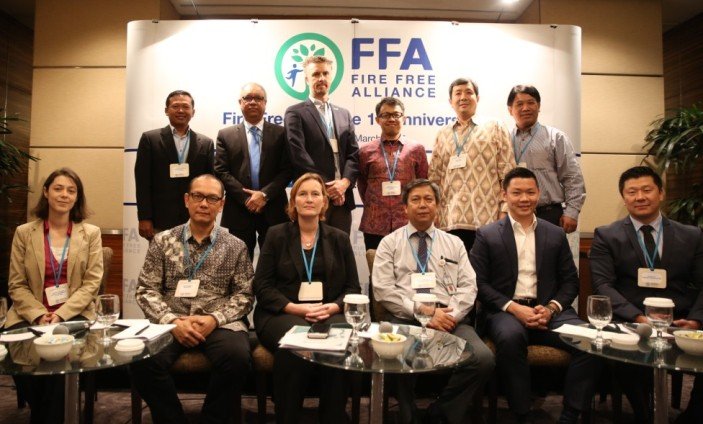
The Government of Indonesia has intensified efforts to protect the environment by preventing fires and strengthening the country’s fire-fighting response. Supporting the Government’s leadership on fire prevention is a voluntary multi-stakeholder group called Fire- Free Alliance (FFA).
More than 200 villages, covering at least 1.5 million hectares of land in various parts of Indonesia, are now participating in community-based fire prevention initiatives. This is the result of the first year of collaborative work of the FFA, which is made up of forestry and agriculture companies, NGOs, and other concerned partners committed to resolving Indonesia’s persistent fire and haze issues.
Established in February 2016, the FFA focuses on fire prevention through community engagement. Founding members include APRIL, Asian Agri, IDH, Musim Mas, PM.Haze and Wilmar. The Alliance also welcomed Sime Darby and IOI Group as new members, announced today on the sidelines of the Responsible Business Forum held in Jakarta.
According to the ‘FFA Members Review 2016’ report released today, the FFA has rapidly expanded fire prevention outreach to 218 villages in various parts of Indonesia. Of these, 77 villages signed up with FFA members for intensive fire-free programmes in 2016. This is 756% increase in the number of villages since the Fire Free Village Programme (FFVP) was launched by APRIL with nine villages in mid 2015. In some cases, FFA members have reported reductions in fire incidences of between 50% and 90% from 2015 to 2016.
“The FFA was established to help members share knowledge and resources. It serves as a platform for members to help one another develop the most effective strategies to prevent and manage fire risks through long-term partnerships with communities across Indonesia and Malaysia,” said Dorjee Sun, Director of Carbon Conservation which serves as FFA’s secretariat.
“APRIL recognises the lead role that the Ministry of Environment and Forestry, the Coordinating Ministry of Economic Affairs as well Provincial Government has in fire prevention and fire management in Indonesia. We supported the establishment of the Fire Free Alliance because we believe that the forestry and agricultural sectors have a responsibility that extends beyond our concession boundaries and work in partnership with communities to reduce the impact of fires and smoke haze. The FFA provides a platform to help scale the FFVP and enable other companies and NGOs to collaborate and share best practice,” added Craig Tribolet, Forest Protection Manager, APRIL.
“The issue of fire and haze is bigger than the industry. FFA’s strength stems from its collective breadth of expertise and experience amongst members from different sectors in their work with the local communities in their surrounding areas. There is no one-size-fits-all solution when it comes to working with communities, but the candid sharing amongst committed and like-minded FFA members helps with identification and development of innovative solutions that could be adapted to each member’s respective operating landscapes,” said Gurcharan Singh, Wilmar’s Plantation Head – Indonesia.
1
IDH’s Tony Wood: “The Fire Free Alliance provides a strong and clear commitment by member companies towards preventing forest fires now and in the future. The knowledge sharing and protocol setting at the senior level represents a breakthrough for Indonesian companies who are now demonstrating that by working together, everyone can win. Of even greater significance has been the enthusiasm and immediate success at the operational level by those who physically identify villages and implement the programmes. This is what is leading to the success of the programme at the village level. Because of this, IDH is actively involved in developing and translating a generic toolkit, actively disseminating the benefits to more potential partners, and even becoming involved in directly sponsoring villages.”
Sime Darby and IOI Group have joined as new members, further extending the reach of the
FFA’s community fire prevention and management programmes across Indonesia and Malaysia as it enters its second year. Both companies are attracted to the information-sharing platform and the collaborative and non-competitive culture of FFA where members share the same goal of a sustainable and fire-free region.
“I congratulate the FFA in the expansion of its fire prevention outreach efforts. The inclusion of new members like Sime Darby validates the importance of a multi-stakeholder approach to solving the haze problem from the source. We hope that we can continue to support the fire prevention efforts of agri-businesses and advocate for the consumption of haze-free products,’ said Benjamin Tay, President of PM.Haze, a research, outreach and advocacy organisation that believes that everyday individuals can be equipped with the knowledge, skills and means to stop haze.
Achievements and commitments by current and new FFA members include:
APRIL: 18 villages participating in FFVP in 2016 with a further 50 villages in a precursor Fire Aware Communities programme. Programme to continue in 2017 with 9 new villages enlisted while 9 others, into their third year, graduate to ‘fire resilient communities’. 600,000 ha covered by programme, with just 0.07% of this area damaged by fire in 2016.
Asian Agri: 7 villages in Riau plus 2 in Jambi participating in programme evaluation since October 2016, with the programme expanding by 6 more villages in 2017. Just 6.78 ha of 306,664 ha burnt in 2016, with burnt area reduced by over 50% from the 13.75 ha burnt in 2015. Piloting fire free honey initiative with Segati Village to test market support for fire free-labelled products.
IDH: Will continue to support the CPO Fund to develop 5 villages and also develop 1 fire free village directly in a high-risk area, and engaging all 6 in the awareness raising programme element. 2017 goals also include identifying 109 villages for possible inclusion in a Fire Free Programme.
IOI Group: Implemented high conservation stock assessments, peatland mapping and initial peatland restoration in 2016. Recruited 50 people for Fire Awareness Training (FAT) through
Manggala Agni Pontianak to ‘Prevent and Patrol’ in concession and conservation areas till 2020. In 2017, a further 60 people will receive training under FAT. IOI also plans to expand the no- burning farming plan with communities to 4 villages with 32 participants.
Musim Mas: 71 villages engaged in Fire Free Awareness campaign in 2016, covering 500,000 ha. A community infrastructure reward of 25M rupiah (nearly USD 2,000) available for villages remaining fire free for one year. 5 villages will engage in a closer engagement with a comprehensive community fire free programme in 2017.
2
PM.Haze: Launched canal blocking project and RSPO certified oil campaign for restaurants in Singapore. In 2017, PM.Haze plans to organise new trips to Sungai Tohor village on Tebing Tinggi Island in Indonesia to support the Hydrological Restoration programme with the Peat Restoration Agency (BRG) and led by WAHLI a local non government organisation.
Sime Darby: Implemented ‘Fire Prevention through Sustainable Farming Practices’ programme in 4 villages in 2016, covering an area of 17,158 ha working alongside University of Riau (UNRI), where survey of 280 local farmers showed that 76.63% engaged in slash and burn. Fire occurrences were reduced from 40 hotspots in 2013-2014 to 1 hotspot in 2015-2016. In 2017, further programmes are planned with 4 additional villages in Riau with UNRI and also a further 7 villages in South Kalimantan with University of Lambung Mangkurat (UNLAM).
Wilmar: Socialised ‘Fire-Free Community’ programme to 61 villages in South Sumatra and
Central Kalimantan in 2016. 1.39 ha of planted area and 67.15 ha of unplanted area burnt in 2016, representing an improvement of approximately 90% on previous years. 2017 goal is to halve the mean average incidence of fires from 2011-2015 in Indonesia plantations and reduce fires in the buffer areas 5km beyond plantation boundaries.
FFA Members Review 2016. Full report is available at : https://www.firefreealliance.org/updates/
About Fire Free Alliance (FFA). The FFA was launched on 29 February 2016 and is a voluntary, multi- stakeholder platform comprising forestry and agriculture companies, NGOs and other concerned partners keen to contribute to a solution to Indonesia’s persistent fire and haze problems with a focus on fire prevention through community engagement. Founding members include APRIL, Asian Agri, IDH, Musim Mas, PM.Haze, and Wilmar. Joined in 2017 by new members Sime Darby and IOI Group, FFA has fostered a culture of sharing, trust and collaboration amongst its members and a members’ based information-sharing platform (http://www.FireFreeAlliance.org).
About Fire Free Village Programme (FFVP). FFVP is a fire management programme that seeks to prevent the fires by focusing on engagement with the community. Initiated and led by APRIL, FFVP was first piloted in 2014 and officially launched in mid 2015. With support from local NGOs the
FFVP’s mix of community level engagement, no burn incentives, capability building and awareness and education initiatives significantly reduced incidences of fire among participating communities. (http://www.aprilasia.com/images/pdf_files/Fire-Free-Village-Program-Review-2016.pdf).
As well as drawing on the FFVP programme elements and the experience of participating companies, the FFA helps member companies tailor and adapt the programme to meet the specific fire prevention needs in the communities where they operate.
