
search

Neil Byron, a member of APRIL’s SAC, believes that economics plays a vital role in securing an environmentally and socially balanced future

In 1973, German born British economist E.F. Schumacher published what The Times Literary Supplement later cited as ‘one of the 100 most influential books since World War II’. It was called ‘Small is Beautiful – A Study of Economics as if People Mattered’. Schumacher broke the mould of economics, shifting the conversation from ‘big is better’ and countering the assumption that economics was simply an adjunct of commerce. He founded the ‘Appropriate Technology’ movement.

To the young Neil Byron this was an eye-opener, and it contributed substantially to the formation of his world view. As he puts it: “I am an anthropocentric economist; I see economics as being about the wise use of resources in the interests of society. This means managing and investing in human and natural capital, not simply the efficient deployment of financial and material assets”.
neilbyron3 — APRIL Asia

Neil Byron, APRIL Stakeholder Advisory Committee Member

Byron describes his childhood in rural Queensland as “idyllic” – running through the bush with his brothers. This immersion in landscape, to some extent, informed his subsequent career. He hadn’t even realised there was a career called ‘Forestry’ until he was offered a scholarship to study it at university. After completing his B. Sc. in forestry at the Australian National University, he spent two years working with the Queensland Forest Service.

But a budding interest in economics and policy – stimulated by Schumacher’s inspiring vision – led to a radical change, and so he moved 7,500 miles to Vancouver to take a Masters and then a PhD in resource and environmental economics at the University of British Columbia.

“Some people think of me as a tropical forester, but the truth is, I’ve not been that for decades,” he says. “I have long considered myself to be an economist, although one focused on social and natural capital. I returned to Australia and taught at my alma mater, then spent three years running the Australian government’s forestry economics research unit. This reflected an emerging general understanding that economics was applicable to nature and people”.

“The late sixties and early seventies had seen a major change in resource development in Australia. This was the time of the emergence of a global environmental consciousness, and we began to ask ourselves why were we digging huge holes to extract minerals, why were we involved in large scale logging. At one point, there was an appalling suggestion that we should mine the Great Barrier Reef for limestone. When I told people in 1977 that I had a PhD in environmental economics, without exception, they replied there was no such thing – yet now there are respected university programs in this around the world.’

In 1982, Byron went to Bangladesh working for the UNDP where he spent four years helping to develop community livelihoods based on natural resources ‘from duck husbandry to community forestry’, as he puts it. His growing interest in the social aspects of economics led him to start a degree in anthropology, and while he didn’t complete this, these studies informed his subsequent values and his work on rural development all over Asia and the south Pacific, including five years as Assistant Director General at CIFOR, based in Indonesia.

It’s clear that Byron’s career rode the zeitgeist of environmental awakening, through the lens of economics. “Economic insights can be applied to all natural resources and issues – atmosphere, watersheds, livelihoods and poverty, land degradation, minerals, oil, and of course forests. I see environmental economics as the art of getting as much human benefit as possible out of what you’ve got without wrecking ecosystems which are our most basic resource. Natural capital is as important as human and financial capital. It’s about using resources wisely”.

Byron places himself at the nexus of natural resources, policy and environmentalism. Byron spent 12 years as the Commissioner responsible for environment, agriculture and natural resources at Australian Productivity Commission. He presided over 26 public enquiries and oversaw the Commission’s environmental economics programme. In 2011, he returned to academia and became an Adjunct Professor of Environmental Economics at the University of Canberra’s Institute of Applied Ecology. He was asked to chair an independent review of biodiversity legislation in New South Wales, which led to the repeal of an accumulation of ineffective legislation, and the drafting of a new Biodiversity Conservation Act.

Asked if there is a defining theme around his work, he says “Managing the environment as if people and ecosystems really matter. Some environmentalists come from a conservation science point of view, and see society and the economy as irrelevant or ‘the enemy’. I contrast, I see things from a social economic position but recognise that a healthy robust environment is crucial to human well-being (and vice versa). The trick is getting the balance right. Successful environmental management is multi-faceted. I don’t think it is feasible to ‘preserve’ free of all human touch, unless local people really want that.  I think we should tread lightly and treat wisely”.

Byron also has a view of the role of big business in treating the planet wisely. “I have seen absolutely awful destruction wrought by artisanal miners, doing more damage than big multinationals. This is true in south east Asia, west Africa, the Amazon.  When poverty – desperation – is endemic, then the natural landscape is, understandably, seen as a resource to be exploited. And in these cases, pillaged. In Vietnam, Indonesia and the Philippines, the environment’s strongest allies now could be business and productive employment. I have seen it work. I recall a debate at CIFOR about illegal logging and the fact that if a road was built, in short order the adjacent forest would be cleared. A Malaysian colleague thought this was nonsense, and he had never seen it. I pointed out that Malaysia had far higher levels of urban employment than Indonesia and other southeast Asian countries, where unemployment – and underemployment – can run to 35 percent or more.’

“During the 2008 financial crisis, 8 million people moved out of Manila and started clearing forest to grow food, or over-fishing the coastline. They had no choice. Difficult, illegal, dangerous, poorly paid work in the forests was the only way to support a household when the formal economy could not offer a decent livelihood”.

Byron’s view since childhood is that everybody, regardless of race, religion, or wealth, has both an opportunity and an obligation to do whatever they can to make their part of the world a better place – not the whole world, but starting at the neighbourhood, family, community and working up and out. So Byron’s view of the future is optimistic, provided we continue to get smarter about the relationship between society, business and natural resources. “Not all big businesses do good, but many, increasingly, do because they are under continuous scrutiny. More of that, and sound public policy that encourages economic improvement of people’s lives, and strong policing of environmental protection measures, will enable us more and more to manage the environment as though both it and local people really matter”.

svg+xml;charset=utf — APRIL Asia
sustainable growth — APRIL Asia

Method

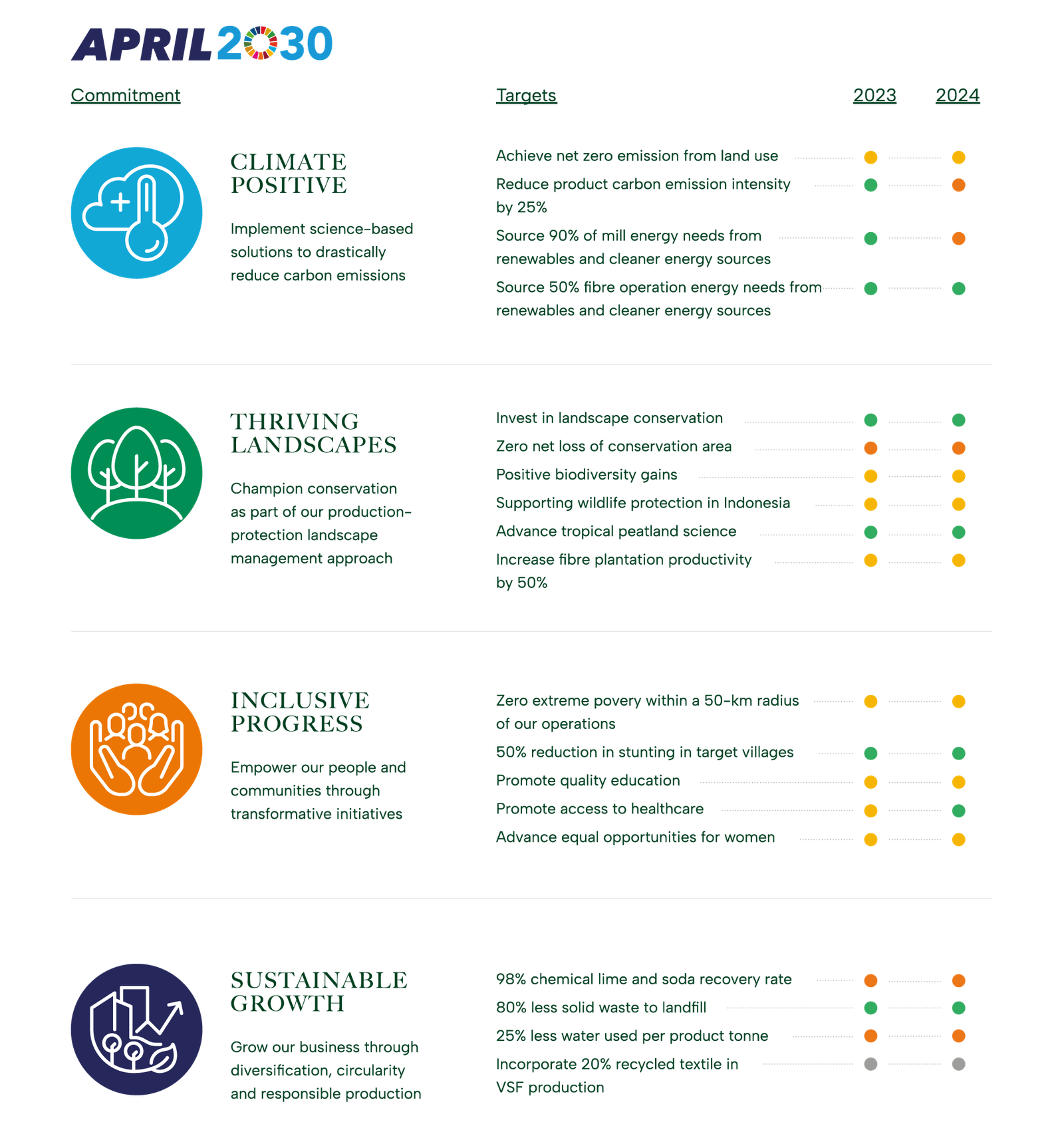
Waste disposed is recorded through various means of measurement including estimation of weight by waste type. Particular waste types as described above are measured as a wet waste and converted to a bone dry (BD) weight. The wet waste weight is multiplied by the consistency of each waste type to determine the BD. The consistency is predetermined by the lab.

Baseline
71kg/T

Performance 2022

On Track

sustainable growth — APRIL Asia

Method

The DPTW utilisation rate and % of textile waste per tonne of product will be based on R&D lab/pilot/demo procedures.

Baseline
0%

Performance 2022

In Development

sustainable growth — APRIL Asia

Method

Water consumption per tonne of product is calculated based on water consumed in the production of saleable pulp, paper, viscose staple fiber and viscose yarn measured by flow meters, via calculation and water balances divided by the production figures for saleable pulp, paper, viscose staple fibre and viscose yarn.

Baseline
28 m3/T

Performance 2022

Not Progressing

sustainable growth — APRIL Asia

Method

Soda content within the liquor cycle and losses are determined by means of mass balance based on daily lab analysis.

Lime volume in the lime kiln and losses are determined by means of lime make-up.

The recovery rate is calculated net of the percentage of make-up amounts added. The annual figure is based on the average monthly recovery rate.

Baseline
96%

Performance 2022

Not Progressing

inclusive progress — APRIL Asia

Method

Number of Mill and Nursery contractor calculated based on Man Power data which grouped by gender level calculated as a monthly average.

Baseline
2571

inclusive progress — APRIL Asia

Method

The number of own and supply partners employees is calculated based on year-end Man Power data which is grouped by gender. The identification of leadership position refer to employees’ grade D2 or Manager level and above.

Baseline
55 women employees in leadership positions

Performance 2022

Progressing

inclusive progress — APRIL Asia

Method

Women’s effective participation is identified from the participation list for each program. Percentage of female participation is calculated by the number of women participating divided by the total participants.

Baseline
34%

Performance 2022

Progressing

inclusive progress — APRIL Asia

Method

In development

Baseline
In development

Performance 2022

Progressing

inclusive progress — APRIL Asia

Method

In development

Baseline
In development

Performance 2022

Progressing

inclusive progress — APRIL Asia

Method

In development

Baseline
In development

Performance 2022

Progressing

inclusive progress — APRIL Asia

Method

We engaged third party to conduct assessment in APRIL-supported schools using the framework that was developed by Research Triangle Institute (RTI) and USAID.

Baseline
In development

Performance 2022

Progressing

inclusive progress — APRIL Asia

Method

Poverty mapping is identified through:

  1. Desktop analysis using National Statistics, Village Potential Statistics, SMERU Poverty Map.
  2. On-the-ground verification through FGD, village transect walk, interview with community.

Baseline
3%

Performance 2022

Progressing

thriving landscapes — APRIL Asia

Method

Peer-reviewed scientific journal publication standards

Baseline
1

Performance 2022

On Track

thriving landscapes — APRIL Asia

Method

Documentation of Participation (presentation of papers or posters) in national and international dialogues, workshops and conferences

Baseline
6

Performance 2022

On Track

thriving landscapes — APRIL Asia

Method

Number of scientists from universities and research institutions that have collaborated with APRIL on peatland management during the calendar year

Baseline
9

Performance 2022

On Track

thriving landscapes — APRIL Asia

Method

Wood deliveries (excluding open market supply) to the mill are used as a basis to calculate MAI (Tonnes/ Ha/Yr). The MAI is based on the 3 year area weighted rolling average growth for all closed compartments.

Baseline
20T/ha/yr

Performance 2022

On Track

thriving landscapes — APRIL Asia

Method

Methodology to be developed specific to animal species and does not include plants. Qualifying initiatives may vary widely in nature but must have the animal protection as the primary objective.

Partnerships will be developed and documented in line with an overarching strategy prioritizing stakeholders and threats specific to the country of Indonesia assessed.

Performance 2022

Progressing

thriving landscapes — APRIL Asia

Method

May include various initiatives relating to conservation of RTE species to be defined in a priority list, initiatives may be conducted solely or in collaboration with other stakeholders.

Baseline
2

thriving landscapes — APRIL Asia

Method

Methodology to be developed to measure change in ecosystem services and values over time (carbon sequestration, water provision, resource provision including fish and honey)

Baseline
not yet developed

thriving landscapes — APRIL Asia

Method

Reports for reforestation of previously encroached and degraded area including all areas where assisted natural regeneration, planting or enrichment planting of species that improve habitat value have taken place during the year but excludes natural regeneration.

Baseline
275 ha

Performance 2022

Progressing

thriving landscapes — APRIL Asia

Method

Area within conservation is derived from land bank which is based on land cover analysis and is updated annually to capture any boundary changes, land use changes or measurement data.

Baseline
0 ha Net loss

Performance 2022

Not Progressing

thriving landscapes — APRIL Asia

Method

Landscape conservation funding includes restoration and conservation costs associated with the RER as well as the allocation of a proportion of the costs related to APRIL’s maintenance of conservation values under its production-protection model. The allocation is based on proportionate amount of each cost that is related to conservation and restoration.

The wood volume is based on wood delivered to the Mill.

Baseline
USD$0.7 per tonne of plantation fiber

Performance 2022

On Track

climate positive 1 — APRIL Asia

Method

Mill

Calculate from the records of fuel types used the amount consumed in boilers to generate power, heat and steam including energy use for mobile & including transportation. Each of the fuel types are converted to energy expressed by Giga Joule Lower Heating Value (GJ LHV) following the IPCC guidelines.

Baseline: 87%

Performance 2022

On Track

Forest Operations

Calculate from the records of fuel types the quantity consumed by major categories of forest management activities by Fiber operations.

This covers energy used for Forest operations, infrastructure including wood transport from estate to mill; When a blend of fuel types is used (such as B20) the contribution to renewable and cleaner energy targets is calculated separately for each fuel rather than considering the blend as a cleaner fuel type.

Baseline: 19%

Performance 2022

Progressing

climate positive 1 — APRIL Asia

Method

APRIL follows the international GHG protocol as developed by WRI/WBCSD to develop its emissions profile. The total emissions measured as emissions intensity is calculated based on tonnes of Scope 1 and 2 Mill Greenhouse Gas Emissions per tonne of product (paper, pulp and viscose). The emissions boundary scope covers gate-to-gate (wood processing in wood yard until pulp, paper and viscose production) of the three main GHGs: CO2, CH4, and N2O.

Baseline
0.55 tCO2e/product tonne

Performance 2022

On Track

climate positive 1 — APRIL Asia

Method

To quantify the total GHG emission and removals across APRIL’s land bank from land use, APRIL follows the GHG Protocol Agricultural Guidance and IPCC Guidelines for Agricultural, Forestry, and Other Land Use. To detect the land cover change within the look-back period, i.e. 20 years APRIL utilized the remotely sensed data.

The GHG emission will be calculated as the total of carbon stock changes in woody biomass and soil organic carbon and include all major carbon fluxes such as peat decomposition, plantation growth and harvesting, and fires.

To quantify the amount of carbon unit to balance the emission, the Verified Carbon Standard (VCS), the Climate, Community and Biodiversity Standards (CCB), or other internationally accepted standard will be used.

Performance 2022

Progressing

This site is registered on wpml.org as a development site. Switch to a production site key to remove this banner.