
search

John Pereira, Deputy Head of Operations, Restorasi Ekosistem Riau, shares his perspectives on the workings of private-sector led conservation and restoration project and highlights the importance of stakeholder collaboration as a key element of its success to date.

Conservation is a team sport. It isn’t easy. It isn’t cheap. And you have to be in it for the long haul.

At Restorasi Ekosistem Riau (RER) — a unique project on Sumatra that is conserving and restoring a vast area of vital peat swamp forest — this is something of a guiding mantra. If you want to do conservation well, you cannot do it alone.

RER was set up over a decade ago by APRIL Group to restore and conserve ecologically important peat swamp forests and other valuable habitats on Indonesia’s Kampar Peninsula and Padang Island in the Province of Riau. It is managed and funded by the company.

Before I explain why collaboration is so important to us at RER, you might be wondering why a company that produces pulp, paper and textile products is investing in biodiversity protection and conservation.

Stepping back, we know that nature-based solutions that conserve biodiversity are vital for mitigating climate change and maintaining key ecosystem services like clean water, carbon storage and flood protection. But the world is in the midst of a nature crisis, with wildlife populations having plunged by more than two thirds since 1970. Yet globally, there is a huge shortfall in funding for conservation initiatives – around US$ 700 billion per year.

I’ve worked in conservation and eco-tourism for over two decades. Whether in South Africa, Zambia, Mozambique or the Middle East, I’ve seen how hard it is for conservation projects to achieve their aims. National Parks are under-resourced and NGO-run projects often struggle for consistent funding over the long term.

The private sector has a responsibility to step up and APRIL recognizes that land-based enterprises like itself can only credibly claim to be operating sustainably if nature conservation is integral to their approach. That means using operational capability, administrative capacity and knowhow to benefit nature in significant and tangible ways, for example through APRIL’s management of the RER project.

It also means making meaningful connections between the business and its conservation goals. One way APRIL does this is by allocating US$1 to conservation for every tonne of wood delivered to the mill complex in Pangkalan Kerinci, Riau Province. That creates a solid ongoing link between the company’s plantation productivity and biodiversity protection. The internal levy delivered US$16m for the company’s conservation work in 2023.

Biodiversity Sanctuary

A major beneficiary of that consistent funding is RER, a very special area of remote and degraded peat swamp forest. It gives the project financial stability and consistent momentum: the assurance that next year, whatever needs to be done will be funded.

Just as resources matter, so does size. And at over 150,000 hectares, RER is around the size of greater London. It is home to a spectacular array of plants and animals including sun bear, flat-headed cat, Southern pig-tailed macaque and Sumatran tiger. Of the 896 species in key taxonomic groups that have been recorded there, 75 are included in the IUCN Red List, with 13 classed as Critically Endangered.

Our team of over 200 RER employees, security rangers and local labour work to manage and protect the forest – and to understand this exquisite ecosystem better. Last year, the project celebrated its 10th birthday, a period in which that team’s blood, sweat and tears have gone into the ground stopping poachers and restoring vital habitats that were damaged previously by fire and illegal logging.

We’re proud of the results, but they have only been possible with some key partnerships. Just as you can’t build a house with a team of plumbers — you need surveyors, builders, carpenters, tilers and the rest — likewise, a team of ecologists can’t run a protected area. We need hydrologists, landscape managers, data scientists, wildlife tech experts and many other skilled professionals. It is through partnerships that we’ve been able to draw on the expertise needed to advance our conservation goals.

Team Effort

The government of Indonesia and local authorities are key partners. APRIL’s stewardship of the land is possible because of a 60-year Ecosystem Restoration Concession, a license from the government that requires us to manage the land and conserve biodiversity.

Likewise, the conservation NGO Fauna and Flora International has been a consistent partner from the start, helping us to understand the range of species that exist in RER. Their experts are about to embark on detailed studies of the fish and understory plants in the RER, to name a couple of taxonomic groups.

Another collaboration, with researchers at the University of South Wales and the Institut Pertanian Bogor University in Bogor, West Java, is looking in detail at the habitats of endangered sun bears. And our friends at the University of Kent have analysed 7 years of camera trap data to understand trends in the diversity of mammal species in the forest.

Local NGO, the Forest Wildlife Society (PJHS) has been doing vital work on facilitating the development of conservation management for key priority species in Kampar Peninsula and Padang Island landscape.

Beyond research collaborations, the most important partnerships we have —like any conservation project — are with local communities. We work closely with local people to facilitate access to the RER in a way that will not harm the biodiversity — for example through sustainable fishing and providing solar lamps so that fishers don’t use alternatives like kerosene that could start fires.

We are also working with Dutch NGO Tropenbos International to help local communities. In the absence of regular employment and income, some individuals may turn to illegal forest exploitation such as wood extraction or poaching. The aim is to improve the economic prospects of people in local villages through new skills and agricultural knowhow that will provide opportunities to generate income and improve living standards.

We are not aware of any comparable program on the scale of RER run by the private sector anywhere in the world. When the program launched, there was no playbook for what APRIL was trying to achieve, especially in peatlands. We’ve not got everything right, but collaboration has been our way of learning as we go. It is a team sport we hope to keep playing for a very long time.

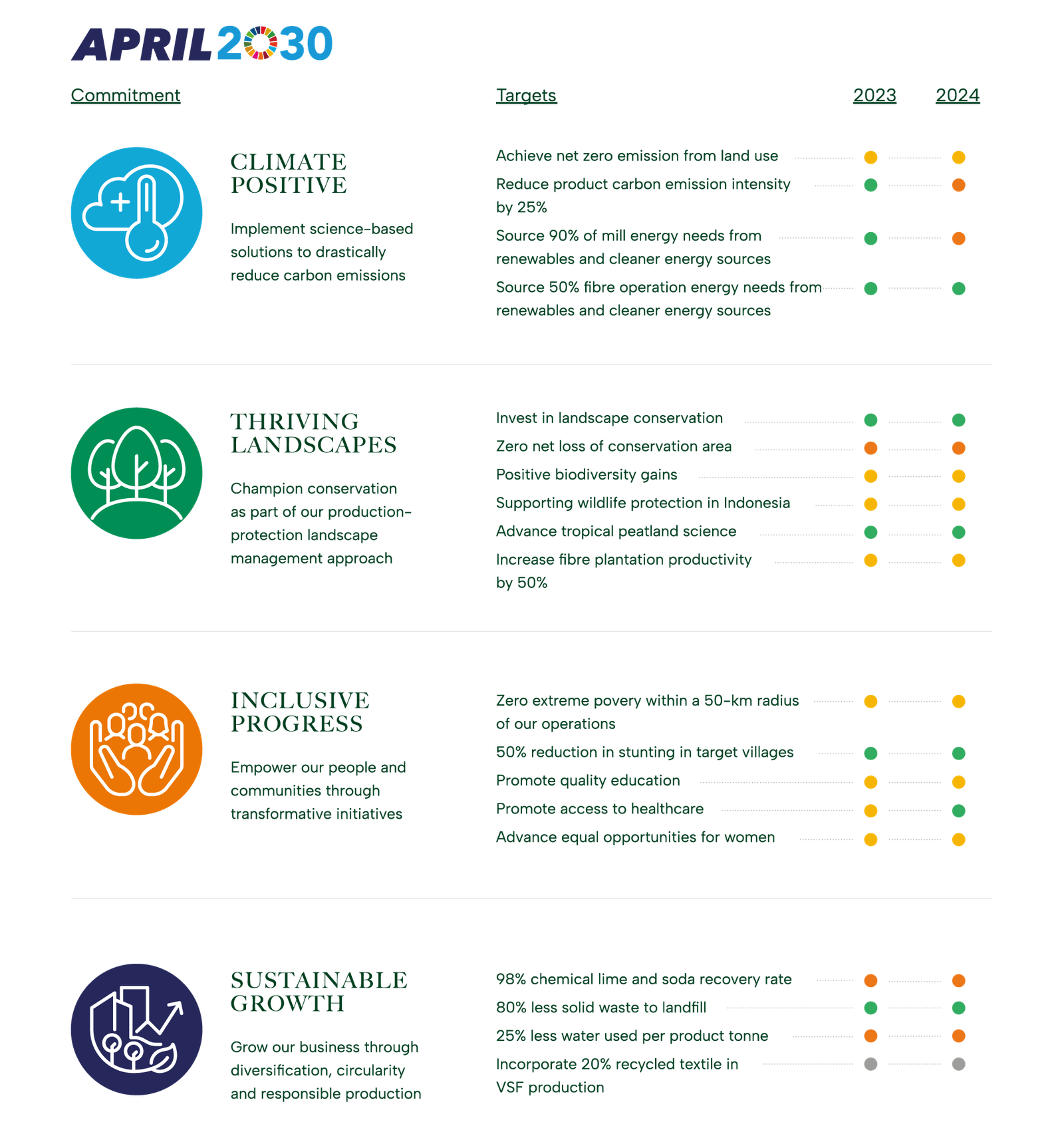
svg+xml;charset=utf — APRIL Asia
sustainable growth — APRIL Asia

Method

Waste disposed is recorded through various means of measurement including estimation of weight by waste type. Particular waste types as described above are measured as a wet waste and converted to a bone dry (BD) weight. The wet waste weight is multiplied by the consistency of each waste type to determine the BD. The consistency is predetermined by the lab.

Baseline
71kg/T

Performance 2022

On Track

sustainable growth — APRIL Asia

Method

The DPTW utilisation rate and % of textile waste per tonne of product will be based on R&D lab/pilot/demo procedures.

Baseline
0%

Performance 2022

In Development

sustainable growth — APRIL Asia

Method

Water consumption per tonne of product is calculated based on water consumed in the production of saleable pulp, paper, viscose staple fiber and viscose yarn measured by flow meters, via calculation and water balances divided by the production figures for saleable pulp, paper, viscose staple fibre and viscose yarn.

Baseline
28 m3/T

Performance 2022

Not Progressing

sustainable growth — APRIL Asia

Method

Soda content within the liquor cycle and losses are determined by means of mass balance based on daily lab analysis.

Lime volume in the lime kiln and losses are determined by means of lime make-up.

The recovery rate is calculated net of the percentage of make-up amounts added. The annual figure is based on the average monthly recovery rate.

Baseline
96%

Performance 2022

Not Progressing

inclusive progress — APRIL Asia

Method

Number of Mill and Nursery contractor calculated based on Man Power data which grouped by gender level calculated as a monthly average.

Baseline
2571

inclusive progress — APRIL Asia

Method

The number of own and supply partners employees is calculated based on year-end Man Power data which is grouped by gender. The identification of leadership position refer to employees’ grade D2 or Manager level and above.

Baseline
55 women employees in leadership positions

Performance 2022

Progressing

inclusive progress — APRIL Asia

Method

Women’s effective participation is identified from the participation list for each program. Percentage of female participation is calculated by the number of women participating divided by the total participants.

Baseline
34%

Performance 2022

Progressing

inclusive progress — APRIL Asia

Method

In development

Baseline
In development

Performance 2022

Progressing

inclusive progress — APRIL Asia

Method

In development

Baseline
In development

Performance 2022

Progressing

inclusive progress — APRIL Asia

Method

In development

Baseline
In development

Performance 2022

Progressing

inclusive progress — APRIL Asia

Method

We engaged third party to conduct assessment in APRIL-supported schools using the framework that was developed by Research Triangle Institute (RTI) and USAID.

Baseline
In development

Performance 2022

Progressing

inclusive progress — APRIL Asia

Method

Poverty mapping is identified through:

  1. Desktop analysis using National Statistics, Village Potential Statistics, SMERU Poverty Map.
  2. On-the-ground verification through FGD, village transect walk, interview with community.

Baseline
3%

Performance 2022

Progressing

thriving landscapes — APRIL Asia

Method

Peer-reviewed scientific journal publication standards

Baseline
1

Performance 2022

On Track

thriving landscapes — APRIL Asia

Method

Documentation of Participation (presentation of papers or posters) in national and international dialogues, workshops and conferences

Baseline
6

Performance 2022

On Track

thriving landscapes — APRIL Asia

Method

Number of scientists from universities and research institutions that have collaborated with APRIL on peatland management during the calendar year

Baseline
9

Performance 2022

On Track

thriving landscapes — APRIL Asia

Method

Wood deliveries (excluding open market supply) to the mill are used as a basis to calculate MAI (Tonnes/ Ha/Yr). The MAI is based on the 3 year area weighted rolling average growth for all closed compartments.

Baseline
20T/ha/yr

Performance 2022

On Track

thriving landscapes — APRIL Asia

Method

Methodology to be developed specific to animal species and does not include plants. Qualifying initiatives may vary widely in nature but must have the animal protection as the primary objective.

Partnerships will be developed and documented in line with an overarching strategy prioritizing stakeholders and threats specific to the country of Indonesia assessed.

Performance 2022

Progressing

thriving landscapes — APRIL Asia

Method

May include various initiatives relating to conservation of RTE species to be defined in a priority list, initiatives may be conducted solely or in collaboration with other stakeholders.

Baseline
2

thriving landscapes — APRIL Asia

Method

Methodology to be developed to measure change in ecosystem services and values over time (carbon sequestration, water provision, resource provision including fish and honey)

Baseline
not yet developed

thriving landscapes — APRIL Asia

Method

Reports for reforestation of previously encroached and degraded area including all areas where assisted natural regeneration, planting or enrichment planting of species that improve habitat value have taken place during the year but excludes natural regeneration.

Baseline
275 ha

Performance 2022

Progressing

thriving landscapes — APRIL Asia

Method

Area within conservation is derived from land bank which is based on land cover analysis and is updated annually to capture any boundary changes, land use changes or measurement data.

Baseline
0 ha Net loss

Performance 2022

Not Progressing

thriving landscapes — APRIL Asia

Method

Landscape conservation funding includes restoration and conservation costs associated with the RER as well as the allocation of a proportion of the costs related to APRIL’s maintenance of conservation values under its production-protection model. The allocation is based on proportionate amount of each cost that is related to conservation and restoration.

The wood volume is based on wood delivered to the Mill.

Baseline
USD$0.7 per tonne of plantation fiber

Performance 2022

On Track

climate positive 1 — APRIL Asia

Method

Mill

Calculate from the records of fuel types used the amount consumed in boilers to generate power, heat and steam including energy use for mobile & including transportation. Each of the fuel types are converted to energy expressed by Giga Joule Lower Heating Value (GJ LHV) following the IPCC guidelines.

Baseline: 87%

Performance 2022

On Track

Forest Operations

Calculate from the records of fuel types the quantity consumed by major categories of forest management activities by Fiber operations.

This covers energy used for Forest operations, infrastructure including wood transport from estate to mill; When a blend of fuel types is used (such as B20) the contribution to renewable and cleaner energy targets is calculated separately for each fuel rather than considering the blend as a cleaner fuel type.

Baseline: 19%

Performance 2022

Progressing

climate positive 1 — APRIL Asia

Method

APRIL follows the international GHG protocol as developed by WRI/WBCSD to develop its emissions profile. The total emissions measured as emissions intensity is calculated based on tonnes of Scope 1 and 2 Mill Greenhouse Gas Emissions per tonne of product (paper, pulp and viscose). The emissions boundary scope covers gate-to-gate (wood processing in wood yard until pulp, paper and viscose production) of the three main GHGs: CO2, CH4, and N2O.

Baseline
0.55 tCO2e/product tonne

Performance 2022

On Track

climate positive 1 — APRIL Asia

Method

To quantify the total GHG emission and removals across APRIL’s land bank from land use, APRIL follows the GHG Protocol Agricultural Guidance and IPCC Guidelines for Agricultural, Forestry, and Other Land Use. To detect the land cover change within the look-back period, i.e. 20 years APRIL utilized the remotely sensed data.

The GHG emission will be calculated as the total of carbon stock changes in woody biomass and soil organic carbon and include all major carbon fluxes such as peat decomposition, plantation growth and harvesting, and fires.

To quantify the amount of carbon unit to balance the emission, the Verified Carbon Standard (VCS), the Climate, Community and Biodiversity Standards (CCB), or other internationally accepted standard will be used.

Performance 2022

Progressing

This site is registered on wpml.org as a development site. Switch to a production site key to remove this banner.