
search

Recognized as the center of Malay culture in Indonesia, Riau is preserving its cultural heritage via sustainable tourism programs.

Its situation in the central-eastern coast of Sumatra and located along the Malacca Strait has given Riau an advantage. For centuries, merchants and traders have visited Riau. Kingdoms and sultanates flourished amid its rich and diverse landscapes. Its rich history also gives way to a highly diverse population, with communities tied to several ethnic groups: Malays, Javanese, Chinese, Minangkabau, Batak, Buginese, and Banjarese identify themselves as Orang Riau. These priceless cultural assets are the heritage of Riau, and efforts in preserving them have been underway in recent years, especially the revitalization of Malay culture as the province’s identity. 

As the world’s largest archipelagic nation, whose unity depends on how it values diversity, the various ethnic backgrounds that make up the country’s population and culture are essential elements that determine Indonesia’s survival. The story of Indonesia’s independence celebrates diversity amid adversity. Among the government’s chief responsibilities is its commitment to preserving the people’s varied customs and traditions.

The Malay legacy of Riau is an identity that needs to be celebrated through its architecture, literature, history, tradition, cuisine, and many more.

Recently, Riau’s traditional headscarf, Tanjak Melayu, made headlines after an online celebrity was caught wearing it inappropriately. The headscarf is an important icon that illustrates the region’s power and influence in the past, which today serves as a token of respect and pride. Customarily, royal members of Riau’s sultanate and highly regarded members of society wear the headscarf.

Another example of Malay culture historical significance is embodied in the grandeur of Siak Sri Inderapura Palace. It is a testament to the power and influence of the Sultanate of Siak. Sultan Abdul Jalil Rahmat Shah, fondly known as Raja Kecil, founded the sultanate in 1722. At its peak, the sultanate was a dominant power on the eastern coast of Sumatra due to its trade control of the surrounding Melaka Straits. However, the Dutch and British colonializations changed the sultanate’s influence. After 1824, the sultanate even became a protectorate of the Dutch. In 1945, the last Sultan of Siak, Syarif Qasim II, declared his allegiance to the Republic of Indonesia.

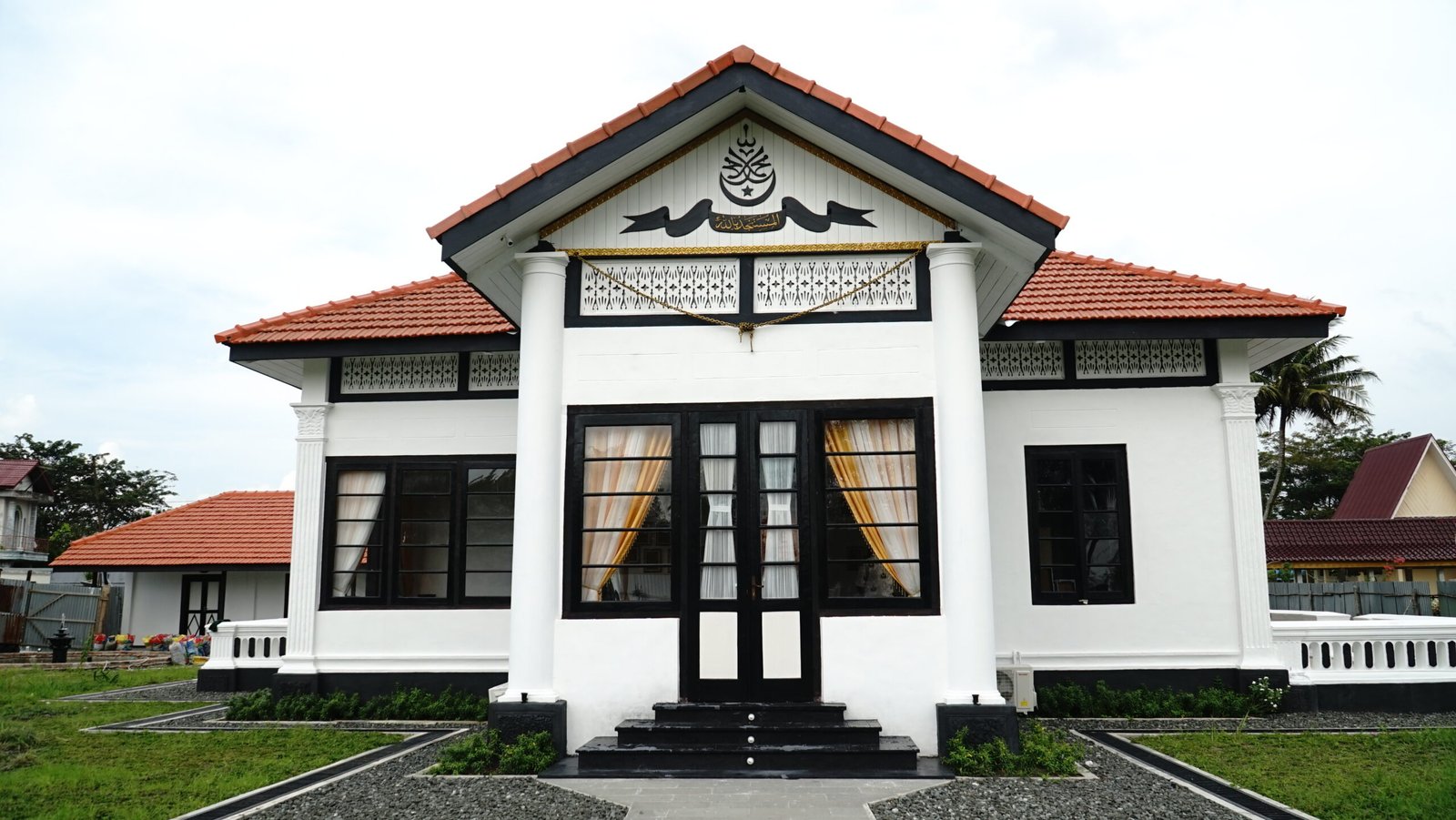
The remains of this golden period have withstood the test of time. The Siak Palace, with its Malay, Arabic and European influences, is now a museum and one of the most visited heritage tourism destinations in Riau. The vast complex housed several palaces, including Istana Peraduan, a leisure palace belonging to the last reigning Sultan. The palace was built in 1915, and furnished with the best-imported materials from Europe. It served as a place for Sultan Syarif Qasim II and his family to rest and receive official visits.

After the sultan passed away, the palace was used only for a small number of ceremonial events. However, the palace remains intact and its architectural design serves as a source of reference for many historians and scholars. Recently, the palace underwent a makeover process led by PT Riau Andalan Pulp and Paper (PT RAPP) with the express purpose of restoring it to its former glory. The operating arm of APRIL Group, PT RAPP recognizes the historical and cultural significance of Istana Peraduan for Siak and the province of Riau. The restoration took eight months to finish, covering the interior and exterior parts of the palace. The interior work remains faithful to the original design, reconstructing the living room, family room, master bedroom or bilik peraduan, dining room, in-between room, and diorama room with great care and attention to details. The renovation is part of PT RAPP’s acknowledgment of the critical role of cultural heritage in creating a proud sense of identity.
DSC00241 scaled — APRIL Asia

Istana Peraduan Siak

Only by integrating these legacies and Riau’s natural environment within a responsible tourism framework can a destination be protected, preserved and referred to as sustainable.

“To appreciate our own arts and culture is to preserve our identity,” said Sri Mekka, the Head of Riau’s Museum and Cultural Parks, a local agency which operates under the Ministry of Education and Culture. “It is our mission as part of the administration of Riau Province to develop and promote our region’s arts and culture. We are working closely with Riau’s Department of Tourism and Economy to improve the socio-economic welfare of our communities.”

Ultimately, sustainable tourist development has been recognized as the motor to promote and protect cultural heritage. Siak Regency’s responsible heritage management and multi-stakeholders’ involvement, including private sector, is a fine example of how collaboration benefits all parties. The same approach can be applied in Indonesia’s other regencies, where culture is an asset and heritage preservation has become more crucial than ever before.

“Indonesia needs a development and conservation strategy to protect our nation’s heritage,” said Mohammad Sofwan Effendi, the Human Resources Director at the Indonesian Ministry of Education and Culture, as quoted by Antara News in February, 2021. “This is our collective responsibility.”

svg+xml;charset=utf — APRIL Asia
sustainable growth — APRIL Asia

Method

Waste disposed is recorded through various means of measurement including estimation of weight by waste type. Particular waste types as described above are measured as a wet waste and converted to a bone dry (BD) weight. The wet waste weight is multiplied by the consistency of each waste type to determine the BD. The consistency is predetermined by the lab.

Baseline
71kg/T

Performance 2022

On Track

sustainable growth — APRIL Asia

Method

The DPTW utilisation rate and % of textile waste per tonne of product will be based on R&D lab/pilot/demo procedures.

Baseline
0%

Performance 2022

In Development

sustainable growth — APRIL Asia

Method

Water consumption per tonne of product is calculated based on water consumed in the production of saleable pulp, paper, viscose staple fiber and viscose yarn measured by flow meters, via calculation and water balances divided by the production figures for saleable pulp, paper, viscose staple fibre and viscose yarn.

Baseline
28 m3/T

Performance 2022

Not Progressing

sustainable growth — APRIL Asia

Method

Soda content within the liquor cycle and losses are determined by means of mass balance based on daily lab analysis.

Lime volume in the lime kiln and losses are determined by means of lime make-up.

The recovery rate is calculated net of the percentage of make-up amounts added. The annual figure is based on the average monthly recovery rate.

Baseline
96%

Performance 2022

Not Progressing

inclusive progress — APRIL Asia

Method

Number of Mill and Nursery contractor calculated based on Man Power data which grouped by gender level calculated as a monthly average.

Baseline
2571

inclusive progress — APRIL Asia

Method

The number of own and supply partners employees is calculated based on year-end Man Power data which is grouped by gender. The identification of leadership position refer to employees’ grade D2 or Manager level and above.

Baseline
55 women employees in leadership positions

Performance 2022

Progressing

inclusive progress — APRIL Asia

Method

Women’s effective participation is identified from the participation list for each program. Percentage of female participation is calculated by the number of women participating divided by the total participants.

Baseline
34%

Performance 2022

Progressing

inclusive progress — APRIL Asia

Method

In development

Baseline
In development

Performance 2022

Progressing

inclusive progress — APRIL Asia

Method

In development

Baseline
In development

Performance 2022

Progressing

inclusive progress — APRIL Asia

Method

In development

Baseline
In development

Performance 2022

Progressing

inclusive progress — APRIL Asia

Method

We engaged third party to conduct assessment in APRIL-supported schools using the framework that was developed by Research Triangle Institute (RTI) and USAID.

Baseline
In development

Performance 2022

Progressing

inclusive progress — APRIL Asia

Method

Poverty mapping is identified through:

  1. Desktop analysis using National Statistics, Village Potential Statistics, SMERU Poverty Map.
  2. On-the-ground verification through FGD, village transect walk, interview with community.

Baseline
3%

Performance 2022

Progressing

thriving landscapes — APRIL Asia

Method

Peer-reviewed scientific journal publication standards

Baseline
1

Performance 2022

On Track

thriving landscapes — APRIL Asia

Method

Documentation of Participation (presentation of papers or posters) in national and international dialogues, workshops and conferences

Baseline
6

Performance 2022

On Track

thriving landscapes — APRIL Asia

Method

Number of scientists from universities and research institutions that have collaborated with APRIL on peatland management during the calendar year

Baseline
9

Performance 2022

On Track

thriving landscapes — APRIL Asia

Method

Wood deliveries (excluding open market supply) to the mill are used as a basis to calculate MAI (Tonnes/ Ha/Yr). The MAI is based on the 3 year area weighted rolling average growth for all closed compartments.

Baseline
20T/ha/yr

Performance 2022

On Track

thriving landscapes — APRIL Asia

Method

Methodology to be developed specific to animal species and does not include plants. Qualifying initiatives may vary widely in nature but must have the animal protection as the primary objective.

Partnerships will be developed and documented in line with an overarching strategy prioritizing stakeholders and threats specific to the country of Indonesia assessed.

Performance 2022

Progressing

thriving landscapes — APRIL Asia

Method

May include various initiatives relating to conservation of RTE species to be defined in a priority list, initiatives may be conducted solely or in collaboration with other stakeholders.

Baseline
2

thriving landscapes — APRIL Asia

Method

Methodology to be developed to measure change in ecosystem services and values over time (carbon sequestration, water provision, resource provision including fish and honey)

Baseline
not yet developed

thriving landscapes — APRIL Asia

Method

Reports for reforestation of previously encroached and degraded area including all areas where assisted natural regeneration, planting or enrichment planting of species that improve habitat value have taken place during the year but excludes natural regeneration.

Baseline
275 ha

Performance 2022

Progressing

thriving landscapes — APRIL Asia

Method

Area within conservation is derived from land bank which is based on land cover analysis and is updated annually to capture any boundary changes, land use changes or measurement data.

Baseline
0 ha Net loss

Performance 2022

Not Progressing

thriving landscapes — APRIL Asia

Method

Landscape conservation funding includes restoration and conservation costs associated with the RER as well as the allocation of a proportion of the costs related to APRIL’s maintenance of conservation values under its production-protection model. The allocation is based on proportionate amount of each cost that is related to conservation and restoration.

The wood volume is based on wood delivered to the Mill.

Baseline
USD$0.7 per tonne of plantation fiber

Performance 2022

On Track

climate positive 1 — APRIL Asia

Method

Mill

Calculate from the records of fuel types used the amount consumed in boilers to generate power, heat and steam including energy use for mobile & including transportation. Each of the fuel types are converted to energy expressed by Giga Joule Lower Heating Value (GJ LHV) following the IPCC guidelines.

Baseline: 87%

Performance 2022

On Track

Forest Operations

Calculate from the records of fuel types the quantity consumed by major categories of forest management activities by Fiber operations.

This covers energy used for Forest operations, infrastructure including wood transport from estate to mill; When a blend of fuel types is used (such as B20) the contribution to renewable and cleaner energy targets is calculated separately for each fuel rather than considering the blend as a cleaner fuel type.

Baseline: 19%

Performance 2022

Progressing

climate positive 1 — APRIL Asia

Method

APRIL follows the international GHG protocol as developed by WRI/WBCSD to develop its emissions profile. The total emissions measured as emissions intensity is calculated based on tonnes of Scope 1 and 2 Mill Greenhouse Gas Emissions per tonne of product (paper, pulp and viscose). The emissions boundary scope covers gate-to-gate (wood processing in wood yard until pulp, paper and viscose production) of the three main GHGs: CO2, CH4, and N2O.

Baseline
0.55 tCO2e/product tonne

Performance 2022

On Track

climate positive 1 — APRIL Asia

Method

To quantify the total GHG emission and removals across APRIL’s land bank from land use, APRIL follows the GHG Protocol Agricultural Guidance and IPCC Guidelines for Agricultural, Forestry, and Other Land Use. To detect the land cover change within the look-back period, i.e. 20 years APRIL utilized the remotely sensed data.

The GHG emission will be calculated as the total of carbon stock changes in woody biomass and soil organic carbon and include all major carbon fluxes such as peat decomposition, plantation growth and harvesting, and fires.

To quantify the amount of carbon unit to balance the emission, the Verified Carbon Standard (VCS), the Climate, Community and Biodiversity Standards (CCB), or other internationally accepted standard will be used.

Performance 2022

Progressing

This site is registered on wpml.org as a development site. Switch to a production site key to remove this banner.