
search

When it comes to the fight for women’s equality in Indonesia, the name Raden Ajeng Kartini always comes to mind. Her thoughts and struggles in the past have inspired modern women in Indonesia to fight stereotypes and discrimination in all areas of life, including the workplace.

Nowadays, women can be seen in a range of high profile leadership positions. Sri Mulyani Indrawati, for example, was named as the first female Minister of Finance in Indonesia’s history, and won the best Minister of Finance in the world title last year for her outstanding fiscal management during the current pandemic. Similarly, Najwa Shihab, has become arguably one of Indonesia’s most respected female journalists today.

At a global level, Kamala Harris has made history as the first woman and woman of color to become the US Vice President. Prime Minister Jacinda Ardern of New Zealand has been praised globally for her leadership in in managing the Covid-19 pandemic in her country.

Despite these positive role models, progress towards gender equality is far from complete. Based on last year’s Statistics Indonesia (BPS) data, there is an imbalance in the Labor Force Participation Rate (TPAK) in Indonesia – 53.13% for women and 82.41% for men.

According to research done by McKnsey in 2018, Indonesia can add $135 billion to its annual gross domestic product by 2025 if the country can improve gender equality in the workplace by 56%.

There are still many cases where women are forced to leave work due to the requirements of parenting. In addition, women in Indonesia earn less on average per month than men as the gender pay gap still stands at nearly 23%.

Celebrated every APRIL 21, Kartini Day is a moment for us to think how we much further can we go to challenge inequality.

To address the issue of inequality and in alignment with its commitment to be an equal opportunity employer, APRIL is promoting equal opportunities and participation for its female employees. Moreover, as a company that supports the United Nations Sustainable Development Goals (SDGs), APRIL seeks to ensure full and effective participation of women employees.

In the next section, you will find three female leaders at APRIL, E-commerce & Marketing Manager Patricia Dharmawan, Corporate Legal Manager Astiyanty, and Talent Acquisition Margareta Herawan, sharing their passion and insights on how to challenge the stigma and barriers women face in the workplace.

 web KARTINI DAY 2021 APRIL profile — APRIL Asia

What do you enjoy most about your job?

Margareta: As a talent acquisition professional, what I love most about this role is meeting new people! This job allows me to meet countless people from various backgrounds. I also enjoy witnessing our recruited talents grow and perform well in the company. I feel so proud!

Patricia: As a sales and marketing professional, I really enjoy how the role challenges me to be dynamic and creative. We all know the sales environment is ever-changing and consumers come first. This keeps me on my toes and forces me to stay agile in meeting all of our customers’ needs.

Astiyanty: I am a great negotiator! This job always requires me to hone my negotiating skills, using my legal expertise. So, I am challenged every day and I love it!


To celebrate Kartini Day, what changes do you want to see?

Patricia: I want to challenge the stigma and stereotypes that still exist in society, where women are sometimes still viewed as unequal to men. For example, an outspoken woman is often seen as ‘bossy’ and not as a potential leader. At APRIL, I feel fortunate that there is no limitation for us to showcase our talent and abilities. In fact, the company ensures the effective participation of women equitably through our APRIL2030 strategy.

Astiyanty: We have to challenge existing stigmas and stereotypes. When a woman is persistent, we are often viewed as stubborn or difficult to work with. We must abolish this bias because men and women can actually provide the same result. In fact, women can frequently do things better! I hope women will have more space to express their creativity, and compete on an equal basis with men, which will in turn help us to achieve better career paths.

Margareta: We need to challenge the perception that women are not able to be successful both in the workplace and family. It is time to put that assumption aside and show that a balance between life and work for women is easily achieved with a supportive environment. At APRIL, we have a good foundation toward that setting. Workers can get paid leave, maternity and paternity leave, as well as menstrual leave. More importantly, we have equal opportunities to improve and upgrade our skills.

web KARTINI DAY 2021 APRIL — APRIL Asia

What barriers have you faced, as women, in becoming successful in your field? How did you overcome them?

Astiyanty: My role as a Legal Manager requires long hours. However, I am fortunate to be able to overcome this challenge with the support of my husband and family! I also try my best to allocate time so that work, family, social life and other matters are in harmony.

Margareta: As a practitioner in the Human Resources field, I am required to work with data and have the ability to quickly understand people’s characteristics. This sometimes can be time consuming. To avoid burnout, I balance work by getting some “me time” by reading and exercising. I love to swim and going for walks.

Patricia: Sometimes I find it difficult to reach agreements with clients, only because I’m a woman. Moreover, the sales industry is in some ways still male dominated and clients sometimes prefer to ask male colleagues for help. I face this challenge by continuously showing our clients that men and women are equal. I ensure to bring value to our clients, deep dive into the landscape of our industry and analyze current trends that will help us make the best decisions for both companies and clients.


How important it is for women to lift each other up and what does it mean to you?

Patricia: Very important! No one understands women better than women themselves. Therefore, we really need to always provide support and respect for other women’s efforts and actions. When women support each other, amazing things can happen!

Astiyanty: Support from fellow women means a lot, especially when we are down. Perhaps, there are fellow women who have faced similar situations in the past. It is time for women to support each other to achieve more. The power of the pack!

Margareta: To improve equality, I believe encouraging and supporting other women is key! Did you know that women who support other women are more successful at work? So, one of the ways to overcome inequality is to share best practices when faced with similar situations to as many women as possible. This way, we can help to win this fight against the current unfavorable stigmas.

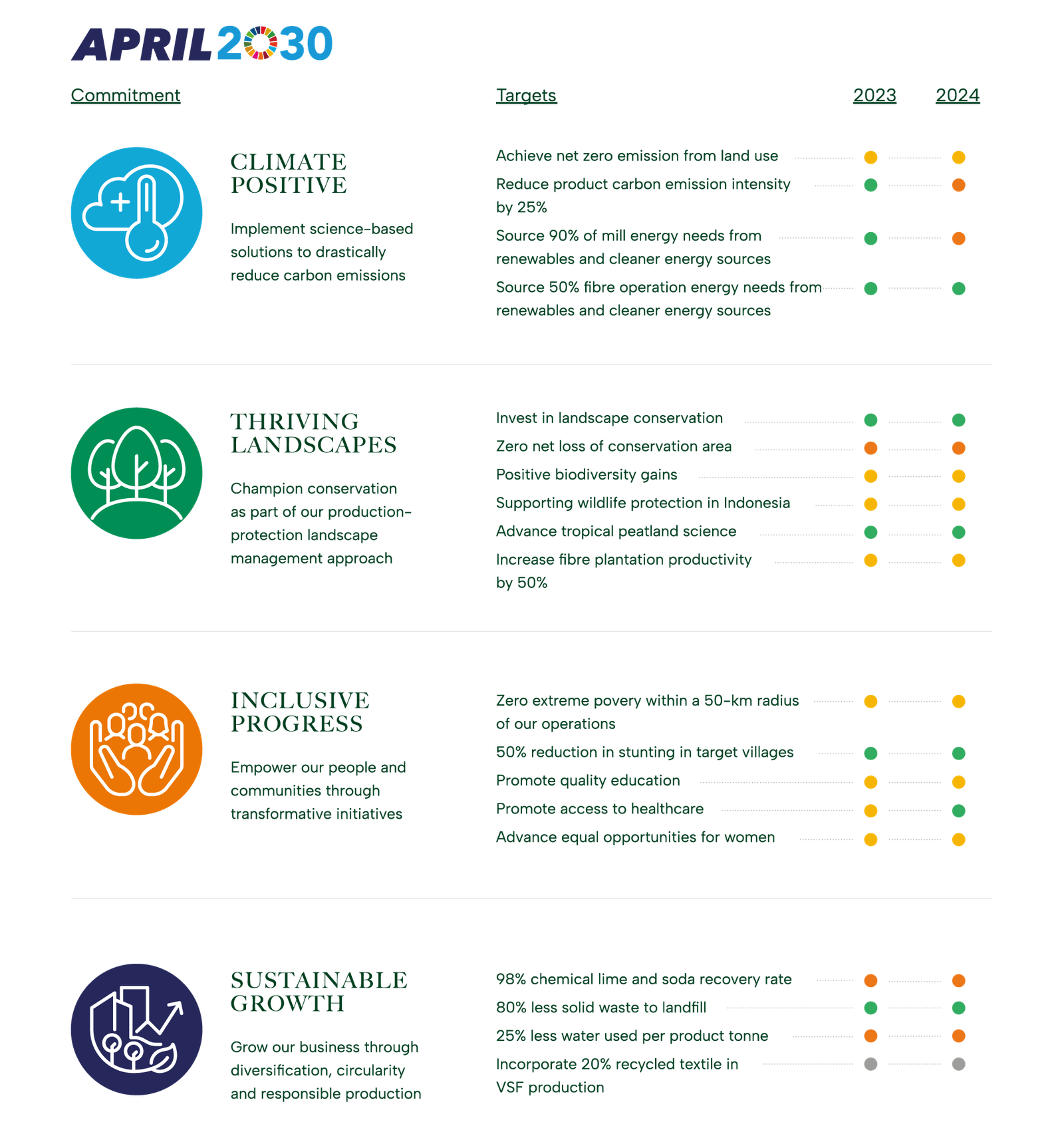
svg+xml;charset=utf — APRIL Asia
sustainable growth — APRIL Asia

Method

Waste disposed is recorded through various means of measurement including estimation of weight by waste type. Particular waste types as described above are measured as a wet waste and converted to a bone dry (BD) weight. The wet waste weight is multiplied by the consistency of each waste type to determine the BD. The consistency is predetermined by the lab.

Baseline
71kg/T

Performance 2022

On Track

sustainable growth — APRIL Asia

Method

The DPTW utilisation rate and % of textile waste per tonne of product will be based on R&D lab/pilot/demo procedures.

Baseline
0%

Performance 2022

In Development

sustainable growth — APRIL Asia

Method

Water consumption per tonne of product is calculated based on water consumed in the production of saleable pulp, paper, viscose staple fiber and viscose yarn measured by flow meters, via calculation and water balances divided by the production figures for saleable pulp, paper, viscose staple fibre and viscose yarn.

Baseline
28 m3/T

Performance 2022

Not Progressing

sustainable growth — APRIL Asia

Method

Soda content within the liquor cycle and losses are determined by means of mass balance based on daily lab analysis.

Lime volume in the lime kiln and losses are determined by means of lime make-up.

The recovery rate is calculated net of the percentage of make-up amounts added. The annual figure is based on the average monthly recovery rate.

Baseline
96%

Performance 2022

Not Progressing

inclusive progress — APRIL Asia

Method

Number of Mill and Nursery contractor calculated based on Man Power data which grouped by gender level calculated as a monthly average.

Baseline
2571

inclusive progress — APRIL Asia

Method

The number of own and supply partners employees is calculated based on year-end Man Power data which is grouped by gender. The identification of leadership position refer to employees’ grade D2 or Manager level and above.

Baseline
55 women employees in leadership positions

Performance 2022

Progressing

inclusive progress — APRIL Asia

Method

Women’s effective participation is identified from the participation list for each program. Percentage of female participation is calculated by the number of women participating divided by the total participants.

Baseline
34%

Performance 2022

Progressing

inclusive progress — APRIL Asia

Method

In development

Baseline
In development

Performance 2022

Progressing

inclusive progress — APRIL Asia

Method

In development

Baseline
In development

Performance 2022

Progressing

inclusive progress — APRIL Asia

Method

In development

Baseline
In development

Performance 2022

Progressing

inclusive progress — APRIL Asia

Method

We engaged third party to conduct assessment in APRIL-supported schools using the framework that was developed by Research Triangle Institute (RTI) and USAID.

Baseline
In development

Performance 2022

Progressing

inclusive progress — APRIL Asia

Method

Poverty mapping is identified through:

  1. Desktop analysis using National Statistics, Village Potential Statistics, SMERU Poverty Map.
  2. On-the-ground verification through FGD, village transect walk, interview with community.

Baseline
3%

Performance 2022

Progressing

thriving landscapes — APRIL Asia

Method

Peer-reviewed scientific journal publication standards

Baseline
1

Performance 2022

On Track

thriving landscapes — APRIL Asia

Method

Documentation of Participation (presentation of papers or posters) in national and international dialogues, workshops and conferences

Baseline
6

Performance 2022

On Track

thriving landscapes — APRIL Asia

Method

Number of scientists from universities and research institutions that have collaborated with APRIL on peatland management during the calendar year

Baseline
9

Performance 2022

On Track

thriving landscapes — APRIL Asia

Method

Wood deliveries (excluding open market supply) to the mill are used as a basis to calculate MAI (Tonnes/ Ha/Yr). The MAI is based on the 3 year area weighted rolling average growth for all closed compartments.

Baseline
20T/ha/yr

Performance 2022

On Track

thriving landscapes — APRIL Asia

Method

Methodology to be developed specific to animal species and does not include plants. Qualifying initiatives may vary widely in nature but must have the animal protection as the primary objective.

Partnerships will be developed and documented in line with an overarching strategy prioritizing stakeholders and threats specific to the country of Indonesia assessed.

Performance 2022

Progressing

thriving landscapes — APRIL Asia

Method

May include various initiatives relating to conservation of RTE species to be defined in a priority list, initiatives may be conducted solely or in collaboration with other stakeholders.

Baseline
2

thriving landscapes — APRIL Asia

Method

Methodology to be developed to measure change in ecosystem services and values over time (carbon sequestration, water provision, resource provision including fish and honey)

Baseline
not yet developed

thriving landscapes — APRIL Asia

Method

Reports for reforestation of previously encroached and degraded area including all areas where assisted natural regeneration, planting or enrichment planting of species that improve habitat value have taken place during the year but excludes natural regeneration.

Baseline
275 ha

Performance 2022

Progressing

thriving landscapes — APRIL Asia

Method

Area within conservation is derived from land bank which is based on land cover analysis and is updated annually to capture any boundary changes, land use changes or measurement data.

Baseline
0 ha Net loss

Performance 2022

Not Progressing

thriving landscapes — APRIL Asia

Method

Landscape conservation funding includes restoration and conservation costs associated with the RER as well as the allocation of a proportion of the costs related to APRIL’s maintenance of conservation values under its production-protection model. The allocation is based on proportionate amount of each cost that is related to conservation and restoration.

The wood volume is based on wood delivered to the Mill.

Baseline
USD$0.7 per tonne of plantation fiber

Performance 2022

On Track

climate positive 1 — APRIL Asia

Method

Mill

Calculate from the records of fuel types used the amount consumed in boilers to generate power, heat and steam including energy use for mobile & including transportation. Each of the fuel types are converted to energy expressed by Giga Joule Lower Heating Value (GJ LHV) following the IPCC guidelines.

Baseline: 87%

Performance 2022

On Track

Forest Operations

Calculate from the records of fuel types the quantity consumed by major categories of forest management activities by Fiber operations.

This covers energy used for Forest operations, infrastructure including wood transport from estate to mill; When a blend of fuel types is used (such as B20) the contribution to renewable and cleaner energy targets is calculated separately for each fuel rather than considering the blend as a cleaner fuel type.

Baseline: 19%

Performance 2022

Progressing

climate positive 1 — APRIL Asia

Method

APRIL follows the international GHG protocol as developed by WRI/WBCSD to develop its emissions profile. The total emissions measured as emissions intensity is calculated based on tonnes of Scope 1 and 2 Mill Greenhouse Gas Emissions per tonne of product (paper, pulp and viscose). The emissions boundary scope covers gate-to-gate (wood processing in wood yard until pulp, paper and viscose production) of the three main GHGs: CO2, CH4, and N2O.

Baseline
0.55 tCO2e/product tonne

Performance 2022

On Track

climate positive 1 — APRIL Asia

Method

To quantify the total GHG emission and removals across APRIL’s land bank from land use, APRIL follows the GHG Protocol Agricultural Guidance and IPCC Guidelines for Agricultural, Forestry, and Other Land Use. To detect the land cover change within the look-back period, i.e. 20 years APRIL utilized the remotely sensed data.

The GHG emission will be calculated as the total of carbon stock changes in woody biomass and soil organic carbon and include all major carbon fluxes such as peat decomposition, plantation growth and harvesting, and fires.

To quantify the amount of carbon unit to balance the emission, the Verified Carbon Standard (VCS), the Climate, Community and Biodiversity Standards (CCB), or other internationally accepted standard will be used.

Performance 2022

Progressing

This site is registered on wpml.org as a development site. Switch to a production site key to remove this banner.