
search

Happy International Women’s Day (IWD) 2020! This year’s IWD emphasizes the importance of gender equality, under the theme of ‘Collective Individualism’.

We’ve got an abundance of talent here APRIL Group, so we decided to commission members of the Riau Andalan Photography Club (KOPRAL) to take portraits of some of their female colleagues across all our different departments and offices.

Hear from eight of the women below:
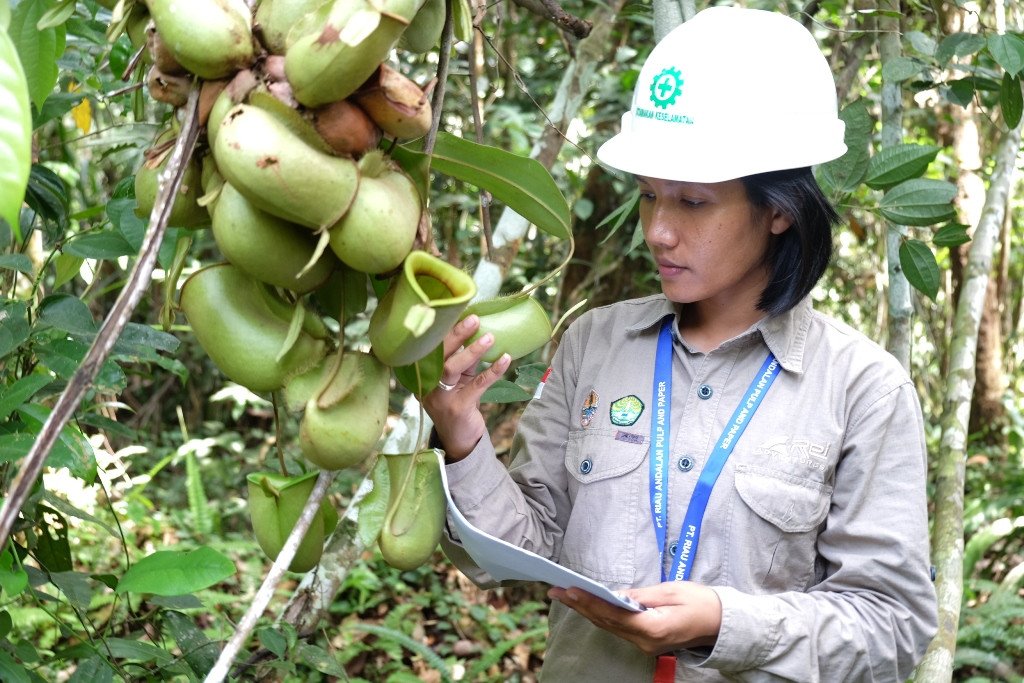
artauli agustina — APRIL Asia

Artauli Agustina

Environment Officer at Pelalawan Estate

As an Environment Officer, I carry out environmental monitoring and management – checking that all the plants, animals, soil, water, and air quality in our estate are in good condition. I think my work benefits both the environment as well as the people around me, and getting to work both in the office as well as outdoors in the field is pretty fun. I was definitely a bit apprehensive at first, as the only female Estate Environment Officer at Riau Fibre. I was worried I wouldn’t be able to meet the company’s expectations, but I soon realized that if you’re enthusiastic and well-meaning, and willing to learn and cooperate, most things usually turn out well. The goal is to be part of a team which creates a fun work environment and works together towards the same environmental sustainability goals. I think APRIL Group clearly provides equal opportunities to women and men at every level. Ultimately, it’s up to us to work hard and determine our area of passion, and the company will be able to see where we fit best.
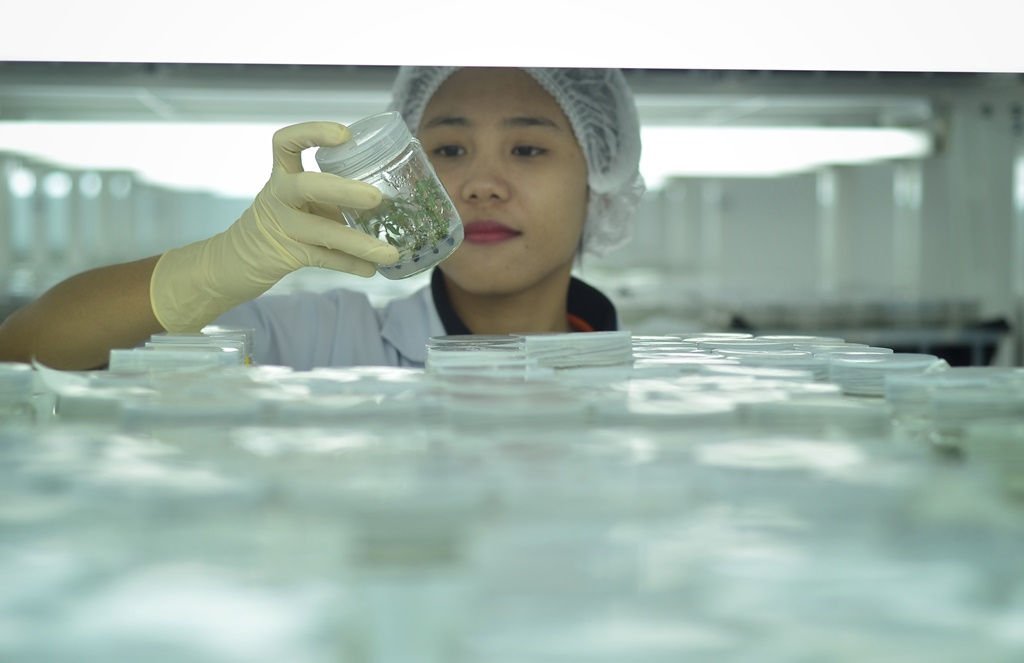
niska ziliwu — APRIL Asia

Niska Ziliwu

Lab Assistant at Kerinci Technology Centre Lab

My job is to prepare our seedlings to be transferred from the lab to the nursery and I really enjoy it. I’ve learned how important it is to be meticulous, and the level of care I have for these plants is the same as that I have for my own family! It can be pretty hard sometimes when I have to climb up to move plants on or off a high shelf (as they can be quite heavy) but honestly, anyone who’s determined can do it. I’m glad that everyone gets equal treatment in my workplace, with both female and male employees working well together as a team.
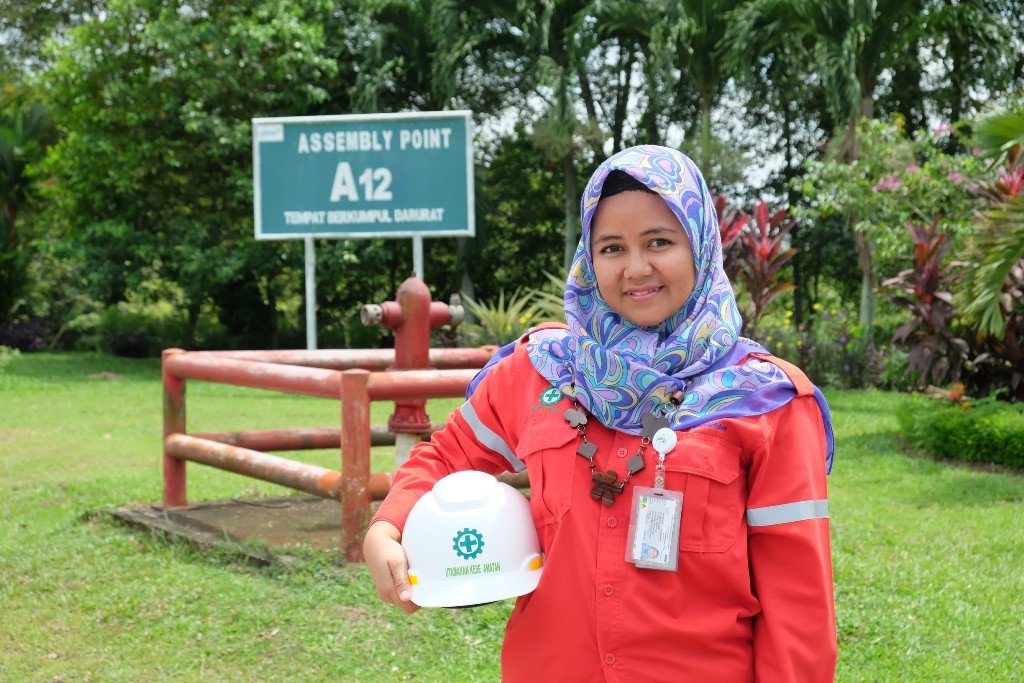
syarly susan — APRIL Asia

Syarly Susan

Safety & Health Data Analysis Officer cum Admin Officer at OHS Department

I monitor and analyse any accidents that may occur in the fiber operational areas in Kerinci, summarising them in reports. In my opinion, there really is no difference between females or males in the field of safety, although I do think that women are more maternal by nature, so we do tend to worry a bit more! Safety is really important to me – in the workplace as well as at home. I’m happy to be working at APRIL, where gender equality is obvious with all women and men having the same opportunities.
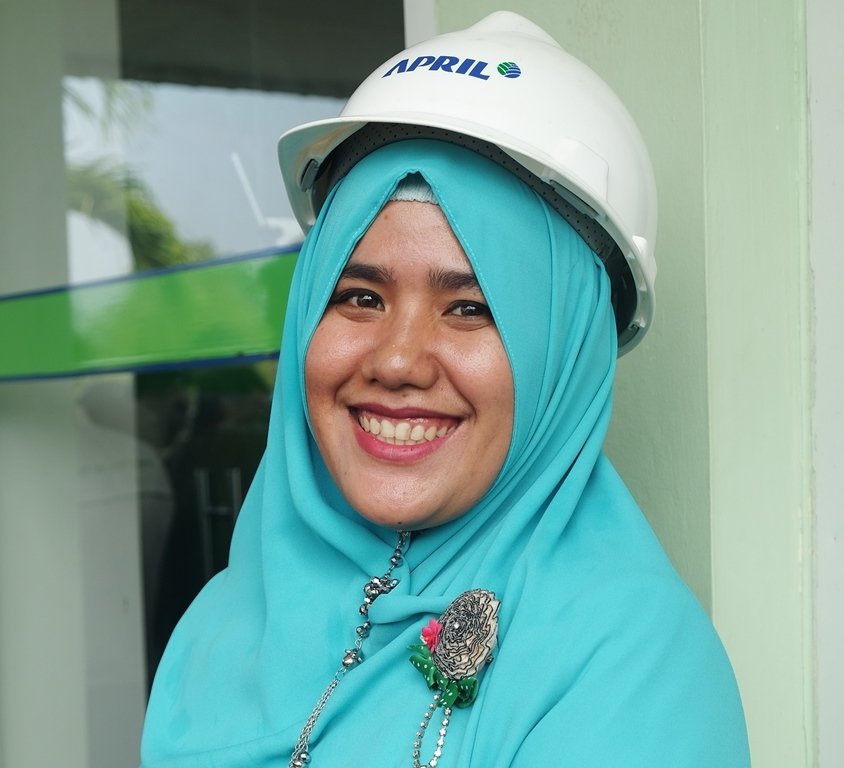
ajeng arerimaslona — APRIL Asia

Ajeng Arerimaslona

Production Scheduling Assistant at Forest Planning Department

I help to draft the Integrated Operation Plan (IOP) that our estates have to adhere to, as well as ensure that they’re actually adhering to it. It’s a great job that allows me to work with many people – from the staff in the plantations to those in sector planning – which is something I truly enjoy. Being the only woman in our IOP team has never once been a hindrance to my work or career, and I’m glad to say I actually have full support from all my co-worker and superiors at this company.
ratih saraswati — APRIL Asia

Ratih Saraswati

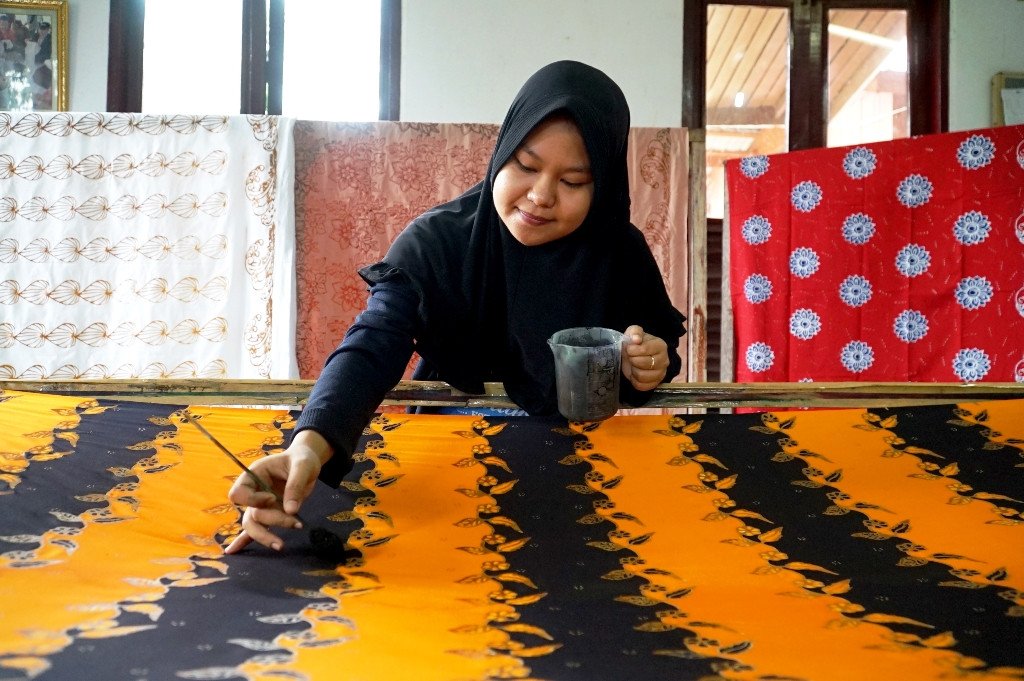
Batik Crafter at Rumah Batik Andalan

In my opinion, all of the women who work here at Rumah Batik Andalan are really strong and determined. I think a lot of people underestimate the art of making batik without knowing that it is actually quite heavy work that requires a combination of physical strength, creativity and artistic skills. Thankfully I think I have all those qualities, and I truly find pleasure in making bono batik with beautiful motifs.

lasma elfrida — APRIL Asia

Lasma Elfrida

Teacher at Mutiara Harapan School

I teach the youngest students in the school: the four to six year olds. Teaching kids of this age range can be challenging especially at the start when they are so young and don’t even know about basic numbers or quantities yet. But I enjoy encouraging them to learn and practice, and witnessing their eventual learning progress. As a teacher at school and mother-of-two at home, I’m actually quite proud of myself since every week day, I work eight hours at school as a teacher and then I go home to become a teacher to my own kids!
melisana — APRIL Asia

Melisana

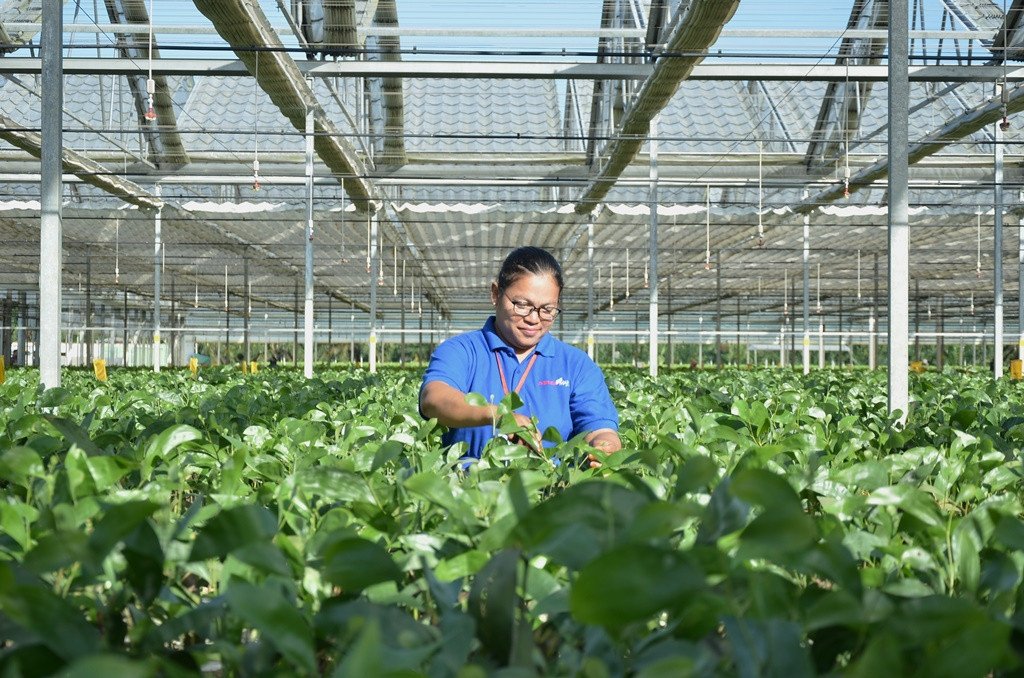
Planting Operator at Kerinci Nursery 2

I believe APRIL is committed to achieving gender equality, just by the way it clearly gives the same opportunity to both women and men to grow in their respective fields. Of course, there are some jobs which women may prefer over others. I think caring for plants and ensuring they grow up to be strong and healthy does require a high level of patience and thoroughness – I feel like I’m basically a doting mother caring for a child when I’m watching my seedlings in the nursery.
dila permata sari — APRIL Asia

Dila Permata Sari

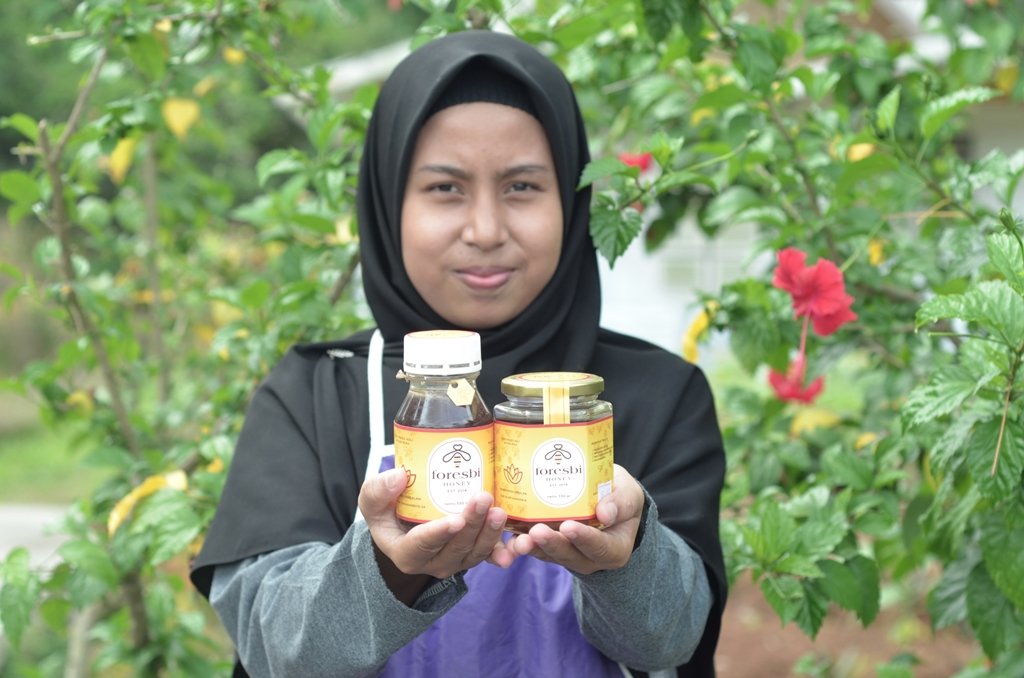
Staff member at Rumah Madu Andalan

Gender equality can be better achieved when women do not limit themselves. I think it pays off if you work hard – and the women who I work with are definitely hard workers! There’s a great pleasure in packing honey and knowing that it’s a product that other people can eventually enjoy. But it does come with some challenges, such as having to ensure that the weight of the honey packed in each bottle is no more or no less, and that the correct labels are pasted properly and clearly onto the bottles.

Meet the Photographers!
doris debora — APRIL Asia

Doris Debora

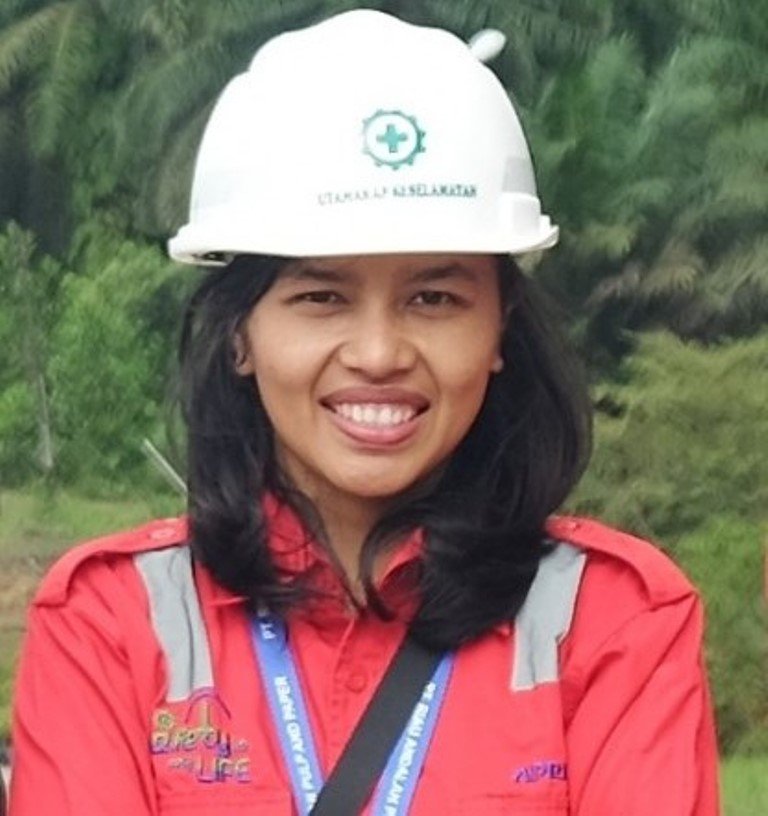
Fiber Safety Officer at OHS Department

It’s been three years since I joined the Photography Club – it felt like I encountered a treasure trove when I first met the other photography enthusiasts in our company. We often arrange photo hunting events where I get to gain photography tips and advice from the senior members in this club.

Taking Artauli’s photo was a particularly memorable experience since it took place at Tasik Anggerek, RAPP’s conservation site in our Pelalawan Estate. We had to go far into the jungle to find the Kantung Semar plant you see in the photo, and my feet were bitten by many leeches. But it was worth it since the photo met my expectations.

henri putra — APRIL Asia

Henri Putra

Dispatcher at Woodyard PTSI

It was a special moment when I took the photo of Melisana in KCN 2 because we were hosting President Jokowi in the nursery at the time. While waiting for the right moment to capture a nice photo, I roamed around the nursery and was amazed by its beauty. I think that to us photographers, the nursery is a perfect spot to hunt for beautiful photos. This was actually my first time visiting KCN 2 and I hope to revisit soon.

I joined KOPRAL three years ago. I love photography and I’m a self-taught photographer! Joining the club really helped my confidence in taking photos to grow, and I’m grateful that the club exists in Riau Complex. We welcome anyone who’s interested to join us.

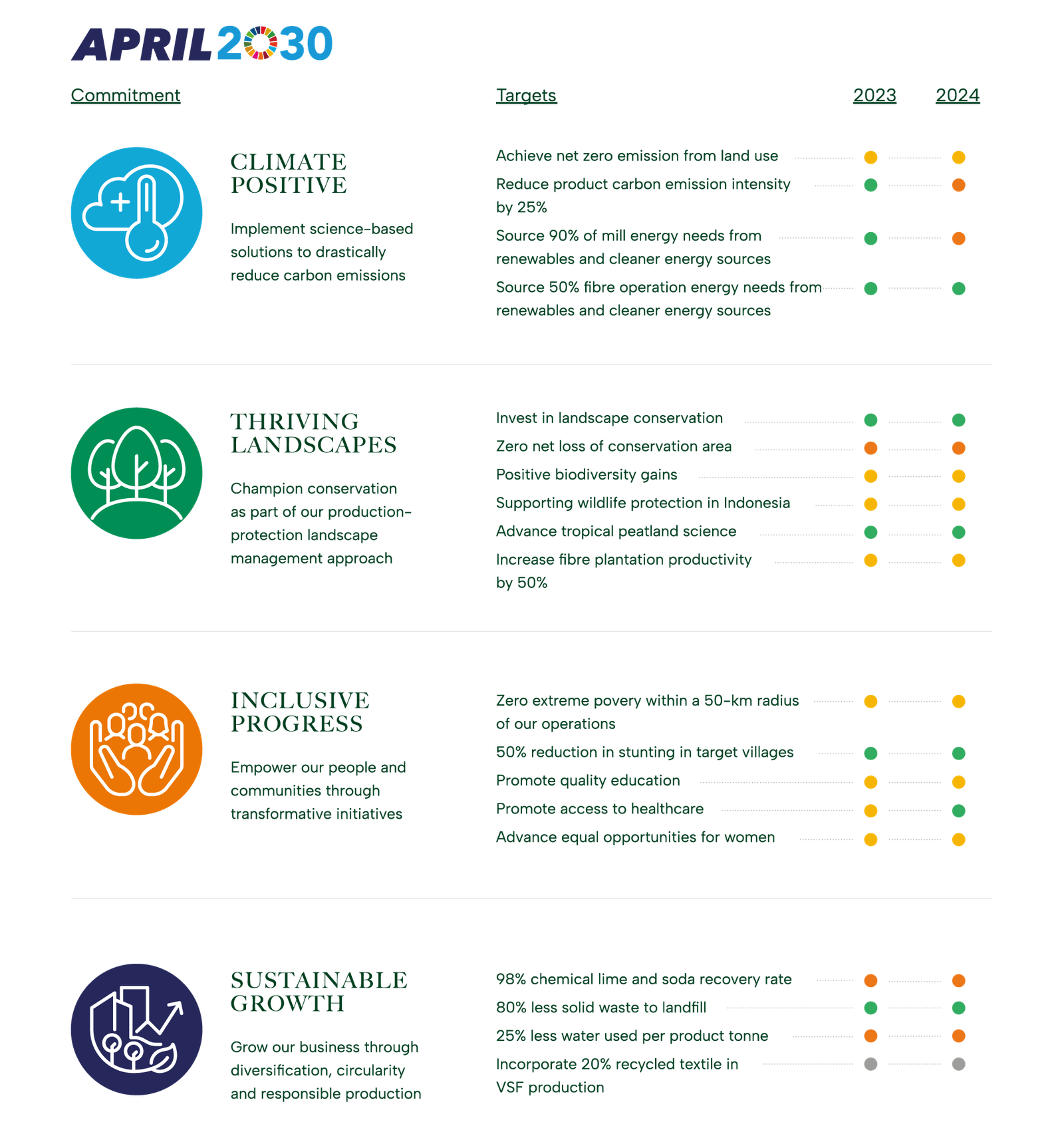
svg+xml;charset=utf — APRIL Asia
sustainable growth — APRIL Asia

Method

Waste disposed is recorded through various means of measurement including estimation of weight by waste type. Particular waste types as described above are measured as a wet waste and converted to a bone dry (BD) weight. The wet waste weight is multiplied by the consistency of each waste type to determine the BD. The consistency is predetermined by the lab.

Baseline
71kg/T

Performance 2022

On Track

sustainable growth — APRIL Asia

Method

The DPTW utilisation rate and % of textile waste per tonne of product will be based on R&D lab/pilot/demo procedures.

Baseline
0%

Performance 2022

In Development

sustainable growth — APRIL Asia

Method

Water consumption per tonne of product is calculated based on water consumed in the production of saleable pulp, paper, viscose staple fiber and viscose yarn measured by flow meters, via calculation and water balances divided by the production figures for saleable pulp, paper, viscose staple fibre and viscose yarn.

Baseline
28 m3/T

Performance 2022

Not Progressing

sustainable growth — APRIL Asia

Method

Soda content within the liquor cycle and losses are determined by means of mass balance based on daily lab analysis.

Lime volume in the lime kiln and losses are determined by means of lime make-up.

The recovery rate is calculated net of the percentage of make-up amounts added. The annual figure is based on the average monthly recovery rate.

Baseline
96%

Performance 2022

Not Progressing

inclusive progress — APRIL Asia

Method

Number of Mill and Nursery contractor calculated based on Man Power data which grouped by gender level calculated as a monthly average.

Baseline
2571

inclusive progress — APRIL Asia

Method

The number of own and supply partners employees is calculated based on year-end Man Power data which is grouped by gender. The identification of leadership position refer to employees’ grade D2 or Manager level and above.

Baseline
55 women employees in leadership positions

Performance 2022

Progressing

inclusive progress — APRIL Asia

Method

Women’s effective participation is identified from the participation list for each program. Percentage of female participation is calculated by the number of women participating divided by the total participants.

Baseline
34%

Performance 2022

Progressing

inclusive progress — APRIL Asia

Method

In development

Baseline
In development

Performance 2022

Progressing

inclusive progress — APRIL Asia

Method

In development

Baseline
In development

Performance 2022

Progressing

inclusive progress — APRIL Asia

Method

In development

Baseline
In development

Performance 2022

Progressing

inclusive progress — APRIL Asia

Method

We engaged third party to conduct assessment in APRIL-supported schools using the framework that was developed by Research Triangle Institute (RTI) and USAID.

Baseline
In development

Performance 2022

Progressing

inclusive progress — APRIL Asia

Method

Poverty mapping is identified through:

  1. Desktop analysis using National Statistics, Village Potential Statistics, SMERU Poverty Map.
  2. On-the-ground verification through FGD, village transect walk, interview with community.

Baseline
3%

Performance 2022

Progressing

thriving landscapes — APRIL Asia

Method

Peer-reviewed scientific journal publication standards

Baseline
1

Performance 2022

On Track

thriving landscapes — APRIL Asia

Method

Documentation of Participation (presentation of papers or posters) in national and international dialogues, workshops and conferences

Baseline
6

Performance 2022

On Track

thriving landscapes — APRIL Asia

Method

Number of scientists from universities and research institutions that have collaborated with APRIL on peatland management during the calendar year

Baseline
9

Performance 2022

On Track

thriving landscapes — APRIL Asia

Method

Wood deliveries (excluding open market supply) to the mill are used as a basis to calculate MAI (Tonnes/ Ha/Yr). The MAI is based on the 3 year area weighted rolling average growth for all closed compartments.

Baseline
20T/ha/yr

Performance 2022

On Track

thriving landscapes — APRIL Asia

Method

Methodology to be developed specific to animal species and does not include plants. Qualifying initiatives may vary widely in nature but must have the animal protection as the primary objective.

Partnerships will be developed and documented in line with an overarching strategy prioritizing stakeholders and threats specific to the country of Indonesia assessed.

Performance 2022

Progressing

thriving landscapes — APRIL Asia

Method

May include various initiatives relating to conservation of RTE species to be defined in a priority list, initiatives may be conducted solely or in collaboration with other stakeholders.

Baseline
2

thriving landscapes — APRIL Asia

Method

Methodology to be developed to measure change in ecosystem services and values over time (carbon sequestration, water provision, resource provision including fish and honey)

Baseline
not yet developed

thriving landscapes — APRIL Asia

Method

Reports for reforestation of previously encroached and degraded area including all areas where assisted natural regeneration, planting or enrichment planting of species that improve habitat value have taken place during the year but excludes natural regeneration.

Baseline
275 ha

Performance 2022

Progressing

thriving landscapes — APRIL Asia

Method

Area within conservation is derived from land bank which is based on land cover analysis and is updated annually to capture any boundary changes, land use changes or measurement data.

Baseline
0 ha Net loss

Performance 2022

Not Progressing

thriving landscapes — APRIL Asia

Method

Landscape conservation funding includes restoration and conservation costs associated with the RER as well as the allocation of a proportion of the costs related to APRIL’s maintenance of conservation values under its production-protection model. The allocation is based on proportionate amount of each cost that is related to conservation and restoration.

The wood volume is based on wood delivered to the Mill.

Baseline
USD$0.7 per tonne of plantation fiber

Performance 2022

On Track

climate positive 1 — APRIL Asia

Method

Mill

Calculate from the records of fuel types used the amount consumed in boilers to generate power, heat and steam including energy use for mobile & including transportation. Each of the fuel types are converted to energy expressed by Giga Joule Lower Heating Value (GJ LHV) following the IPCC guidelines.

Baseline: 87%

Performance 2022

On Track

Forest Operations

Calculate from the records of fuel types the quantity consumed by major categories of forest management activities by Fiber operations.

This covers energy used for Forest operations, infrastructure including wood transport from estate to mill; When a blend of fuel types is used (such as B20) the contribution to renewable and cleaner energy targets is calculated separately for each fuel rather than considering the blend as a cleaner fuel type.

Baseline: 19%

Performance 2022

Progressing

climate positive 1 — APRIL Asia

Method

APRIL follows the international GHG protocol as developed by WRI/WBCSD to develop its emissions profile. The total emissions measured as emissions intensity is calculated based on tonnes of Scope 1 and 2 Mill Greenhouse Gas Emissions per tonne of product (paper, pulp and viscose). The emissions boundary scope covers gate-to-gate (wood processing in wood yard until pulp, paper and viscose production) of the three main GHGs: CO2, CH4, and N2O.

Baseline
0.55 tCO2e/product tonne

Performance 2022

On Track

climate positive 1 — APRIL Asia

Method

To quantify the total GHG emission and removals across APRIL’s land bank from land use, APRIL follows the GHG Protocol Agricultural Guidance and IPCC Guidelines for Agricultural, Forestry, and Other Land Use. To detect the land cover change within the look-back period, i.e. 20 years APRIL utilized the remotely sensed data.

The GHG emission will be calculated as the total of carbon stock changes in woody biomass and soil organic carbon and include all major carbon fluxes such as peat decomposition, plantation growth and harvesting, and fires.

To quantify the amount of carbon unit to balance the emission, the Verified Carbon Standard (VCS), the Climate, Community and Biodiversity Standards (CCB), or other internationally accepted standard will be used.

Performance 2022

Progressing

This site is registered on wpml.org as a development site. Switch to a production site key to remove this banner.