
search

Restorasi Ekosistem Riau’s Head of Operations, Brad Sanders, recently spoke at the Responsible Business Forum in Singapore about the ecosystem restoration project and how it contributes to Sustainable Development Goal 15: Life on Land – Forest and Biodiversity Restoration. The following has been adapted from his remarks during a workshop session at the Forum.

Restorasi Ekosistem Riau, or RER, is one of the most exciting programs I have ever been involved in, and where I have the privilege to be the Head of Operations responsible for the restoration of 150,000 hectares of lowland tropical rainforest in central Sumatra, as well as leading a team of 170 dedicated people.

The program, which began in 2013, aims to promote sustainably managed forests to help reverse forest degradation and halt biodiversity loss. This purpose aligns with Sustainable Development Goal 15: Life on Land, though we intersect with other Goals as well. While the program precedes the Goals, they now provide a common language and a further layer of measurement that we can apply.
brad 01 — APRIL Asia

Our mission: Protect, Assess, Restore and Manage

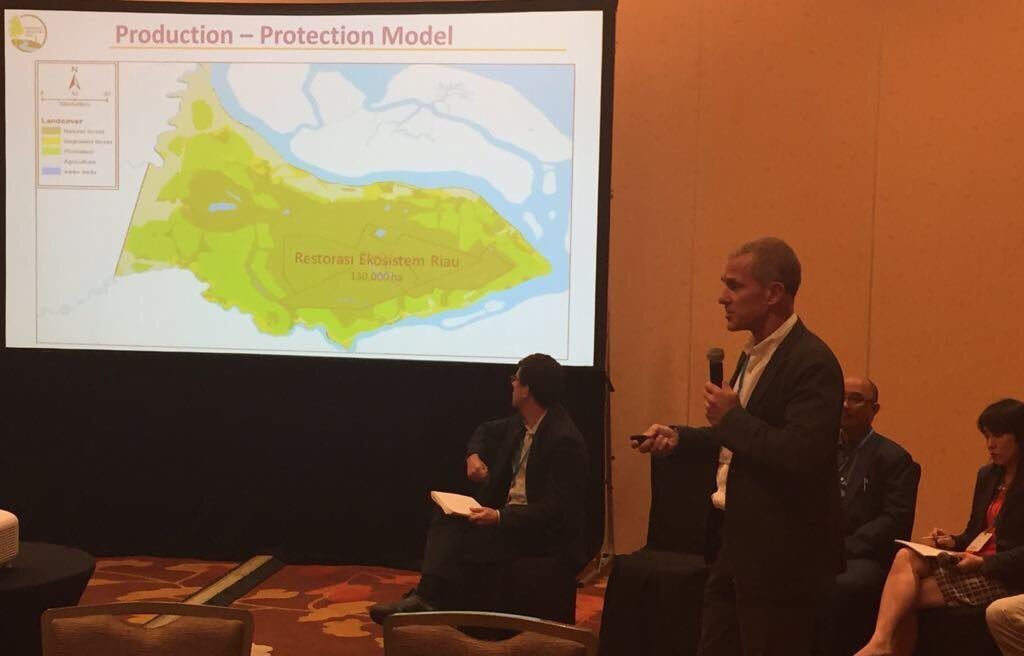
In restoring this landscape, we are guided by a clear mission to ‘Protect, Assess, Restore and Manage’ the forest area we are responsible for. We do this through the production–protection model, whereby a fibre plantation ring serves as a protective buffer around the forest restoration area. This enhances our ability to protect and manage the tropical forest on peat domes which are located in the core of the Kampar Peninsula.

The progress of the program to date is based on three important factors: community buy-in, long-term finance and partnerships.

Establishing trust with the communities who continue to rely on forests for livelihood is an ongoing task and is key to protecting and restoring the area’s biodiversity. Over 17,000 people reside in nine communities along the Kampar River that borders the south side of the Kampar Peninsula. The majority of people are ethnic Malay, while the remainder is a mixture of Minang, Bugis, Nias, Batak, Jawa and Sunda.

Some of the families have a direct dependency on the forest and on the Kampar Peninsula. As well as providing employment to local communities, our engagement with the people of the area includes direct discussions on activities that can be sustainably supported, such as fishing or farming, while mitigating those that degrade the forest and its biodiversity.

Production for Protection

Second, the program is well-financed, enabling full implementation of the 60-year restoration licenses granted by the Ministry of Environment and Forestry. APRIL’s initial 10-year, US$100 million investment allows the RER team to focus on its mission. Where other initiatives have struggled due to inconsistent access to reliable funding, APRIL’s support means we have reliable and adequate finances to cover RER’s operational costs. It also demonstrates the benefits of the production-protection model, where commercial operations on the perimeter of our restoration area not only provide protection, but effectively fund ecosystem restoration and forest protection. While similar initiatives explore opportunities in carbon trade, eco-tourism, donor funding or the promotion of non-timber forest products trade, our experience shows that this is the most reliable, consistent and effective economic model for restoration that we’ve seen in Indonesia, especially given the extent of the resources that are required for ongoing active management.

Partnership and Scale

Third, RER has great partners, variously contributing to the development of significant biodiversity and carbon baseline assessments projects, strategic land use assessments and multi-stakeholder dialogues, and focused training of farmers and implementation of no-burn farming techniques to intensify crop production and improve the well-being of these communities.

To give a sense of the scale of the project, RER’s first Biodiversity Report recorded 72 species of mammals and confirmed the presence of five of Sumatra’s six cat species. As well, 15 of the species recorded are globally threatened with two – the Sumatran Tiger and Sunda Pangolin – listed as Critically Endangered. The plant inventory recorded 112 tree species and 40 non-tree species; the bird inventory 220 bird species from 53 families; and the amphibian and reptile inventories 14 and 61 species respectively. A recent report of bird life on the Kampar Peninsula updated the number of species present to 299.

An Active Presence

Today’s discussion is about how we can accelerate progress. In our view, accelerating progress is best achieved through engagement with government, communities and partners, and through a balanced, long-term approach to production and protection. Under this approach, we are able to maintain active management on the ground which is key to any conservation effort. Having an ‘active’ physical presence enables us to respond to daily or seasonal influences and to prevent fire or encroachment. It is worth noting that over the past two years there has been no fire and no encroachment into the RER area.

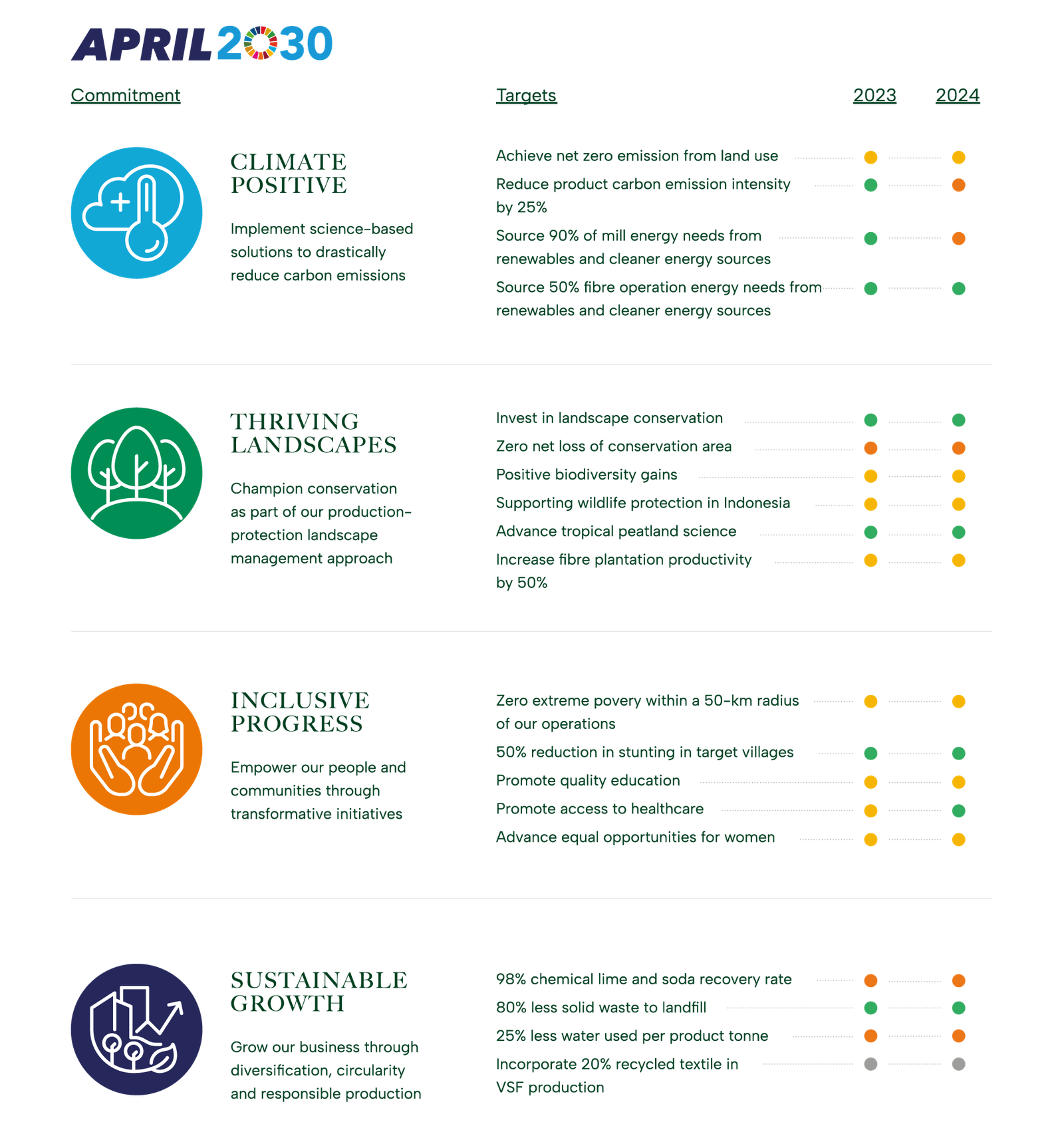
It is also about ensuring that conservation and protection are part of a holistic sustainable forest management strategy. In APRIL’s case, that describes its 1-for-1 approach, where it aims to conserve or protect one hectare of forest for every hectare of plantation. Restorasi Ekosistem Riau contributes to this goal, which is now more than 80% realised.

svg+xml;charset=utf — APRIL Asia
sustainable growth — APRIL Asia

Method

Waste disposed is recorded through various means of measurement including estimation of weight by waste type. Particular waste types as described above are measured as a wet waste and converted to a bone dry (BD) weight. The wet waste weight is multiplied by the consistency of each waste type to determine the BD. The consistency is predetermined by the lab.

Baseline
71kg/T

Performance 2022

On Track

sustainable growth — APRIL Asia

Method

The DPTW utilisation rate and % of textile waste per tonne of product will be based on R&D lab/pilot/demo procedures.

Baseline
0%

Performance 2022

In Development

sustainable growth — APRIL Asia

Method

Water consumption per tonne of product is calculated based on water consumed in the production of saleable pulp, paper, viscose staple fiber and viscose yarn measured by flow meters, via calculation and water balances divided by the production figures for saleable pulp, paper, viscose staple fibre and viscose yarn.

Baseline
28 m3/T

Performance 2022

Not Progressing

sustainable growth — APRIL Asia

Method

Soda content within the liquor cycle and losses are determined by means of mass balance based on daily lab analysis.

Lime volume in the lime kiln and losses are determined by means of lime make-up.

The recovery rate is calculated net of the percentage of make-up amounts added. The annual figure is based on the average monthly recovery rate.

Baseline
96%

Performance 2022

Not Progressing

inclusive progress — APRIL Asia

Method

Number of Mill and Nursery contractor calculated based on Man Power data which grouped by gender level calculated as a monthly average.

Baseline
2571

inclusive progress — APRIL Asia

Method

The number of own and supply partners employees is calculated based on year-end Man Power data which is grouped by gender. The identification of leadership position refer to employees’ grade D2 or Manager level and above.

Baseline
55 women employees in leadership positions

Performance 2022

Progressing

inclusive progress — APRIL Asia

Method

Women’s effective participation is identified from the participation list for each program. Percentage of female participation is calculated by the number of women participating divided by the total participants.

Baseline
34%

Performance 2022

Progressing

inclusive progress — APRIL Asia

Method

In development

Baseline
In development

Performance 2022

Progressing

inclusive progress — APRIL Asia

Method

In development

Baseline
In development

Performance 2022

Progressing

inclusive progress — APRIL Asia

Method

In development

Baseline
In development

Performance 2022

Progressing

inclusive progress — APRIL Asia

Method

We engaged third party to conduct assessment in APRIL-supported schools using the framework that was developed by Research Triangle Institute (RTI) and USAID.

Baseline
In development

Performance 2022

Progressing

inclusive progress — APRIL Asia

Method

Poverty mapping is identified through:

  1. Desktop analysis using National Statistics, Village Potential Statistics, SMERU Poverty Map.
  2. On-the-ground verification through FGD, village transect walk, interview with community.

Baseline
3%

Performance 2022

Progressing

thriving landscapes — APRIL Asia

Method

Peer-reviewed scientific journal publication standards

Baseline
1

Performance 2022

On Track

thriving landscapes — APRIL Asia

Method

Documentation of Participation (presentation of papers or posters) in national and international dialogues, workshops and conferences

Baseline
6

Performance 2022

On Track

thriving landscapes — APRIL Asia

Method

Number of scientists from universities and research institutions that have collaborated with APRIL on peatland management during the calendar year

Baseline
9

Performance 2022

On Track

thriving landscapes — APRIL Asia

Method

Wood deliveries (excluding open market supply) to the mill are used as a basis to calculate MAI (Tonnes/ Ha/Yr). The MAI is based on the 3 year area weighted rolling average growth for all closed compartments.

Baseline
20T/ha/yr

Performance 2022

On Track

thriving landscapes — APRIL Asia

Method

Methodology to be developed specific to animal species and does not include plants. Qualifying initiatives may vary widely in nature but must have the animal protection as the primary objective.

Partnerships will be developed and documented in line with an overarching strategy prioritizing stakeholders and threats specific to the country of Indonesia assessed.

Performance 2022

Progressing

thriving landscapes — APRIL Asia

Method

May include various initiatives relating to conservation of RTE species to be defined in a priority list, initiatives may be conducted solely or in collaboration with other stakeholders.

Baseline
2

thriving landscapes — APRIL Asia

Method

Methodology to be developed to measure change in ecosystem services and values over time (carbon sequestration, water provision, resource provision including fish and honey)

Baseline
not yet developed

thriving landscapes — APRIL Asia

Method

Reports for reforestation of previously encroached and degraded area including all areas where assisted natural regeneration, planting or enrichment planting of species that improve habitat value have taken place during the year but excludes natural regeneration.

Baseline
275 ha

Performance 2022

Progressing

thriving landscapes — APRIL Asia

Method

Area within conservation is derived from land bank which is based on land cover analysis and is updated annually to capture any boundary changes, land use changes or measurement data.

Baseline
0 ha Net loss

Performance 2022

Not Progressing

thriving landscapes — APRIL Asia

Method

Landscape conservation funding includes restoration and conservation costs associated with the RER as well as the allocation of a proportion of the costs related to APRIL’s maintenance of conservation values under its production-protection model. The allocation is based on proportionate amount of each cost that is related to conservation and restoration.

The wood volume is based on wood delivered to the Mill.

Baseline
USD$0.7 per tonne of plantation fiber

Performance 2022

On Track

climate positive 1 — APRIL Asia

Method

Mill

Calculate from the records of fuel types used the amount consumed in boilers to generate power, heat and steam including energy use for mobile & including transportation. Each of the fuel types are converted to energy expressed by Giga Joule Lower Heating Value (GJ LHV) following the IPCC guidelines.

Baseline: 87%

Performance 2022

On Track

Forest Operations

Calculate from the records of fuel types the quantity consumed by major categories of forest management activities by Fiber operations.

This covers energy used for Forest operations, infrastructure including wood transport from estate to mill; When a blend of fuel types is used (such as B20) the contribution to renewable and cleaner energy targets is calculated separately for each fuel rather than considering the blend as a cleaner fuel type.

Baseline: 19%

Performance 2022

Progressing

climate positive 1 — APRIL Asia

Method

APRIL follows the international GHG protocol as developed by WRI/WBCSD to develop its emissions profile. The total emissions measured as emissions intensity is calculated based on tonnes of Scope 1 and 2 Mill Greenhouse Gas Emissions per tonne of product (paper, pulp and viscose). The emissions boundary scope covers gate-to-gate (wood processing in wood yard until pulp, paper and viscose production) of the three main GHGs: CO2, CH4, and N2O.

Baseline
0.55 tCO2e/product tonne

Performance 2022

On Track

climate positive 1 — APRIL Asia

Method

To quantify the total GHG emission and removals across APRIL’s land bank from land use, APRIL follows the GHG Protocol Agricultural Guidance and IPCC Guidelines for Agricultural, Forestry, and Other Land Use. To detect the land cover change within the look-back period, i.e. 20 years APRIL utilized the remotely sensed data.

The GHG emission will be calculated as the total of carbon stock changes in woody biomass and soil organic carbon and include all major carbon fluxes such as peat decomposition, plantation growth and harvesting, and fires.

To quantify the amount of carbon unit to balance the emission, the Verified Carbon Standard (VCS), the Climate, Community and Biodiversity Standards (CCB), or other internationally accepted standard will be used.

Performance 2022

Progressing

This site is registered on wpml.org as a development site. Switch to a production site key to remove this banner.