
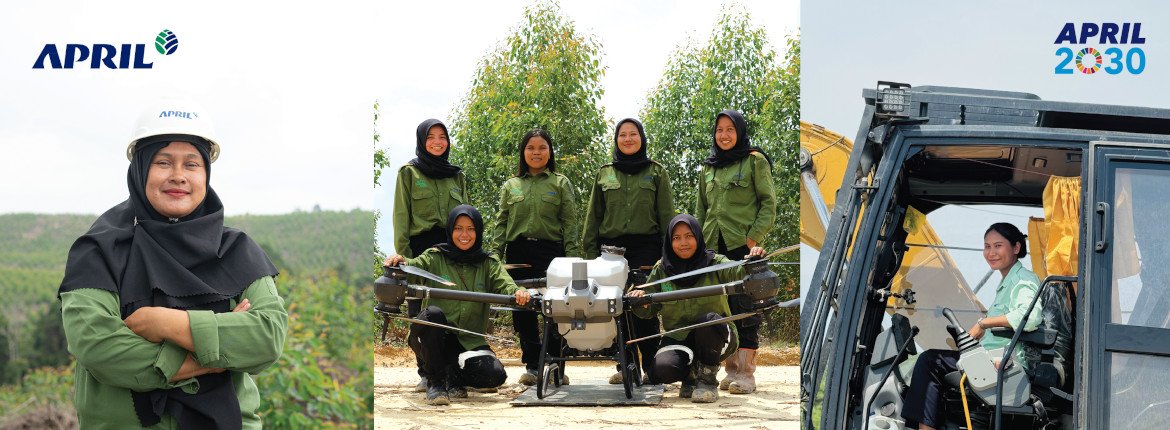
• APRIL’s Gender Action Plan aims to increase the proportion of women workers, across its forestry operations, including management.
  • Actions address practical, social and cultural barriers to women’s advancement.
  • Targeted programmes and initiatives have successfully trained women in roles that were traditionally held by men.

Through APRIL’s strategic push for gender equality across the business, the company is enabling women to take on non-traditional roles and advance into leadership positions.

Piloting drones, operating mechanised harvesting equipment and supervising plantations in the field are not jobs typically associated with women in the forestry industry. But these are just a few of the roles where women are breaking through barriers to take on positions once considered out of reach.

APRIL2030 agenda sets targets for women’s empowerment and advancement in the company, alongside broader social goals.

Achieving these goals requires more than good intentions. It calls for addressing the social and cultural barriers that have limited women’s participation by creating an inclusive work environment that supports their growth.

Through APRIL’s Gender Action Plan, the company is implementing targeted initiatives to ensure women can thrive across all levels of the company. For example, APRIL has introduced support such as nursing rooms and daycare centres. It has also implemented Standard Operating Procedures to prevent sexual harassment and bullying, and provided mandatory unconscious bias training for all employees.

Eleven female forums have also been established across different business units and departments, enabling women employees to discuss equal employment opportunities and raise gender-related issues. In addition, more than 2,500 employees completed the online Gender Equality Training programme last year alone.

Another key initiative was the launch of the company’s Diversity, Equity, and Inclusion Policy in March 2024. Developed in collaboration with the Indonesia Business Coalition for Women Empowerment, the policy aligns APRIL with international standards such as the UN Convention on the Elimination of All Forms of Discrimination Against Women, reinforcing the company’s commitment to equal opportunity and zero tolerance for discrimination.

These measures are starting to have an impact on the company’s workforce composition. As part of the APRIL2030 agenda, the company has a target to increase the proportion of women in the workforce and in leadership positions to 20 percent. Currently, there are 3,611 women in the workforce, representing 18.1 percent, which is still below the APRIL2030 target at 20%. In senior roles, there are 64 women, accounting 11.9 percent of total leadership positions.

Across APRIL’s operations, women are stepping forward to lead, inspire and shaping progress. Here are their stories:

Piloting Drones for Precision Forestry

Drones are an increasingly important part of APRIL’s operations with a variety of uses including aerial observation, tracking plant health and deploying pesticides.

Nina Kurnia BR Sembiring is the coordinator for APRIL’s all-female drone pilot team, which has been in operation since 2023. The 15 pilots launch 30 flights a day covering up to 25 hectares.

“Being a drone pilot is not what women might consider doing, but APRIL has been expanding career paths for women, and supports our growth through several training programmes,” said Sembiring. She has obtained certificates as an operator and instructor, and she also holds pilot licences from the Indonesian Drone Pilot Association and DJI, a global provider of Unmanned Aerial Vehicle (UAV) technology based in Shenzhen, China.

“I want to prove to all women in Indonesia that becoming drone pilots is not restricted only for men. I am a woman, and I believe I can nail it because I am confident and eager to keep learning. Technology is constantly advancing, and we need to stay updated,” she added.

Leading Operational Excellence in the Plantations

At Teso West Estate, one of APRIL’s plantations in Riau Province, the company launched a key initiative last year to establish an all-female team in operational roles, with technical training provided through the APRIL Learning Institute (ALI). The team is comprised of one Superintendent, five Assistants and 16 Supervisors who are all women.

Superintendent Dina Trinawati recalls feeling unsure about the role when she embarked on the training. “I questioned whether I was capable of working in the Plantation Department (Operational), given the high challenges and targets that were different from my previous job scope,” she said.

The programme has given her the confidence that she and her female colleagues can excel. “Now I believe that women are capable of working in plantation operations. The main challenges lie in the characteristics or uniqueness of women themselves,” she said.

The plan is to roll the programme out to other estates in the future and Trinawati says she hopes her team will inspire others. “Women must challenge stigmas and not allow them to become barriers or weaknesses that hold them back,” she added.

Leading the Harvesting Front

Another training programme that started last year was designed to up-skill the company’s first all-women mechanised harvesting team. Like all trainee operators, the seven women began with classroom lessons and simulator sessions, before moving on to further training using real equipment in the field. Their role involves operating an excavator with a special head attachment to fell and debark trees, before the logs are extracted from the compartment and loaded them onto trucks.

Lilis, who comes from neighbouring Penyengat village, recalled feeling quite hesitant about joining the programme. “I doubted my abilities as a woman — thinking I was weak, afraid of the heat, and scared of living in the forest. The idea of operating heavy machinery felt impossible,” she said.

The structured training helped shift her perspective. “I realized that everything can be learned step-by-step. The operational life here isn’t as frightening as people had made it seem, and over time my confidence grew,” said Lilis.

Now proud of what the team has achieved, Lilis hopes their journey will inspire others. “I want our experience to show other women that they can take bold steps forward and challenge the limits they think they have,” she said.

At APRIL, these women are redefining what’s possible in the forestry industry. While there is still more to be done to create lasting change, their experiences continue to prove that gender is no barrier to ambition. The company is committed to enabling that momentum through its actions to remove barriers to advancement and empower women.

APRIL’s 2024 Sustainability Report – Staying the Course – can be downloaded here.

svg+xml;charset=utf — APRIL Asia
sustainable growth — APRIL Asia

Method

Waste disposed is recorded through various means of measurement including estimation of weight by waste type. Particular waste types as described above are measured as a wet waste and converted to a bone dry (BD) weight. The wet waste weight is multiplied by the consistency of each waste type to determine the BD. The consistency is predetermined by the lab.

Baseline
71kg/T

Performance 2022

On Track

sustainable growth — APRIL Asia

Method

The DPTW utilisation rate and % of textile waste per tonne of product will be based on R&D lab/pilot/demo procedures.

Baseline
0%

Performance 2022

In Development

sustainable growth — APRIL Asia

Method

Water consumption per tonne of product is calculated based on water consumed in the production of saleable pulp, paper, viscose staple fiber and viscose yarn measured by flow meters, via calculation and water balances divided by the production figures for saleable pulp, paper, viscose staple fibre and viscose yarn.

Baseline
28 m3/T

Performance 2022

Not Progressing

sustainable growth — APRIL Asia

Method

Soda content within the liquor cycle and losses are determined by means of mass balance based on daily lab analysis.

Lime volume in the lime kiln and losses are determined by means of lime make-up.

The recovery rate is calculated net of the percentage of make-up amounts added. The annual figure is based on the average monthly recovery rate.

Baseline
96%

Performance 2022

Not Progressing

inclusive progress — APRIL Asia

Method

Number of Mill and Nursery contractor calculated based on Man Power data which grouped by gender level calculated as a monthly average.

Baseline
2571

inclusive progress — APRIL Asia

Method

The number of own and supply partners employees is calculated based on year-end Man Power data which is grouped by gender. The identification of leadership position refer to employees’ grade D2 or Manager level and above.

Baseline
55 women employees in leadership positions

Performance 2022

Progressing

inclusive progress — APRIL Asia

Method

Women’s effective participation is identified from the participation list for each program. Percentage of female participation is calculated by the number of women participating divided by the total participants.

Baseline
34%

Performance 2022

Progressing

inclusive progress — APRIL Asia

Method

In development

Baseline
In development

Performance 2022

Progressing

inclusive progress — APRIL Asia

Method

In development

Baseline
In development

Performance 2022

Progressing

inclusive progress — APRIL Asia

Method

In development

Baseline
In development

Performance 2022

Progressing

inclusive progress — APRIL Asia

Method

We engaged third party to conduct assessment in APRIL-supported schools using the framework that was developed by Research Triangle Institute (RTI) and USAID.

Baseline
In development

Performance 2022

Progressing

inclusive progress — APRIL Asia

Method

Poverty mapping is identified through:

  1. Desktop analysis using National Statistics, Village Potential Statistics, SMERU Poverty Map.
  2. On-the-ground verification through FGD, village transect walk, interview with community.

Baseline
3%

Performance 2022

Progressing

thriving landscapes — APRIL Asia

Method

Peer-reviewed scientific journal publication standards

Baseline
1

Performance 2022

On Track

thriving landscapes — APRIL Asia

Method

Documentation of Participation (presentation of papers or posters) in national and international dialogues, workshops and conferences

Baseline
6

Performance 2022

On Track

thriving landscapes — APRIL Asia

Method

Number of scientists from universities and research institutions that have collaborated with APRIL on peatland management during the calendar year

Baseline
9

Performance 2022

On Track

thriving landscapes — APRIL Asia

Method

Wood deliveries (excluding open market supply) to the mill are used as a basis to calculate MAI (Tonnes/ Ha/Yr). The MAI is based on the 3 year area weighted rolling average growth for all closed compartments.

Baseline
20T/ha/yr

Performance 2022

On Track

thriving landscapes — APRIL Asia

Method

Methodology to be developed specific to animal species and does not include plants. Qualifying initiatives may vary widely in nature but must have the animal protection as the primary objective.

Partnerships will be developed and documented in line with an overarching strategy prioritizing stakeholders and threats specific to the country of Indonesia assessed.

Performance 2022

Progressing

thriving landscapes — APRIL Asia

Method

May include various initiatives relating to conservation of RTE species to be defined in a priority list, initiatives may be conducted solely or in collaboration with other stakeholders.

Baseline
2

thriving landscapes — APRIL Asia

Method

Methodology to be developed to measure change in ecosystem services and values over time (carbon sequestration, water provision, resource provision including fish and honey)

Baseline
not yet developed

thriving landscapes — APRIL Asia

Method

Reports for reforestation of previously encroached and degraded area including all areas where assisted natural regeneration, planting or enrichment planting of species that improve habitat value have taken place during the year but excludes natural regeneration.

Baseline
275 ha

Performance 2022

Progressing

thriving landscapes — APRIL Asia

Method

Area within conservation is derived from land bank which is based on land cover analysis and is updated annually to capture any boundary changes, land use changes or measurement data.

Baseline
0 ha Net loss

Performance 2022

Not Progressing

thriving landscapes — APRIL Asia

Method

Landscape conservation funding includes restoration and conservation costs associated with the RER as well as the allocation of a proportion of the costs related to APRIL’s maintenance of conservation values under its production-protection model. The allocation is based on proportionate amount of each cost that is related to conservation and restoration.

The wood volume is based on wood delivered to the Mill.

Baseline
USD$0.7 per tonne of plantation fiber

Performance 2022

On Track

climate positive 1 — APRIL Asia

Method

Mill

Calculate from the records of fuel types used the amount consumed in boilers to generate power, heat and steam including energy use for mobile & including transportation. Each of the fuel types are converted to energy expressed by Giga Joule Lower Heating Value (GJ LHV) following the IPCC guidelines.

Baseline: 87%

Performance 2022

On Track

Forest Operations

Calculate from the records of fuel types the quantity consumed by major categories of forest management activities by Fiber operations.

This covers energy used for Forest operations, infrastructure including wood transport from estate to mill; When a blend of fuel types is used (such as B20) the contribution to renewable and cleaner energy targets is calculated separately for each fuel rather than considering the blend as a cleaner fuel type.

Baseline: 19%

Performance 2022

Progressing

climate positive 1 — APRIL Asia

Method

APRIL follows the international GHG protocol as developed by WRI/WBCSD to develop its emissions profile. The total emissions measured as emissions intensity is calculated based on tonnes of Scope 1 and 2 Mill Greenhouse Gas Emissions per tonne of product (paper, pulp and viscose). The emissions boundary scope covers gate-to-gate (wood processing in wood yard until pulp, paper and viscose production) of the three main GHGs: CO2, CH4, and N2O.

Baseline
0.55 tCO2e/product tonne

Performance 2022

On Track

climate positive 1 — APRIL Asia

Method

To quantify the total GHG emission and removals across APRIL’s land bank from land use, APRIL follows the GHG Protocol Agricultural Guidance and IPCC Guidelines for Agricultural, Forestry, and Other Land Use. To detect the land cover change within the look-back period, i.e. 20 years APRIL utilized the remotely sensed data.

The GHG emission will be calculated as the total of carbon stock changes in woody biomass and soil organic carbon and include all major carbon fluxes such as peat decomposition, plantation growth and harvesting, and fires.

To quantify the amount of carbon unit to balance the emission, the Verified Carbon Standard (VCS), the Climate, Community and Biodiversity Standards (CCB), or other internationally accepted standard will be used.

Performance 2022

Progressing

This site is registered on wpml.org as a development site. Switch to a production site key to remove this banner.