
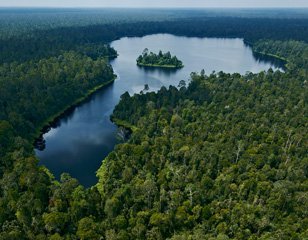
Ronyi Las Silaen memimpin tim Forest Protection Rangers yang menghabiskan hari-hari mereka menelusuri wilayah konsesi Restorasi Ekosistem Riau (RER) yang terletak di Semenanjung Kampar, Riau, Sumatera.

Jagawana (ranger) menjalankan beragam peran. Berjelajah dengan berjalan kaki atau perahu, mereka memainkan berbagai fungsi di dalam RER, termasuk memetakan petunjuk-petunjuk, memantau penyusup di teluk, terlibat dengan masyarakat pengguna hutan, seperti nelayan di sekitar area restorasi, serta mendukung penanaman kembali spesies asli dan mendampingi pengunjung.

Tim jagawana Ronyi juga melakukan tugas penting dalam mengawasi pengelolaan air di wilayah tersebut yang pada saat bersamaan ia juga memberikan perhatian khusus pada sejumlah saluran drainase lama di hutan, yang ditinggalkan oleh operator penebangan sebelumnya yang telah berhenti beroperasi lebih dari satu dekade lalu.

“Menjaga tingkat air yang tepat di bentang alam lahan gambut adalah bagian penting dari pekerjaan kami, jadi kami secara teratur memeriksa bendungan-bendungan yang kami bangun untuk memblokir kanal lama, untuk memastikan mereka tetap berfungsi dan menahan air di dalam kawasan hutan.

“Kami juga memantau ketinggian air di hutan terkait perubahan antara periode basah dan kering untuk lebih memahami bagaimana fungsi hidrologi,” kata Ronyi.
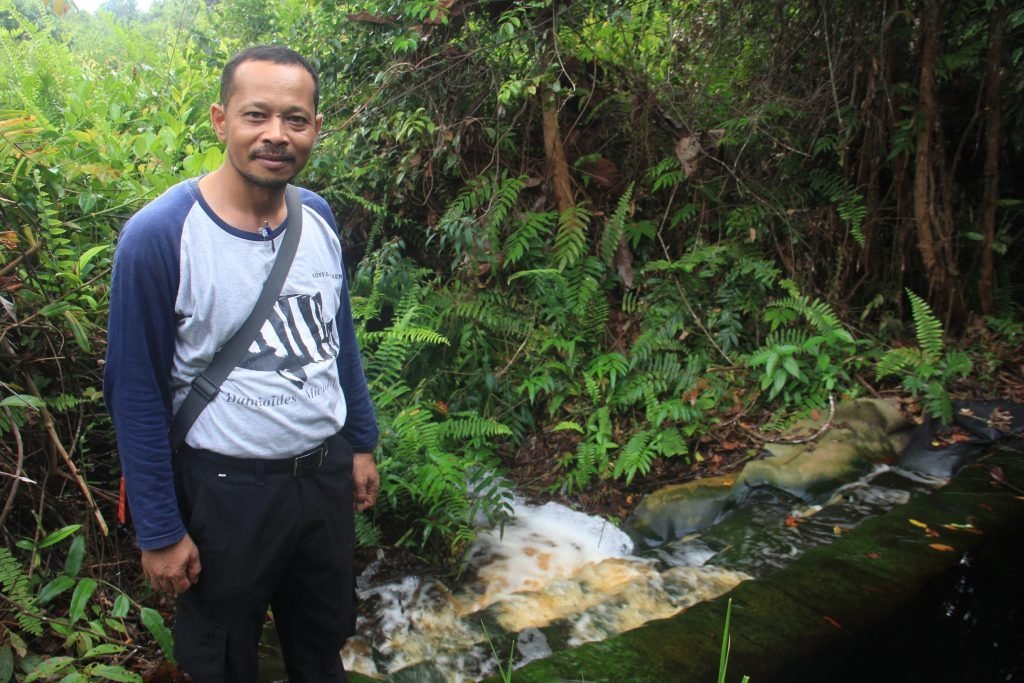
Ronyi 1 — APRIL Asia

Ronyi Las Silaen, Pengawas Perlindungan Hutan, di sebuah kanal yang dibendung di daerah Sangar di wilayah Restorasi Ekosistem Riau. Butuh empat orang dan dua hari untuk menempatkan 80 karung pasir dengan berat antara 25 dan 30kg untuk membangun ketinggian yang sesuai.

Memastikan bahwa ketinggian air berada pada tingkat di mana tanah gambut tetap lembab adalah bagian penting dari pengelolaan kesehatan lahan gambut dan ekosistem mereka yang beragam. Ketinggian air bervariasi dengan curah hujan musiman dan aliran air tanah. Ketika terlalu rendah, tanah gambut menjadi lebih kering dan rentan terhadap api yang dinyalakan secara ilegal untuk membersihkan lahan dengan membakar. Hal itu juga meningkatkan emisi karbon.

“Inilah mengapa penutupan kanal tua sangat penting untuk memulihkan fluktuasi alami dari permukaan air tanah, dan menjaga hutan yang sehat,” Pak Ronyi.

Sejak menerima lisensi pertamanya untuk memulihkan daerah tersebut pada tahun 2013, Restorasi Ekosistem Riau telah mengidentifikasi 36 kanal tua dengan total panjang 116 km. Kanal selebar satu hingga sembilan meter, dan beberapa sedalam 1,5 meter. Kanal-kanal ini didirikan pada tahun 1980 oleh para penebang yang akan menggunakan kanal untuk mengangkut kayu yang mereka tebang dari hutan sekitarnya.

“Pekerjaan yang dilakukan oleh tim Ronyi adalah bagian dari tujuan kami untuk mengembalikan hidrologi hutan gambut dan mengelola perubahan permukaan air fluktuasi musiman yang hampir alami,” kata Brad Sanders, Wakil Kepala Konservasi Restorasi Ekosistem Riau.

“Dengan mengembalikan permukaan air, penurunan dapat diminimalkan, kebakaran lebih mudah dicegah, dan emisi karbon potensial dari gambut yang kering atau terbakar akan berkurang.”

Beberapa kanal tua digunakan sebagai petunjuk oleh nelayan yang menggunakan sungai atau sebagai cara lain untuk memasuki hutan. Jadi, pemulihan dikelola secara hati-hati mempertimbangkan dengan kepentingan masyarakat setempat.

Tujuan tim Ronyi adalah menaikkan level air agar mencapai 40cm, untuk memperlambat atau menghentikan aliran air guna mempertahankan kelembaban gambut yang lebih lama selama musim kemarau. Di daerah Sangar, para jagawana telah membendung kanal sepanjang tiga meter dengan teras-teras, sesuai dengan kemiringan tanah yang dilalui kanal.

“Butuh empat orang dan dua hari untuk menempatkan 80 karung pasir, dengan berat masing-masing antara 25kg dan 30kg, untuk membangun ketinggian yang diinginkan,” kata Ronyi.

Ronyi menjelaskan bahwa jumlah karung pasir yang diperlukan bergantung pada lebar dan kedalaman kanal, dan dapat berkisar dari 80 hingga 300 kantong untuk satu bendungan.

“Hanya butuh beberapa hari jika akses ke kanal melalui jalan darat. Namun bisa memakan waktu beberapa minggu jika kanal terletak lebih dalam di hutan, karena karung pasir perlu ditempatkan pada kapal berkapasitas kecil, sekitar 20-25 kantong untuk sekali jalan, dan kemudian diangkut sejauh 50 km dari Sungai Serkap ke kanal-kanal yang berada di dalam hutan. ”

Bendungan kantong pasir adalah yang pertama dibangun di ujung bawah, atau mulut kanal, di mana ia berpotongan dengan sungai alami dan mengalirkan air dari hutan. Di sinilah ‘tekanan kepala’ atau berat air terbesar mendorong bendungan. Karung pasir terbuat dari bahan tenunan polypropilena berdaya tarik tinggi, yang dikenal sebagai Geo-Reinfox, yang tahan terhadap sinar UV.

Pada hulu, atau di lokasi sepanjang gradien kanal yang berada pada perubahan ketinggian pada 40cm dari bendungan pertama, bendungan kedua dibangun dari material daur ulang yang kuat dan padat, seperti pipa aluminium dan bagian dari felt conveyor belt bekas yang digunakan berasal dari fasilitas manufaktur pabrik kertas APRIL. Perasaan sintetis memiliki porositas yang sangat rendah dan telah mencapai akhir masa manfaatnya sehingga tidak menyebabkan kerusakan lingkungan.

“Sekali setahun, Ronyi dan timnya akan memantau status bendungan dan, jika perlu, memperbaiki atau menambahkan kantung pasir,” kata Sanders. Sejauh ini, sembilan kanal telah ditutup, dengan total panjang 29 km dengan menggunakan 25 bendungan buatan tangan.

svg+xml;charset=utf — APRIL Asia
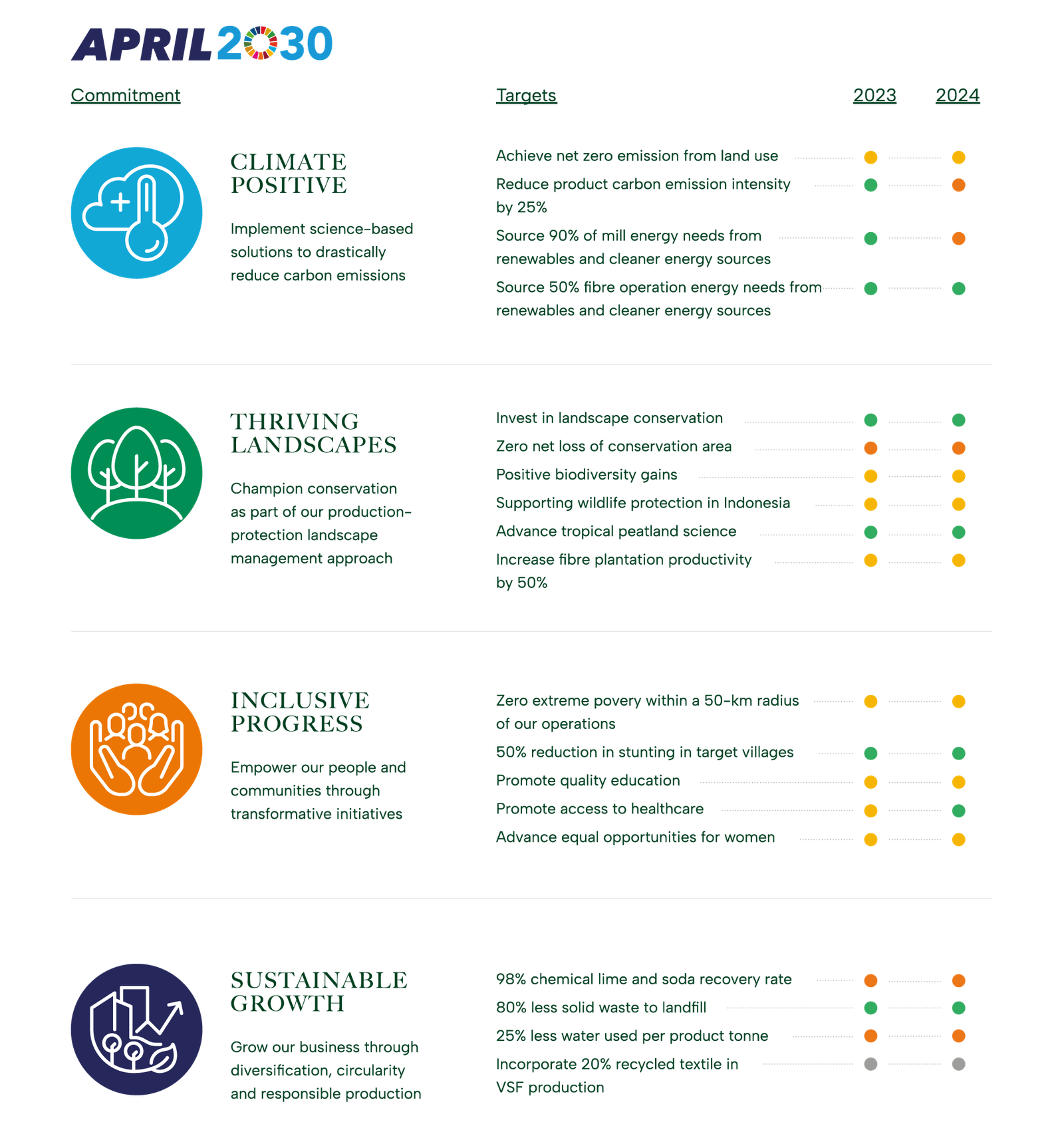
sustainable growth — APRIL Asia

Method

Waste disposed is recorded through various means of measurement including estimation of weight by waste type. Particular waste types as described above are measured as a wet waste and converted to a bone dry (BD) weight. The wet waste weight is multiplied by the consistency of each waste type to determine the BD. The consistency is predetermined by the lab.

Baseline
71kg/T

Performance 2022

On Track

sustainable growth — APRIL Asia

Method

The DPTW utilisation rate and % of textile waste per tonne of product will be based on R&D lab/pilot/demo procedures.

Baseline
0%

Performance 2022

In Development

sustainable growth — APRIL Asia

Method

Water consumption per tonne of product is calculated based on water consumed in the production of saleable pulp, paper, viscose staple fiber and viscose yarn measured by flow meters, via calculation and water balances divided by the production figures for saleable pulp, paper, viscose staple fibre and viscose yarn.

Baseline
28 m3/T

Performance 2022

Not Progressing

sustainable growth — APRIL Asia

Method

Soda content within the liquor cycle and losses are determined by means of mass balance based on daily lab analysis.

Lime volume in the lime kiln and losses are determined by means of lime make-up.

The recovery rate is calculated net of the percentage of make-up amounts added. The annual figure is based on the average monthly recovery rate.

Baseline
96%

Performance 2022

Not Progressing

inclusive progress — APRIL Asia

Method

Number of Mill and Nursery contractor calculated based on Man Power data which grouped by gender level calculated as a monthly average.

Baseline
2571

inclusive progress — APRIL Asia

Method

The number of own and supply partners employees is calculated based on year-end Man Power data which is grouped by gender. The identification of leadership position refer to employees’ grade D2 or Manager level and above.

Baseline
55 women employees in leadership positions

Performance 2022

Progressing

inclusive progress — APRIL Asia

Method

Women’s effective participation is identified from the participation list for each program. Percentage of female participation is calculated by the number of women participating divided by the total participants.

Baseline
34%

Performance 2022

Progressing

inclusive progress — APRIL Asia

Method

In development

Baseline
In development

Performance 2022

Progressing

inclusive progress — APRIL Asia

Method

In development

Baseline
In development

Performance 2022

Progressing

inclusive progress — APRIL Asia

Method

In development

Baseline
In development

Performance 2022

Progressing

inclusive progress — APRIL Asia

Method

We engaged third party to conduct assessment in APRIL-supported schools using the framework that was developed by Research Triangle Institute (RTI) and USAID.

Baseline
In development

Performance 2022

Progressing

inclusive progress — APRIL Asia

Method

Poverty mapping is identified through:

  1. Desktop analysis using National Statistics, Village Potential Statistics, SMERU Poverty Map.
  2. On-the-ground verification through FGD, village transect walk, interview with community.

Baseline
3%

Performance 2022

Progressing

thriving landscapes — APRIL Asia

Method

Peer-reviewed scientific journal publication standards

Baseline
1

Performance 2022

On Track

thriving landscapes — APRIL Asia

Method

Documentation of Participation (presentation of papers or posters) in national and international dialogues, workshops and conferences

Baseline
6

Performance 2022

On Track

thriving landscapes — APRIL Asia

Method

Number of scientists from universities and research institutions that have collaborated with APRIL on peatland management during the calendar year

Baseline
9

Performance 2022

On Track

thriving landscapes — APRIL Asia

Method

Wood deliveries (excluding open market supply) to the mill are used as a basis to calculate MAI (Tonnes/ Ha/Yr). The MAI is based on the 3 year area weighted rolling average growth for all closed compartments.

Baseline
20T/ha/yr

Performance 2022

On Track

thriving landscapes — APRIL Asia

Method

Methodology to be developed specific to animal species and does not include plants. Qualifying initiatives may vary widely in nature but must have the animal protection as the primary objective.

Partnerships will be developed and documented in line with an overarching strategy prioritizing stakeholders and threats specific to the country of Indonesia assessed.

Performance 2022

Progressing

thriving landscapes — APRIL Asia

Method

May include various initiatives relating to conservation of RTE species to be defined in a priority list, initiatives may be conducted solely or in collaboration with other stakeholders.

Baseline
2

thriving landscapes — APRIL Asia

Method

Methodology to be developed to measure change in ecosystem services and values over time (carbon sequestration, water provision, resource provision including fish and honey)

Baseline
not yet developed

thriving landscapes — APRIL Asia

Method

Reports for reforestation of previously encroached and degraded area including all areas where assisted natural regeneration, planting or enrichment planting of species that improve habitat value have taken place during the year but excludes natural regeneration.

Baseline
275 ha

Performance 2022

Progressing

thriving landscapes — APRIL Asia

Method

Area within conservation is derived from land bank which is based on land cover analysis and is updated annually to capture any boundary changes, land use changes or measurement data.

Baseline
0 ha Net loss

Performance 2022

Not Progressing

thriving landscapes — APRIL Asia

Method

Landscape conservation funding includes restoration and conservation costs associated with the RER as well as the allocation of a proportion of the costs related to APRIL’s maintenance of conservation values under its production-protection model. The allocation is based on proportionate amount of each cost that is related to conservation and restoration.

The wood volume is based on wood delivered to the Mill.

Baseline
USD$0.7 per tonne of plantation fiber

Performance 2022

On Track

climate positive 1 — APRIL Asia

Method

Mill

Calculate from the records of fuel types used the amount consumed in boilers to generate power, heat and steam including energy use for mobile & including transportation. Each of the fuel types are converted to energy expressed by Giga Joule Lower Heating Value (GJ LHV) following the IPCC guidelines.

Baseline: 87%

Performance 2022

On Track

Forest Operations

Calculate from the records of fuel types the quantity consumed by major categories of forest management activities by Fiber operations.

This covers energy used for Forest operations, infrastructure including wood transport from estate to mill; When a blend of fuel types is used (such as B20) the contribution to renewable and cleaner energy targets is calculated separately for each fuel rather than considering the blend as a cleaner fuel type.

Baseline: 19%

Performance 2022

Progressing

climate positive 1 — APRIL Asia

Method

APRIL follows the international GHG protocol as developed by WRI/WBCSD to develop its emissions profile. The total emissions measured as emissions intensity is calculated based on tonnes of Scope 1 and 2 Mill Greenhouse Gas Emissions per tonne of product (paper, pulp and viscose). The emissions boundary scope covers gate-to-gate (wood processing in wood yard until pulp, paper and viscose production) of the three main GHGs: CO2, CH4, and N2O.

Baseline
0.55 tCO2e/product tonne

Performance 2022

On Track

climate positive 1 — APRIL Asia

Method

To quantify the total GHG emission and removals across APRIL’s land bank from land use, APRIL follows the GHG Protocol Agricultural Guidance and IPCC Guidelines for Agricultural, Forestry, and Other Land Use. To detect the land cover change within the look-back period, i.e. 20 years APRIL utilized the remotely sensed data.

The GHG emission will be calculated as the total of carbon stock changes in woody biomass and soil organic carbon and include all major carbon fluxes such as peat decomposition, plantation growth and harvesting, and fires.

To quantify the amount of carbon unit to balance the emission, the Verified Carbon Standard (VCS), the Climate, Community and Biodiversity Standards (CCB), or other internationally accepted standard will be used.

Performance 2022

Progressing

This site is registered on wpml.org as a development site. Switch to a production site key to remove this banner.