
Berikut ini merupakan pembaruan dari pernyataan yang telah diterbitkan pada 15 Agustus 2018 dan termasuk informasi tambahan dalam menanggapi laporan media dan pertanyaan dari para pemangku kepentingan.

Operasional Grup APRIL  mengacu kepada Sustainable Forest Management Policy 2.0 (SFMP 2.0) yang diluncurkan pada bulan Juni 2015. Kebijakan ini merupakan komitmen APRIL untuk tidak melakukan deforestasi, melakukan pengelolaan lahan gambut yang bertanggung jawab, konservasi dan restorasi, melakukan pemberdayaan dan keterlibatan masyarakat serta verifikasi dan transparansi.

APRIL memegang teguh komitmen tersebut dan kemajuan implementasi – termasuk tantangan kami – yang terus diverifikasi secara independen dan dilaporkan secara terbuka.

Seluruh pasokan fiber ke pabrik perusahaan mengacu kepada SFMP 2.0, termasuk pasokan dari Pasar Terbuka PT Fajar Surya Swadaya (PT FSS). Kebijakan ini diterapkan melalui sosialisasi, proses uji tuntas  internal, pemantauan kepatuhan termasuk pengawasan perubahan tutupan lahan secara internal melalui data satelit dan verifikasi independen oleh KPMG PRI Kanada dibawah naungan Komite Penasihat Pemangku Kepentingan (SAC) APRIL. Kerangka audit KPMG menggabungkan seluruh input dari dua forum pemangku kepentingan dan konsultasi publik, serta dari Kriteria dan Indikator yang diterbitkan oleh para LSM.

Dalam laporan audit terbaru KPMG PRI, memastikan komitmen bahwa tidak ada deforestasi di APRIL (“0” deforestation) dan komitmen untuk tidak adanya penggunaan kayu campuran (mix hardwood) terus dipastikan. Laporan tersebut juga mencatat perubahan yang signifikan untuk memastikan transparansi dalam rantai pasokan APRIL serta kemampuannya untuk mengakses data pemasok ditahun tersebut. Hal ini termasuk data pemasok dari Pasar Terbuka yang menjadi fokus area bagi perusahaan dan SAC.

Pasokan Kayu PT FSS

Menanggapi laporan yang dirujuk,APRIL Group menegaskan bahwa PT Fajar Surya Swadaya (PT FSS) adalah Pemasok Pasar Terbuka kayu perkebunan kepada perusahaan sejak Juni 2017 dan telah mengikuti proses uji tuntas internal.

Kami menekankan bahwa APRIL tidak membeli dan menggunakan kayu hasil hutan alam dari pemasok Pasar Terbuka ataupun pemasok lainnya.

Dari uji tuntas tersebut kami mengetahui bahwa PT FSS telah menunjuk Tropenbos International untuk melakukan penilaian High Conservation Value (HCV) di daerah konsesi mereka pada APRIL 2015. Berdasarkan hal tersebut, pengembangan perkebunan dilakukan di wilayah non-HCV. Informasi ini telah disampaikan kepada penulis Laporan.

Proses uji tuntas mewajibkan konfirmasi komitmen APRIL untuk memastikan hak-hak masyarakat terpenuhi. Ini termasuk kepastian prosedur operasi standar (SOP) dalam menyelesaikan konflik lahan; tersediannya mekanisme pengaduan eksternal; program pencegahan kebakaran yang memadai serta program-program pengembangan masyarakat.

Kapasitas Produksi

Klaim yang mengatakan bahwa APRIL/RGE telah melakukan “ekspansi yang besar di Indonesia” adalah tidak benar. Pembangunan pabrik rayon viscose oleh Asia Pacific Rayon merupakan bisnis hilir diversifikasi strategi RGE, mengikuti pergantian strategi pertumbuhan dari volume ke nilai. Hal ini telah dikonfirmasi oleh penulis laporan LSM tersebut dalam dua email yang menjelaskan pertanyaan yang diajukan pada 13 Juni dan 16 Juli 2018. Dalam pergantian ini, kami telah mengonfimasi bahwa:

Kapasitas Produksi

Total kapasitas produksi pulp masih 2,8 juta ton. Tidak ada tambahan kapasitas bubur kertas yang dipasang di kompleks pabrik Kerinci. Produksi pulp di seluruh jenis produk ditentukan secara berkala berdasarkan kebutuhan pasar.

 Mengacu pada data jaminan terbaru, total konsumsi serat perkebunan APRIL adalah 10.182.550 ton pada tahun 2016 dan 10.413.540 ton pada tahun 2017. Serat bersumber dari konsesi yang dimiliki PT RAPP (33%), Mitra Pemasok (38%) dan Pemasok Pasar Terbuka (29%). Daftar pemasok tersedia di Dasbor Keberlanjutan APRIL, termasuk peta konsesi mereka. Di luar daftar ini, saat ini APRIL tidak memiliki keterlibatan dalam/dengan konsesi HTI lainnya di Indonesia. Sebagaimana dicatat sebelumnya, Asia Pacific Rayon (APR), pabrik rayon viscose terintegrasi, adalah Grup Bisnis terpisah di bawah RGE dan terletak di kompleks Pangkalan Kerinci APRIL. Dengan kapasitas produksi sebesar 250.000 ton viscose rayon per tahun, disolving pulp APR akan dipasok oleh APRIL. Produksi APR akan dimulai sekitar akhir 2018. Kami juga mencatat bahwa tidak ada tax holiday yang telah diberikan kepada APR. ”

Komitmen terhadap Proses FSC

APRIL telah melakukan dialog dengan Forest Stewardship Council sejak awal 2016 mengenai proses APRIL untuk mengakhiri disasosiasi. Pada bulan Desember 2017, FSC melakukan evaluasi ulang terhadap kesiapan APRIL, yang dipresentasikan dan dikonfirmasi oleh Dewan Direksi FSC. Pada 2018, FSC terus melakukan dialog konstruktif dengan APRIL dan para pemangku kepentingan yang tertarik untuk mengembangkan langkah-langkah guna mengakhiri disasosiasi. Bagian dari proses ini adalah penilaian awal untuk menginformasikan langkah, yang akan dilakukan oleh tim ahli independen yang ditunjuk oleh FSC. Sementara itu, APRIL terus fokus pada penyampaian komitmen SFMP 2.0 dan inisiatif kesiapan internal untuk memperkuat kepatuhan dengan standar FSC yang relevan.

APRIL tetap membuka diri terhadap umpan balik dari para pemangku kepentingan mengenai tindakan yang dapat kami ambil untuk memperjelas dan memperkuat penerapan kebijakan keberlanjutan kita. Seperti yang telah secara konsisten ditawarkan dalam tanggapan email kami untuk permintaan informasi dari Koalisi LSM (Auriga), kami terus mendorong dialog yang membangun dengan mereka dan para pemangku kepentingan lainnya yang berminat.

APRIL telah menyampaikan kepada PT FSS untuk klarifikasi lebih lanjut bila diperlukan. Kami tetap terbuka terhadap pertanyaan atau kekhawatiran apa pun tentang kepatuhan pemasok kami terhadap komitmen kebijakan perusahaan.

APRIL Group menegaskan tidak ada kemitraan dengan PT Silva Rimba Lestari dan tidak pernah menerima pasokan kayu dari perusahaan tersebut.

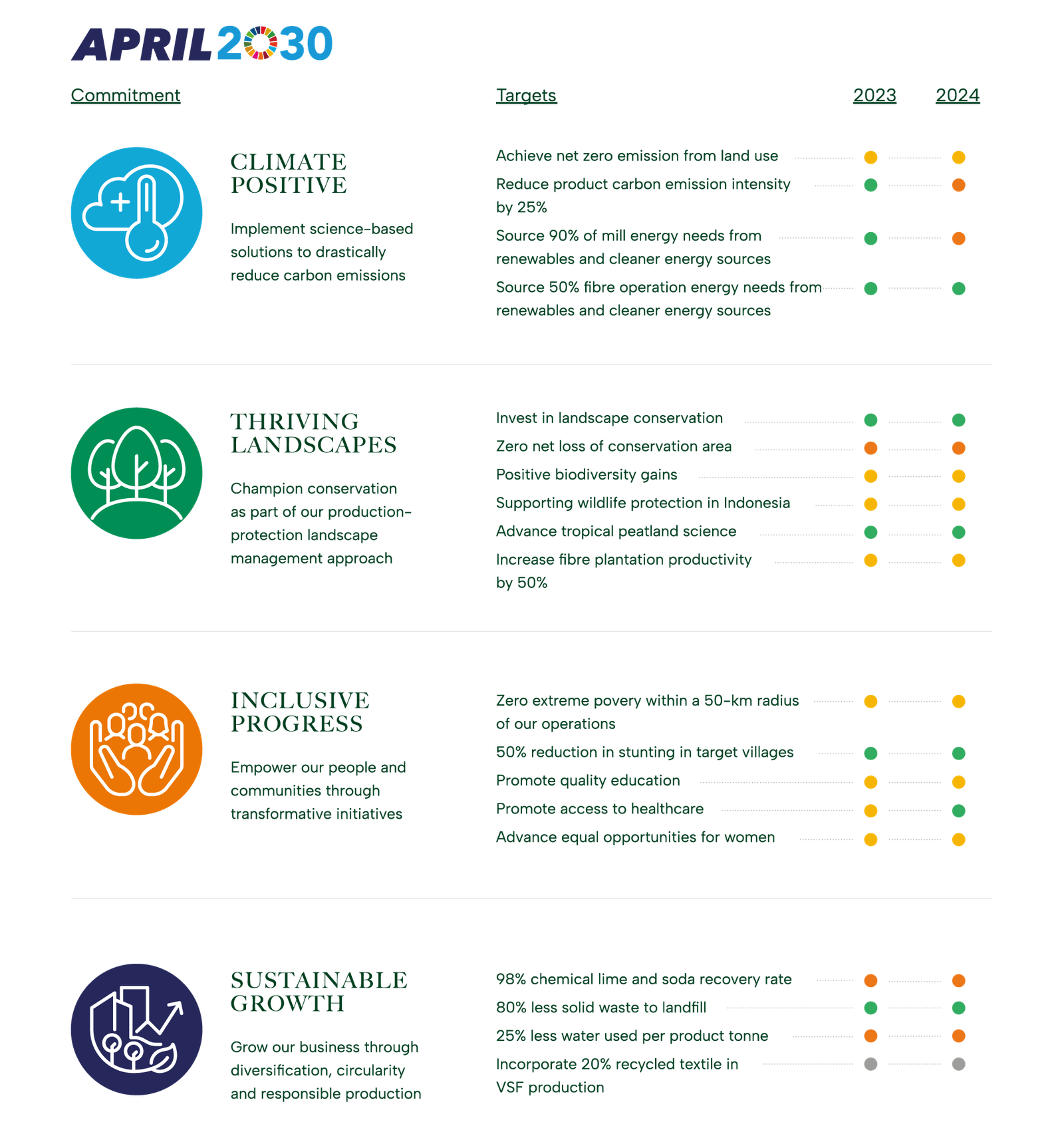
svg+xml;charset=utf — APRIL Asia
sustainable growth — APRIL Asia

Method

Waste disposed is recorded through various means of measurement including estimation of weight by waste type. Particular waste types as described above are measured as a wet waste and converted to a bone dry (BD) weight. The wet waste weight is multiplied by the consistency of each waste type to determine the BD. The consistency is predetermined by the lab.

Baseline
71kg/T

Performance 2022

On Track

sustainable growth — APRIL Asia

Method

The DPTW utilisation rate and % of textile waste per tonne of product will be based on R&D lab/pilot/demo procedures.

Baseline
0%

Performance 2022

In Development

sustainable growth — APRIL Asia

Method

Water consumption per tonne of product is calculated based on water consumed in the production of saleable pulp, paper, viscose staple fiber and viscose yarn measured by flow meters, via calculation and water balances divided by the production figures for saleable pulp, paper, viscose staple fibre and viscose yarn.

Baseline
28 m3/T

Performance 2022

Not Progressing

sustainable growth — APRIL Asia

Method

Soda content within the liquor cycle and losses are determined by means of mass balance based on daily lab analysis.

Lime volume in the lime kiln and losses are determined by means of lime make-up.

The recovery rate is calculated net of the percentage of make-up amounts added. The annual figure is based on the average monthly recovery rate.

Baseline
96%

Performance 2022

Not Progressing

inclusive progress — APRIL Asia

Method

Number of Mill and Nursery contractor calculated based on Man Power data which grouped by gender level calculated as a monthly average.

Baseline
2571

inclusive progress — APRIL Asia

Method

The number of own and supply partners employees is calculated based on year-end Man Power data which is grouped by gender. The identification of leadership position refer to employees’ grade D2 or Manager level and above.

Baseline
55 women employees in leadership positions

Performance 2022

Progressing

inclusive progress — APRIL Asia

Method

Women’s effective participation is identified from the participation list for each program. Percentage of female participation is calculated by the number of women participating divided by the total participants.

Baseline
34%

Performance 2022

Progressing

inclusive progress — APRIL Asia

Method

In development

Baseline
In development

Performance 2022

Progressing

inclusive progress — APRIL Asia

Method

In development

Baseline
In development

Performance 2022

Progressing

inclusive progress — APRIL Asia

Method

In development

Baseline
In development

Performance 2022

Progressing

inclusive progress — APRIL Asia

Method

We engaged third party to conduct assessment in APRIL-supported schools using the framework that was developed by Research Triangle Institute (RTI) and USAID.

Baseline
In development

Performance 2022

Progressing

inclusive progress — APRIL Asia

Method

Poverty mapping is identified through:

  1. Desktop analysis using National Statistics, Village Potential Statistics, SMERU Poverty Map.
  2. On-the-ground verification through FGD, village transect walk, interview with community.

Baseline
3%

Performance 2022

Progressing

thriving landscapes — APRIL Asia

Method

Peer-reviewed scientific journal publication standards

Baseline
1

Performance 2022

On Track

thriving landscapes — APRIL Asia

Method

Documentation of Participation (presentation of papers or posters) in national and international dialogues, workshops and conferences

Baseline
6

Performance 2022

On Track

thriving landscapes — APRIL Asia

Method

Number of scientists from universities and research institutions that have collaborated with APRIL on peatland management during the calendar year

Baseline
9

Performance 2022

On Track

thriving landscapes — APRIL Asia

Method

Wood deliveries (excluding open market supply) to the mill are used as a basis to calculate MAI (Tonnes/ Ha/Yr). The MAI is based on the 3 year area weighted rolling average growth for all closed compartments.

Baseline
20T/ha/yr

Performance 2022

On Track

thriving landscapes — APRIL Asia

Method

Methodology to be developed specific to animal species and does not include plants. Qualifying initiatives may vary widely in nature but must have the animal protection as the primary objective.

Partnerships will be developed and documented in line with an overarching strategy prioritizing stakeholders and threats specific to the country of Indonesia assessed.

Performance 2022

Progressing

thriving landscapes — APRIL Asia

Method

May include various initiatives relating to conservation of RTE species to be defined in a priority list, initiatives may be conducted solely or in collaboration with other stakeholders.

Baseline
2

thriving landscapes — APRIL Asia

Method

Methodology to be developed to measure change in ecosystem services and values over time (carbon sequestration, water provision, resource provision including fish and honey)

Baseline
not yet developed

thriving landscapes — APRIL Asia

Method

Reports for reforestation of previously encroached and degraded area including all areas where assisted natural regeneration, planting or enrichment planting of species that improve habitat value have taken place during the year but excludes natural regeneration.

Baseline
275 ha

Performance 2022

Progressing

thriving landscapes — APRIL Asia

Method

Area within conservation is derived from land bank which is based on land cover analysis and is updated annually to capture any boundary changes, land use changes or measurement data.

Baseline
0 ha Net loss

Performance 2022

Not Progressing

thriving landscapes — APRIL Asia

Method

Landscape conservation funding includes restoration and conservation costs associated with the RER as well as the allocation of a proportion of the costs related to APRIL’s maintenance of conservation values under its production-protection model. The allocation is based on proportionate amount of each cost that is related to conservation and restoration.

The wood volume is based on wood delivered to the Mill.

Baseline
USD$0.7 per tonne of plantation fiber

Performance 2022

On Track

climate positive 1 — APRIL Asia

Method

Mill

Calculate from the records of fuel types used the amount consumed in boilers to generate power, heat and steam including energy use for mobile & including transportation. Each of the fuel types are converted to energy expressed by Giga Joule Lower Heating Value (GJ LHV) following the IPCC guidelines.

Baseline: 87%

Performance 2022

On Track

Forest Operations

Calculate from the records of fuel types the quantity consumed by major categories of forest management activities by Fiber operations.

This covers energy used for Forest operations, infrastructure including wood transport from estate to mill; When a blend of fuel types is used (such as B20) the contribution to renewable and cleaner energy targets is calculated separately for each fuel rather than considering the blend as a cleaner fuel type.

Baseline: 19%

Performance 2022

Progressing

climate positive 1 — APRIL Asia

Method

APRIL follows the international GHG protocol as developed by WRI/WBCSD to develop its emissions profile. The total emissions measured as emissions intensity is calculated based on tonnes of Scope 1 and 2 Mill Greenhouse Gas Emissions per tonne of product (paper, pulp and viscose). The emissions boundary scope covers gate-to-gate (wood processing in wood yard until pulp, paper and viscose production) of the three main GHGs: CO2, CH4, and N2O.

Baseline
0.55 tCO2e/product tonne

Performance 2022

On Track

climate positive 1 — APRIL Asia

Method

To quantify the total GHG emission and removals across APRIL’s land bank from land use, APRIL follows the GHG Protocol Agricultural Guidance and IPCC Guidelines for Agricultural, Forestry, and Other Land Use. To detect the land cover change within the look-back period, i.e. 20 years APRIL utilized the remotely sensed data.

The GHG emission will be calculated as the total of carbon stock changes in woody biomass and soil organic carbon and include all major carbon fluxes such as peat decomposition, plantation growth and harvesting, and fires.

To quantify the amount of carbon unit to balance the emission, the Verified Carbon Standard (VCS), the Climate, Community and Biodiversity Standards (CCB), or other internationally accepted standard will be used.

Performance 2022

Progressing

This site is registered on wpml.org as a development site. Switch to a production site key to remove this banner.