
The Environmental Paper Network (EPN) dan organisasi non-pemerintah lainnya merilis laporan berjudul “Pulping Borneo” dan mengadakan konferensi pers pada tanggal 23 Mei 2023.

Laporan tersebut mencatat berbagai pernyataan dan klaim tentang APRIL, dimana sebelumlaporan dipublikasikan APRIL telah menjawab pertanyaan dari EPN. APRIL memberikan fakta dan bukti yang lengkap dan jelas dalam tanggapan yang kami kirimkan, menunjukkan bahwa klaim terkait APRIL dalam laporan tersebut tidak berdasar.

Sebagai perusahaan yang senantiasa memberikan upaya terbaik dalam pengelolaan hutan lestari serta memajukan konservasi dan pemulihan hutan di Indonesia, APRIL Group memastikan praktik tanpa deforestasi dalam rantai pasokan sesuai dengan komitmen yang tertuang dalam Kebijakan Pengelolaan Hutan Berkelanjutan (SFMP 2.0).

Kami percaya bahwa dalam menerapkan kebijakan tersebut, kami harus melibatkan pihak pemasok serat dan membangun kemampuan mereka demi mematuhi komitmen sukarela tersebut. Sebagai bagian dari upaya untuk terus membangun kepercayaan dengan pemangku kepentingan, kami melakukan pengawasan mandiri terhadap penerapan kebijakan yang dilengkapi dengan verifikasi pihak ketiga setiap tahunnya.

Sejak dimulai pada 2014, seluruh laporan audit dapat diakses oleh masyarakat umum dimana di dalam laporan tersebut, ruang lingkup serta kewenangan auditor yang terlibat telah dibuat jelas yang dikhususkan untuk APRIL dan pemasoknya.

Kami menyadari bahwa penerapan komitmen adalah sebuah proses yang berkesinambungan dan kami hargai masukan yang kritis serta konstruktif dari para pemangku kepentingan.

Laporan EPN mencakup dugaan deforestasi dalam rantai pasokan serat APRIL yang mengacu pada klaim sebelumnya yang telah diselidiki dan ditanggapi oleh oleh APRIL sebelumnya.

Kami tetap teguh dengan pernyataan kami sebelumnya dan mengambil kesempatan ini untuk mempertegasnya kembali, sekaligus memberikan jaminan kepada pemangku kepentingan kami bahwa klaim dalam laporan EPN tersebut tidak benar.

Komitmen Tanpa Deforestasi
APRIL berpegang teguh pada komitmen Tanpa Deforestasi, yang kami buat di tahun 2015, dan menegaskan bahwa tekad tersebut berlaku di seluruh area kegiatan kami, termasuk pemasok serat perusahaan.

Kami telah mengumumkan kepada publik bahwa diversifikasi di sektor hilir berupa produk kertas kemasan di wilayah operasional kami di Pangkalan Kerinci, Provinsi Riau, sepenuhnya sejalan dengan komitmen SFMP 2.0 dan APRIL2030 yang diumumkan pada November 2020, serta patuh terhadap hukum dan perundang-undangan yang berlaku.

Pasokan serat untuk memenuhi kebutuhan produksi saat ini dan masa yang akan datang sepenuhnya berasal dari Hutan Tanaman Industri yang telah tersedia, sesuai dengan SFMP 2.0, dan tidak memerlukan atau memicu konversi hutan baru.

Pemasok serat perusahaan APRIL juga diwajibkan untuk mengikuti standar uji tuntas serta pemantauan kepatuhan, dan mendapatkan jaminan terverikasi dari pihak ketiga.

Selama dalam masa kontrak dengan perusahaan, pemasok pihak ketiga APRIL juga terus dimonitor dan dipastikan kepatuhannya terhadap kebijakan dan prosedur kami. Para pemasok juga wajib memperoleh jaminan yang diperbaharui secara tiap tahunnya dari pihak ketiga yang independen untuk mengukur tingkat kepatuhan mereka terhadap SFMP 2.0; termasuk identifikasi dan pelaporan kebakaran. Daftar pemasok dan peta konsesi tersedia untuk publik di Dashboard Keberlanjutan APRIL.

Untuk pemasok serat jangka panjang, perusahaan menetapkan target peningkatan produktivitas Hutan Tanaman Industri sebesar 50% pada 2030. Selama tiga tahun terakhir, kami telah mencatat produktivitas yang lebih tinggi dari lahan yang sama hingga 29% yield serat. Sebagai hasil dari komitmen kami terhadap penelitian dan pengembangan, lebih dari 60% dari total perkebunan kami sekarang berada di titik atas rentang produktivitas. Perbaikan dalam proses produksi konversi kayu kami telah berhasil mengurangi serat yang dibutuhkan per ton produksi bubur kertas hingga 10%.

Pertumbuhan kami didasarkan atas proses intensifikasi berkelanjutan, optimalisasi lahan, dan penerapan teknik silvikultur. Di sisi produksi, efisiensi dihasilkan dari integrasi vertikal operasi pabrik dengan hutan tanaman industri serta penelitian dan pengembangan bahan baku alternatif.

PT Adindo Hutan Lestari dan PT Fajar Surya Swadaya
Laporan EPN mengulangi klaim sebelumnya terkait dua pemasok, PT Adindo Hutani Lestari dan PT Fajar Surya Swadaya. Kami tetap berpegang pada tanggapan yang telah kami sampaikan kepada EPN dan pemangku kepentingan, yang dirangkum di sini.

  • PT. Adindo Hutani Lestari (PT. AHL): Pada 2020, kami memastikan, berdasarkan bukti dari analisis spasial dan verifikasi lapangan, bahwa tidak terjadi deforestasi di area yang disoroti Auriga dalam laporannya tahun 2020, dan tidak ada pelanggaran terhadap komitmen SFMP 2.0. Hal itu dijelaskan secara rinci dalam tanggapan komprehensif kami terhadap klaim Auriga.
  • PT. Fajar Surya Swadaya (PT. FSS): Kami memastikan pada 2018 bahwa perusahaan tersebut adalah pemasok pasar terbuka. Pasokan dimulai pada Juni 2017 setelah sebelumnya menjalani uji kelayakan internal. APRIL tidak membeli dan menggunakan kayu hutan alam dari pemasok tersebut. Uji kelayakan kami mencatat bahwa PT. FSS mengutus Tropenbos Internasional untuk melakukan penilaian Nilai Konservasi Tinggi terhadap konsesi mereka pada APRIL 2015. hal tersebut menjadi dasar untuk pengembangan hutan tanaman di daerah tidak bernilai konservasi tinggi pada 2016-2017. Hal ini dijelaskan lebih lanjut dalam tanggapan rinci kami kepada pemangku kepentingan.

Hak Asasi Manusia dan Masyarakat
APRIL secara teguh memegang kebijakan hak asasi manusia yang mengharuskan kami menghormati hak asasi manusia, termasuk hak masyarakat adat dan komunitas lokal. Kami beroperasi secara legal di wilayah konsesi yang diizinkan oleh Pemerintah Indonesia dan secara hormat dan adil mengelola lahan yang tumpang tindih dengan masyarakat sesuai dengan prinsip Keputusan Bebas, Didahulukan dan Diinformasikan (KBDD). APRIL secara regular dan terbuka mempublikasikan informasi seputar klaim lahan dan kemajuan dalam penyelesaian klaim lahan dan sengketa masyarakat lainnya.

Proses Remedy FSC
Kami akan bekerja sama dengan FSC dan pemangku kepentingan dalam pengembangan dan penerapan rencana perbaikan perusahaan, mengikuti FSC Remedy Framework, dan akan terus melanjutkan proses disasosiasi.

Kami mengundang pemangku kepentingan untuk memeriksa halaman kasus APRIL di laman FSC untuk mendapatkan keterangan lebih lanjut, namun untuk saat ini, kami dapat menyampaikan bahwa sebagai tanggapan atas penerbitan surat pengakuan terkait kerusakan APRIL Group kepada FSC, Mr. Kim Carstensen, Managing Director FSC, menyatakan “menyambut baik pengakuan atas kerusakan lingkungan dan sosial yang dilakukan APRIL Group serta komitmennya secara penuh dan tulus dalam upaya remedy.”

Selanjutnya, pada Desember 2020, FSC menerbitkan analisis dasar, yang mengakui bahwa langkah nyata telah diambil oleh APRIL untuk menerapkan nilai sosial dan lingkungan, yang sesuai, serta praktik bisnis lebih bertanggung jawab, menunjukkan transparansi, dan langkah untuk meningkatkan keterlibatan pemangku kepentingan.

Kami akan memperbarui informasi kepada para pemangku terkait perkembangan proses ini. Kami menyambut semua masukan dan dengan senang hati menjawab pertanyaan lebih lanjut dari pemangku kepentingan.

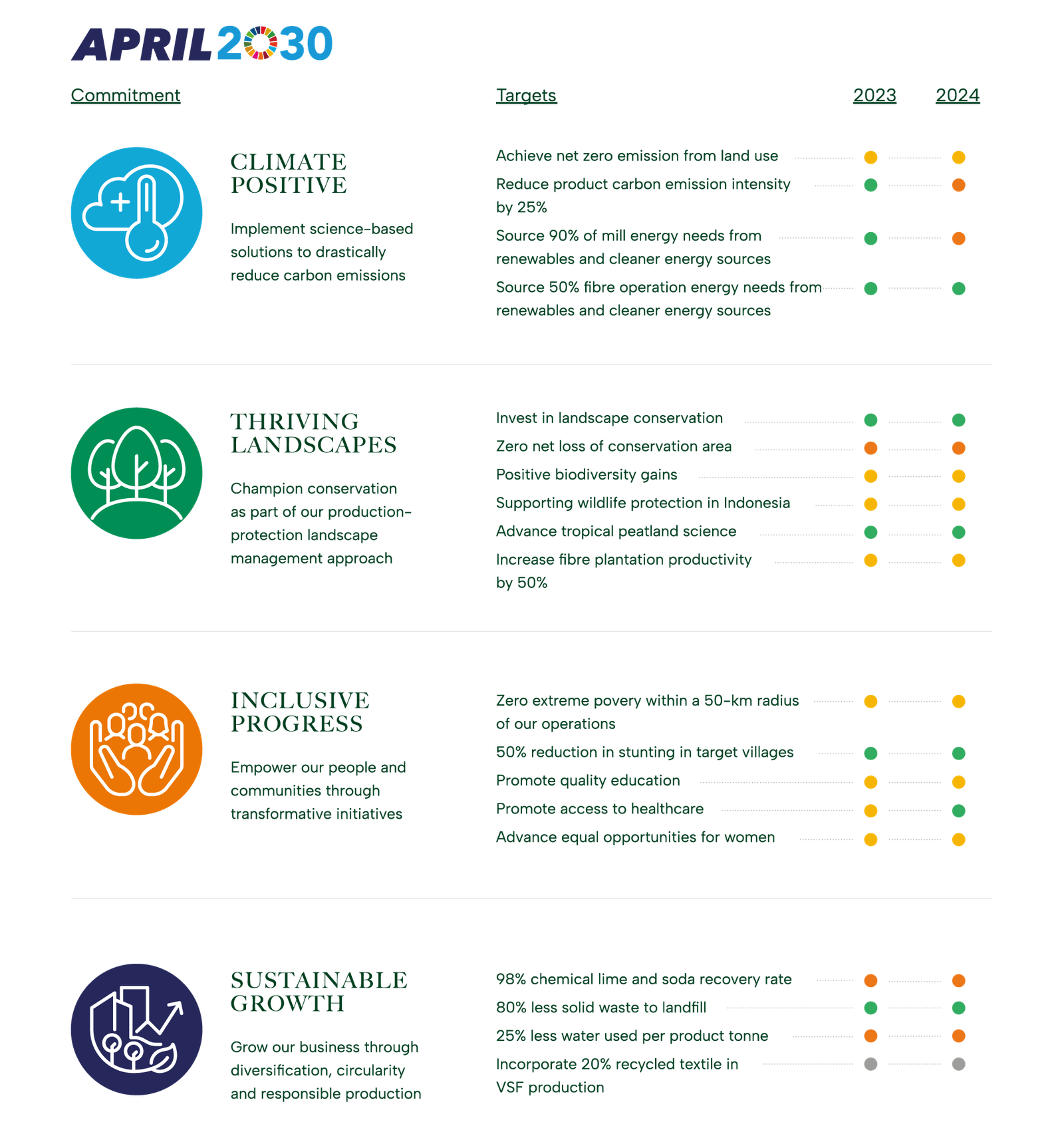
svg+xml;charset=utf — APRIL Asia
sustainable growth — APRIL Asia

Method

Waste disposed is recorded through various means of measurement including estimation of weight by waste type. Particular waste types as described above are measured as a wet waste and converted to a bone dry (BD) weight. The wet waste weight is multiplied by the consistency of each waste type to determine the BD. The consistency is predetermined by the lab.

Baseline
71kg/T

Performance 2022

On Track

sustainable growth — APRIL Asia

Method

The DPTW utilisation rate and % of textile waste per tonne of product will be based on R&D lab/pilot/demo procedures.

Baseline
0%

Performance 2022

In Development

sustainable growth — APRIL Asia

Method

Water consumption per tonne of product is calculated based on water consumed in the production of saleable pulp, paper, viscose staple fiber and viscose yarn measured by flow meters, via calculation and water balances divided by the production figures for saleable pulp, paper, viscose staple fibre and viscose yarn.

Baseline
28 m3/T

Performance 2022

Not Progressing

sustainable growth — APRIL Asia

Method

Soda content within the liquor cycle and losses are determined by means of mass balance based on daily lab analysis.

Lime volume in the lime kiln and losses are determined by means of lime make-up.

The recovery rate is calculated net of the percentage of make-up amounts added. The annual figure is based on the average monthly recovery rate.

Baseline
96%

Performance 2022

Not Progressing

inclusive progress — APRIL Asia

Method

Number of Mill and Nursery contractor calculated based on Man Power data which grouped by gender level calculated as a monthly average.

Baseline
2571

inclusive progress — APRIL Asia

Method

The number of own and supply partners employees is calculated based on year-end Man Power data which is grouped by gender. The identification of leadership position refer to employees’ grade D2 or Manager level and above.

Baseline
55 women employees in leadership positions

Performance 2022

Progressing

inclusive progress — APRIL Asia

Method

Women’s effective participation is identified from the participation list for each program. Percentage of female participation is calculated by the number of women participating divided by the total participants.

Baseline
34%

Performance 2022

Progressing

inclusive progress — APRIL Asia

Method

In development

Baseline
In development

Performance 2022

Progressing

inclusive progress — APRIL Asia

Method

In development

Baseline
In development

Performance 2022

Progressing

inclusive progress — APRIL Asia

Method

In development

Baseline
In development

Performance 2022

Progressing

inclusive progress — APRIL Asia

Method

We engaged third party to conduct assessment in APRIL-supported schools using the framework that was developed by Research Triangle Institute (RTI) and USAID.

Baseline
In development

Performance 2022

Progressing

inclusive progress — APRIL Asia

Method

Poverty mapping is identified through:

  1. Desktop analysis using National Statistics, Village Potential Statistics, SMERU Poverty Map.
  2. On-the-ground verification through FGD, village transect walk, interview with community.

Baseline
3%

Performance 2022

Progressing

thriving landscapes — APRIL Asia

Method

Peer-reviewed scientific journal publication standards

Baseline
1

Performance 2022

On Track

thriving landscapes — APRIL Asia

Method

Documentation of Participation (presentation of papers or posters) in national and international dialogues, workshops and conferences

Baseline
6

Performance 2022

On Track

thriving landscapes — APRIL Asia

Method

Number of scientists from universities and research institutions that have collaborated with APRIL on peatland management during the calendar year

Baseline
9

Performance 2022

On Track

thriving landscapes — APRIL Asia

Method

Wood deliveries (excluding open market supply) to the mill are used as a basis to calculate MAI (Tonnes/ Ha/Yr). The MAI is based on the 3 year area weighted rolling average growth for all closed compartments.

Baseline
20T/ha/yr

Performance 2022

On Track

thriving landscapes — APRIL Asia

Method

Methodology to be developed specific to animal species and does not include plants. Qualifying initiatives may vary widely in nature but must have the animal protection as the primary objective.

Partnerships will be developed and documented in line with an overarching strategy prioritizing stakeholders and threats specific to the country of Indonesia assessed.

Performance 2022

Progressing

thriving landscapes — APRIL Asia

Method

May include various initiatives relating to conservation of RTE species to be defined in a priority list, initiatives may be conducted solely or in collaboration with other stakeholders.

Baseline
2

thriving landscapes — APRIL Asia

Method

Methodology to be developed to measure change in ecosystem services and values over time (carbon sequestration, water provision, resource provision including fish and honey)

Baseline
not yet developed

thriving landscapes — APRIL Asia

Method

Reports for reforestation of previously encroached and degraded area including all areas where assisted natural regeneration, planting or enrichment planting of species that improve habitat value have taken place during the year but excludes natural regeneration.

Baseline
275 ha

Performance 2022

Progressing

thriving landscapes — APRIL Asia

Method

Area within conservation is derived from land bank which is based on land cover analysis and is updated annually to capture any boundary changes, land use changes or measurement data.

Baseline
0 ha Net loss

Performance 2022

Not Progressing

thriving landscapes — APRIL Asia

Method

Landscape conservation funding includes restoration and conservation costs associated with the RER as well as the allocation of a proportion of the costs related to APRIL’s maintenance of conservation values under its production-protection model. The allocation is based on proportionate amount of each cost that is related to conservation and restoration.

The wood volume is based on wood delivered to the Mill.

Baseline
USD$0.7 per tonne of plantation fiber

Performance 2022

On Track

climate positive 1 — APRIL Asia

Method

Mill

Calculate from the records of fuel types used the amount consumed in boilers to generate power, heat and steam including energy use for mobile & including transportation. Each of the fuel types are converted to energy expressed by Giga Joule Lower Heating Value (GJ LHV) following the IPCC guidelines.

Baseline: 87%

Performance 2022

On Track

Forest Operations

Calculate from the records of fuel types the quantity consumed by major categories of forest management activities by Fiber operations.

This covers energy used for Forest operations, infrastructure including wood transport from estate to mill; When a blend of fuel types is used (such as B20) the contribution to renewable and cleaner energy targets is calculated separately for each fuel rather than considering the blend as a cleaner fuel type.

Baseline: 19%

Performance 2022

Progressing

climate positive 1 — APRIL Asia

Method

APRIL follows the international GHG protocol as developed by WRI/WBCSD to develop its emissions profile. The total emissions measured as emissions intensity is calculated based on tonnes of Scope 1 and 2 Mill Greenhouse Gas Emissions per tonne of product (paper, pulp and viscose). The emissions boundary scope covers gate-to-gate (wood processing in wood yard until pulp, paper and viscose production) of the three main GHGs: CO2, CH4, and N2O.

Baseline
0.55 tCO2e/product tonne

Performance 2022

On Track

climate positive 1 — APRIL Asia

Method

To quantify the total GHG emission and removals across APRIL’s land bank from land use, APRIL follows the GHG Protocol Agricultural Guidance and IPCC Guidelines for Agricultural, Forestry, and Other Land Use. To detect the land cover change within the look-back period, i.e. 20 years APRIL utilized the remotely sensed data.

The GHG emission will be calculated as the total of carbon stock changes in woody biomass and soil organic carbon and include all major carbon fluxes such as peat decomposition, plantation growth and harvesting, and fires.

To quantify the amount of carbon unit to balance the emission, the Verified Carbon Standard (VCS), the Climate, Community and Biodiversity Standards (CCB), or other internationally accepted standard will be used.

Performance 2022

Progressing

This site is registered on wpml.org as a development site. Switch to a production site key to remove this banner.