
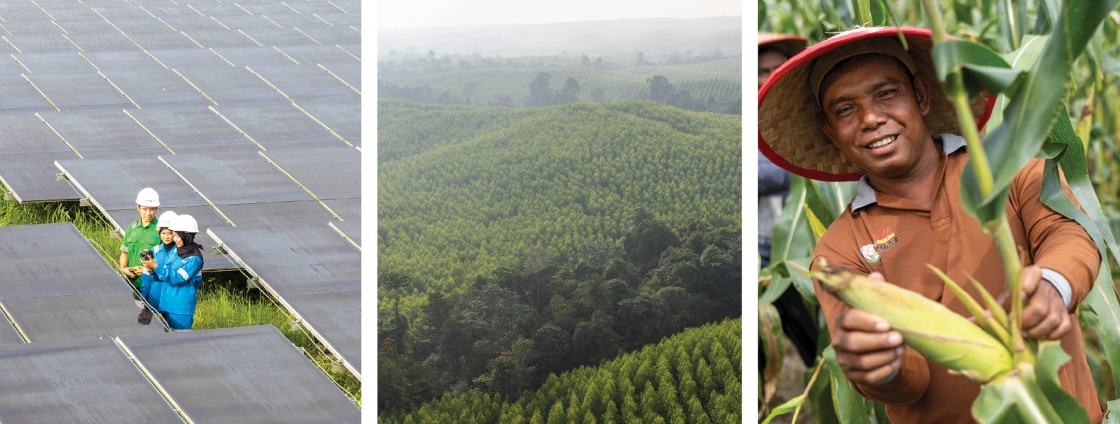
- APRIL’s 2025 Sustainability Report tracks progress towards the company’s APRIL2030 sustainability targets.
- Highlights include a 38% reduction in land-use-change emissions since 2019, US$14.8 million invested in conservation, and expansion of solar power capacity.
- Community initiatives continued to support poverty alleviation, stunting reduction, and sustainable livelihoods in villages surrounding APRIL’s operations.
2025 marked the mid-point of our APRIL2030 agenda and an opportunity to take stock of how far we’ve come towards our sustainability goals and the work that lies ahead.
APRIL’s annual Sustainability Report provides a transparent overview of progress against our APRIL2030 commitments, highlighting measurable outcomes across climate action, conservation, renewable energy, circularity and community development.
Here are ten sustainability highlights from APRIL’s progress in 2025:
- Land-use-change emissions fell by 38% since 2019
APRIL’s land-use-change emissions across its Sumatra operations stood at 3.0 MtCO₂e in 2025, down from 4.8 MtCO₂e in 2019. This represents a 38% reduction over six years and marks continued progress towards APRIL’s goal of achieving net-zero land-use emissions by 2030.
- Mill energy intensity improved by 6 % in two years.
The energy intensity of APRIL’s mill operations fell from 25.21 GJ per air-dried tonne in 2023 to 23.71 GJ per air-dried tonne in 2025, a 6% improvement. This progress reflects continued investment in operational efficiency and technology upgrades to improve mill performance.
- Solar capacity at the mill increased by 135%.
APRIL’s installed solar capacity at the mill increased from 16.8 MWp in 2023 to 39.4 MWp by the end of 2025, a 135% increase over two years. APRIL reached its original 2030 solar capacity target six years ahead of schedule and has since doubled its target to scale up renewable energy in APRIL’s decarbonisation efforts while supporting contributing to Indonesia’s clean energy transition.
- Renewable and clean energy use in fibre operations doubled.
APRIL increased the share of renewable and cleaner energy in its Sumatra fibre operations to 38% in 2025. This progress was supported by the transition from B30 to B40 biodiesel and the expansion of solar power across fibre estate offices. Solar capacity at fibre estate offices grown from zero in 2023 to 2 MWp in 2025. Installed solar capacity grew to 2 MWp in 2025 following the installation of six solar systems at estate offices. APRIL also plans to expand solar generation to 32 estate locations by 2030.
- Producing more fibre from the same land footprint.
APRIL increased fibre plantation productivity while maintaining the same land footprint. Mean Annual Increment, which measures how much fibre can be harvested from one hectare of plantation, increased from 20.3 tonnes per hectare in 2019 to 23.1 tonnes per hectare in 2025, a 13.8% improvement. This progress reflects continued investments in plantation management and silviculture, including drone monitoring and tissue culture for plant breeding.
- US$14.8 million invested into conservation initiatives.
APRIL allocated US$14.8 million to conservation initiatives in 2025 through its US$1 per tonne conservation funding mechanism, which sets aside US$1 for every tonne of plantation wood delivered to the mill in the previous year. The funding supports long-term conservation initiatives, including Restorasi Ekosistem Riau, an approximately 150,000-hectare conservation area, as well as community and NGO-led projects. The 2025 allocation brings APRIL’s total landscape conservation investment to US$75 million since 2020.
- Industrial by-products converted into plantation fertilizer.
APRIL is converting industrial by-products, zinc sludge and fly ash into fertilisers, helping reduce waste sent to landfill while supporting plantation productivity. Field trials have shown a 10% reduction in zinc sludge sent to landfill.
- Expanding support to help families move out of extreme poverty.
APRIL expanded its intervention programmes to 445 households across 77 villages in 2025, using a by-name-by-address approach to tailor support to each family’s needs, including livelihood training, mentoring and regular evaluations. By the end of 2025, 113 participating households had reported stable annual incomes above the extreme poverty line.
- Supporting 114 local villages in reaching child stunting rates below 14%.
APRIL continued to support the government-led stunting reduction efforts through supplementary food, nutrition education and community health initiatives. In 2025, the programme reached more than 15,000 children and 1,650 pregnant women across 138 villages in Riau Province. Across the programme area, 114 villages (79%) had child stunting rates below 14% by the end of 2025, reflecting encouraging progress towards APRIL’s target of supporting a reduction in child stunting rates from the 2019 baseline of 28%.
- Strengthening sustainable livelihoods through agribusiness.
APRIL supported 51 farmer groups through its sustainable agribusiness programme, providing training, farming tools, seedlings, fertiliser, production support and market access to help improve productivity and strengthen local livelihoods. In 2025, participating farmer groups generated IDR 1.1 billion in gross revenue, demonstrating the programme’s contribution to building sustainable, income-generating opportunities for rural communities.
For further details on APRIL’s sustainability and community development initiatives, read the 2025 Sustainability Report.
