
Cari

Tony Sebastian is not one to shy away from challenges. He seeks them out. In his more than 30-year career as a wildlife ecologist and conservation planning specialist, he has built a reputation for being outspoken yet pragmatic, has displayed a willingness to confront entrenched opinion, and is strongly driven to achieve meaningful environmental outcomes.

From restoring the crane habitat in Iran’s Southern Caspian region, writing the wetland restoration guidelines for China, to his present work with APRIL’s team of ecologists to restore and nurture the ecologically-rich Kampar Peninsula as an adviser to Restorasi Ekosistem Riau (RER), he commits to a dogged determination to deliver once he sets his sights on a goal. “Purpose is about willpower to do it,” he says.

His belief matches APRIL’s ambition for the 150,000-ha RER project. “Landscape scale restoration is highly ambitious and expensive. Governments struggle with restoration on their own. The task is simply too big. There is no doubt partnerships are required for restoration”. He adds: “The UN’s Sustainable Development Goals clearly recognise the need for a system where businesses and communities can flourish at the same time as protecting priceless species and ecosystems. I really don’t think there is any other way”.

Sebastian 2017 Portrait 2 medres 1 — APRIL Asia

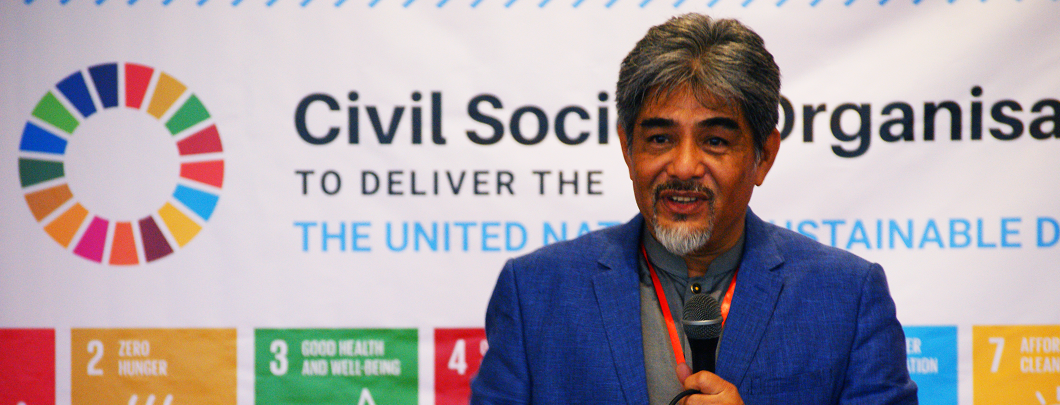
Tony Sebastian, Conservation Planning Specialist

“Not anyone can do it. Big companies are the ones with the resources to manage land at this scale. What is needed is to give these companies the incentives to do so. APRIL’s expressed commitments demonstrate this necessary determination, and resonate with my own objectives and principles.”

His fascination with the environment began at a young age when his biologist father gifted him a pair of binoculars. “Dad gave me a guidebook too, and by the time I was 12 years old, I had seen most of the birds in my area using those binoculars,” Tony recalls.

“We lived in a town called Marudi, along the Baram River, not far from Borneo’s Gunung Mulu National Park. The giant rainforest was at my doorstep. Deer entered our backyard, snakes slithered into our bedrooms, and owls flew into our kitchen. It was never a dull moment,” he adds.

By the time he entered school, he had made up his mind to work with birds and forests.

His fascination with birds saw him studying the white-bellied eagle, providing the material for his dissertation. In a career defining moment, he would join the Malaysian Nature Society (MNS) while a student, eventually becoming its President 20 years later.

Established in 1940, the MNS is Malaysia’s largest and oldest nature society. As President, he would lead the society’s charge for the preservation and management of Malaysia’s single largest forested landscape, prompting public scrutiny and eventual government action. His leadership generated media attention and established his reputation as one of Malaysia’s most outspoken advocates for conservation. “During my time in this role, I learnt that making an impact not only had to do with applying scientific knowledge, but it is about managing and inspiring people,” he says.

His work has taken him to 17 Asian and Mid-Eastern countries. Among his more memorable stints was a United Nations Environment Programme (UNEP) project in Iran between 2000 and 2004. He recalls the stunning scenery of coniferous forests and alpine meadows, from beaches to rice fields and orchards, to snow-capped peaks. Amid this varied and magnificent landscape, a huge task lay at hand – to restore the Siberian crane habitat there. Ecologists did not want this to go the way of the Caspian tiger, which was last seen in the 1960s, and officially declared extinct in 2003.

“It was a deeply sombre conservation project, because the crane was eventually lost. The world did however learn some valuable lessons about restoring habitats and saving species,” he says.

Years later, in 2007, an Asian Development Bank (ADB) project took him to northeast China’s Amur wetlands. The team was tasked to restore farmlands back to wetland. “It turned me into a bit of a wetland restoration expert,” he says, adding that he subsequently wrote the National wetland restoration guidelines for China in 2011.

By then, he had clocked in decades of rich experience and with it, a priceless global view on tackling environmental issues.

So, when APRIL invited him to be one of its advisors to the RER programme, he jumped at the opportunity to bundle up his wealth of knowledge and take it back to his home region of Southeast Asia, where it had all started. He joined the RER in 2016 as a Technical Adviser to the programme, and member of the Advisory Board.

“RER is chiefly about managing an intact forest landscape. APRIL’s explicit desire to do this is an assurance of sustainability,” he says. “When you have reached their size as a company, your obligations to the world are equally large.”

As RER’s Technical Adviser, he says that large companies should keep in mind that to be efficient and credible, you need to build your own capacity. “Through that, you are taking ownership of the project. You are building your strength, and equipping yourself with the core capability to drive the process.”

He feels that restoration is misunderstood, and there is a need to explain the idea.

“Landscape restoration will never be about replicating the forest’s original state. We need to set our objectives and work towards them. Restoration is really about re-establishing ecosystem functions, where these have been degraded or lost.”

RER is already making a significant progress, he notes. “It has taken several years, but we now have a much more comprehensive understanding of what the Kampar wetlands are. What lives in it, how it functions, and where things need fixing. This baseline is the most important thing to be done, because we cannot restore the landscape without understanding its nature and functions intimately.”

He is buoyed by progress. “Kampar is a large landscape, which makes it all the more worth restoring. With large landscapes, the positive impact is greater and the work is more efficient – you have more chance of success when you are operating at large scales.

“The clue is in the title – landscape scale restoration. We need more businesses with the resources and motivation to join this movement and help protect wide swathes of rich biodiversity, and at the same time, thrive commercially.”

svg+xml;charset=utf — APRIL Asia
sustainable growth — APRIL Asia

Method

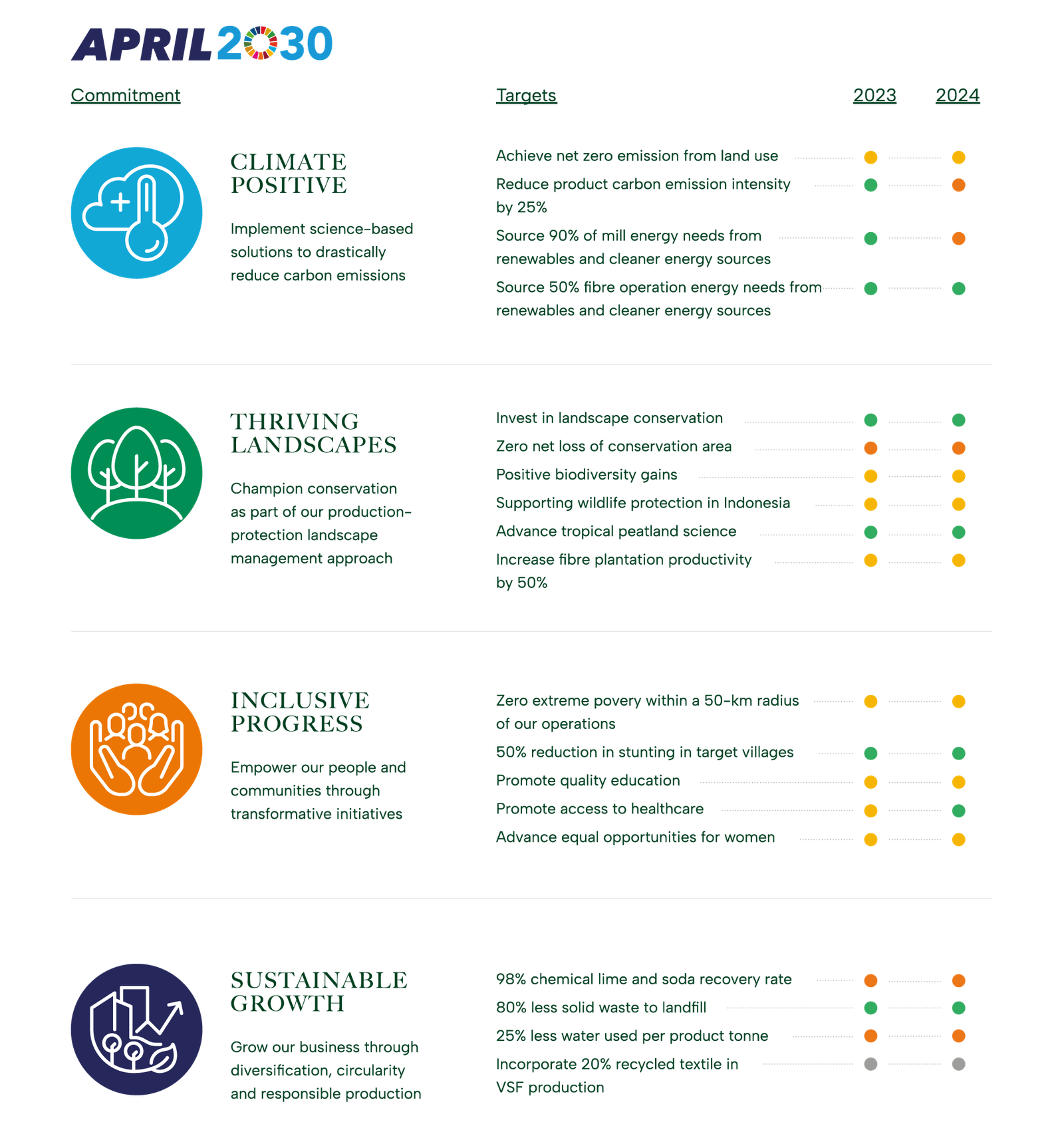
Waste disposed is recorded through various means of measurement including estimation of weight by waste type. Particular waste types as described above are measured as a wet waste and converted to a bone dry (BD) weight. The wet waste weight is multiplied by the consistency of each waste type to determine the BD. The consistency is predetermined by the lab.

Baseline
71kg/T

Performance 2022

On Track

sustainable growth — APRIL Asia

Method

The DPTW utilisation rate and % of textile waste per tonne of product will be based on R&D lab/pilot/demo procedures.

Baseline
0%

Performance 2022

In Development

sustainable growth — APRIL Asia

Method

Water consumption per tonne of product is calculated based on water consumed in the production of saleable pulp, paper, viscose staple fiber and viscose yarn measured by flow meters, via calculation and water balances divided by the production figures for saleable pulp, paper, viscose staple fibre and viscose yarn.

Baseline
28 m3/T

Performance 2022

Not Progressing

sustainable growth — APRIL Asia

Method

Soda content within the liquor cycle and losses are determined by means of mass balance based on daily lab analysis.

Lime volume in the lime kiln and losses are determined by means of lime make-up.

The recovery rate is calculated net of the percentage of make-up amounts added. The annual figure is based on the average monthly recovery rate.

Baseline
96%

Performance 2022

Not Progressing

inclusive progress — APRIL Asia

Method

Number of Mill and Nursery contractor calculated based on Man Power data which grouped by gender level calculated as a monthly average.

Baseline
2571

inclusive progress — APRIL Asia

Method

The number of own and supply partners employees is calculated based on year-end Man Power data which is grouped by gender. The identification of leadership position refer to employees’ grade D2 or Manager level and above.

Baseline
55 women employees in leadership positions

Performance 2022

Progressing

inclusive progress — APRIL Asia

Method

Women’s effective participation is identified from the participation list for each program. Percentage of female participation is calculated by the number of women participating divided by the total participants.

Baseline
34%

Performance 2022

Progressing

inclusive progress — APRIL Asia

Method

In development

Baseline
In development

Performance 2022

Progressing

inclusive progress — APRIL Asia

Method

In development

Baseline
In development

Performance 2022

Progressing

inclusive progress — APRIL Asia

Method

In development

Baseline
In development

Performance 2022

Progressing

inclusive progress — APRIL Asia

Method

We engaged third party to conduct assessment in APRIL-supported schools using the framework that was developed by Research Triangle Institute (RTI) and USAID.

Baseline
In development

Performance 2022

Progressing

inclusive progress — APRIL Asia

Method

Poverty mapping is identified through:

  1. Desktop analysis using National Statistics, Village Potential Statistics, SMERU Poverty Map.
  2. On-the-ground verification through FGD, village transect walk, interview with community.

Baseline
3%

Performance 2022

Progressing

thriving landscapes — APRIL Asia

Method

Peer-reviewed scientific journal publication standards

Baseline
1

Performance 2022

On Track

thriving landscapes — APRIL Asia

Method

Documentation of Participation (presentation of papers or posters) in national and international dialogues, workshops and conferences

Baseline
6

Performance 2022

On Track

thriving landscapes — APRIL Asia

Method

Number of scientists from universities and research institutions that have collaborated with APRIL on peatland management during the calendar year

Baseline
9

Performance 2022

On Track

thriving landscapes — APRIL Asia

Method

Wood deliveries (excluding open market supply) to the mill are used as a basis to calculate MAI (Tonnes/ Ha/Yr). The MAI is based on the 3 year area weighted rolling average growth for all closed compartments.

Baseline
20T/ha/yr

Performance 2022

On Track

thriving landscapes — APRIL Asia

Method

Methodology to be developed specific to animal species and does not include plants. Qualifying initiatives may vary widely in nature but must have the animal protection as the primary objective.

Partnerships will be developed and documented in line with an overarching strategy prioritizing stakeholders and threats specific to the country of Indonesia assessed.

Performance 2022

Progressing

thriving landscapes — APRIL Asia

Method

May include various initiatives relating to conservation of RTE species to be defined in a priority list, initiatives may be conducted solely or in collaboration with other stakeholders.

Baseline
2

thriving landscapes — APRIL Asia

Method

Methodology to be developed to measure change in ecosystem services and values over time (carbon sequestration, water provision, resource provision including fish and honey)

Baseline
not yet developed

thriving landscapes — APRIL Asia

Method

Reports for reforestation of previously encroached and degraded area including all areas where assisted natural regeneration, planting or enrichment planting of species that improve habitat value have taken place during the year but excludes natural regeneration.

Baseline
275 ha

Performance 2022

Progressing

thriving landscapes — APRIL Asia

Method

Area within conservation is derived from land bank which is based on land cover analysis and is updated annually to capture any boundary changes, land use changes or measurement data.

Baseline
0 ha Net loss

Performance 2022

Not Progressing

thriving landscapes — APRIL Asia

Method

Landscape conservation funding includes restoration and conservation costs associated with the RER as well as the allocation of a proportion of the costs related to APRIL’s maintenance of conservation values under its production-protection model. The allocation is based on proportionate amount of each cost that is related to conservation and restoration.

The wood volume is based on wood delivered to the Mill.

Baseline
USD$0.7 per tonne of plantation fiber

Performance 2022

On Track

climate positive 1 — APRIL Asia

Method

Mill

Calculate from the records of fuel types used the amount consumed in boilers to generate power, heat and steam including energy use for mobile & including transportation. Each of the fuel types are converted to energy expressed by Giga Joule Lower Heating Value (GJ LHV) following the IPCC guidelines.

Baseline: 87%

Performance 2022

On Track

Forest Operations

Calculate from the records of fuel types the quantity consumed by major categories of forest management activities by Fiber operations.

This covers energy used for Forest operations, infrastructure including wood transport from estate to mill; When a blend of fuel types is used (such as B20) the contribution to renewable and cleaner energy targets is calculated separately for each fuel rather than considering the blend as a cleaner fuel type.

Baseline: 19%

Performance 2022

Progressing

climate positive 1 — APRIL Asia

Method

APRIL follows the international GHG protocol as developed by WRI/WBCSD to develop its emissions profile. The total emissions measured as emissions intensity is calculated based on tonnes of Scope 1 and 2 Mill Greenhouse Gas Emissions per tonne of product (paper, pulp and viscose). The emissions boundary scope covers gate-to-gate (wood processing in wood yard until pulp, paper and viscose production) of the three main GHGs: CO2, CH4, and N2O.

Baseline
0.55 tCO2e/product tonne

Performance 2022

On Track

climate positive 1 — APRIL Asia

Method

To quantify the total GHG emission and removals across APRIL’s land bank from land use, APRIL follows the GHG Protocol Agricultural Guidance and IPCC Guidelines for Agricultural, Forestry, and Other Land Use. To detect the land cover change within the look-back period, i.e. 20 years APRIL utilized the remotely sensed data.

The GHG emission will be calculated as the total of carbon stock changes in woody biomass and soil organic carbon and include all major carbon fluxes such as peat decomposition, plantation growth and harvesting, and fires.

To quantify the amount of carbon unit to balance the emission, the Verified Carbon Standard (VCS), the Climate, Community and Biodiversity Standards (CCB), or other internationally accepted standard will be used.

Performance 2022

Progressing

This site is registered on wpml.org as a development site. Switch to a production site key to remove this banner.