Cari

The multi-tasking civil society leader talks about her life fighting for justice for people and the environment

Erna Witoelar is best described as a force of nature. Her energy, passion, commitment to causes, her sense of justice – all compete to be heard. Her career would have exhausted most people long ago. Activist, NGO founder, environmentalist, consumer and women’s rights campaigner, government minister, fighter for social justice, a leader on national and international stages.

Ironically, parental influence meant she was originally destined to become a chemical engineer – which she did, by completing her studies at the Bandung Institute of Technology. “But undergraduate life almost immediately steered me into activism,” she says. “I joined many groups and led anti-government demonstrations, becoming the first female chair of the students’ association. I think I knew then that my mission in life was in engendering solidarity, trying to get people to resolve conflicts, fighting for rights and equality.”

And it was her non-academic student life that spurred her subsequent multiple career in civil society. Immediately after university, Erna began work for The Indonesian Consumers Foundation, moving swiftly to its international organization.

It would be easy to assume this energy and multiplicity of interests indicated a more than forceful personality. Unusually though, while certainly assertive and articulate in her views, she refers to dealing with challenge in a different way. “I have often encountered conflict – sometimes in the form of patronage, sometimes as discrimination. When I was younger, my instinct was to respond confrontationally, but over time, I learned that friendship, persuasion and understanding are far better ways of defusing aggression and disagreement.”
IMG 20161108 0057 — APRIL Asia

Erna Witoelar speaking with young people, during her time as Minister

This was especially valuable on the world stage, her first role on which was as President of Consumers International. It was in 1983 that her sense of place as an Indonesian, her role as a leader in civil society, and environmentalism came together, with the creation of the Brundtland Commission. This was the UN’s reaction to the realization that the human environment and natural resources were in danger of severe degradation. It was the beginning of the global sustainable development movement. “This was my awakening,” she says. “I was profoundly aware of environmental issues in general because of my background, and I had access, contacts, networks and leverage so I saw it as my mission to bring Indonesian issues onto the world stage, as well as to bring the tenets of sustainable development back to Indonesia.”

“The first meeting was in Indonesia, when the then Minister asked me to gather a group of NGOs to listen to the Commission,” continues Erna. “I explained that no-one wanted to listen to a lecture. What they wanted was a voice. The voice of ordinary people. And we made that happen, exposing all sort of issues around sustainability including gender, the environment, workers’ rights, campaigners’ issues. The Commission itself was curious and then inspired because of the questions people asked. I like to think that this set the precedent for the Commission’s work all over the world which led to the publication of ‘Our Common Future’ in which the seminal term ‘sustainable development’ was coined, and which gave the underlying and still relevant definition – the kind of development that meets the needs of the present without compromising the ability of future generations to meet their own needs.”

Erna was then spurred to take a post graduate course in Human Ecology, and after a four year stint in Russia, during her husband’s tenure as Ambassador, she returned to a different political environment. In spite of being apolitical for her entire life, she became a member of the General Assembly, and when Indonesia’s 4th President, Abdurrachman Wahid took office, he asked her to take on the role of Minister of Human Settlement and Regional Development. “This had been called The Ministry of Public Works,” Erna points out. “But I wanted people at the centre of development, so I changed the name. My goal was the environment, the alleviation of poverty, and gender equality. I saw it as one job, framed by social justice, and embedded in the creation and improvement of infrastructure.”

This was indeed the only time Erna ever had just one job. Having founded a number of still vibrant NGOs – among them The Indonesian Forum for the Environment (WALHI), Friends of the Environment Fund (DML) the Indonesian Biodiversity Foundation (KEHATI), the Clean Ciliwung River Movement (GCB), the Partnership for Governance Reform Indonesia (PGRI), and the Foundation for Local Governance Initiative (YIPD) she could be forgiven for deciding to take a rest and enjoy travelling with her family or just spending time together. Predictably, she didn’t. Erna takes up the story. “In 2003, Kofi Annan asked me, through his head of The Millennium Campaign Eveline Herfkens, to become the Asia-Pacific Special Ambassador for the UN Millennium Development Goals, a role I continued until 2007. This deepened yet further my understanding of the global-local interconnectedness of sustainability.” Overlapping with this by a year (unsurprisingly), she also became a member of the UN Commission on Legal Empowerment of the Poor, until 2009.

Asked about her relatively new role as a member of APRIL’s Stakeholder Advisory Committee, she is clear that it is another departure for her. “It’s an unusual move for me,” she says. “I have never worked in a business position before, and perhaps it is risky too. But my understanding of sustainable development tells me society cannot achieve its objectives alone. It needs partnerships. The private sector has to be a large part of the solution. And the bigger a business’ legacy of damaging activity, and the bigger its footprint, the more it needs to be willing to contribute commensurately to improvement and restoration. Individuals can do their bit – recycle, consume sustainably – and governments can set frameworks. But it is in the gift of big business to make the biggest difference. And it has to think about empowering and building, and not just about charity. I am passionate about helping people work together so I thought I might be able to make a difference by plunging into an unfamiliar environment. Yes, it’s a challenge, and I hope I can make a difference.”

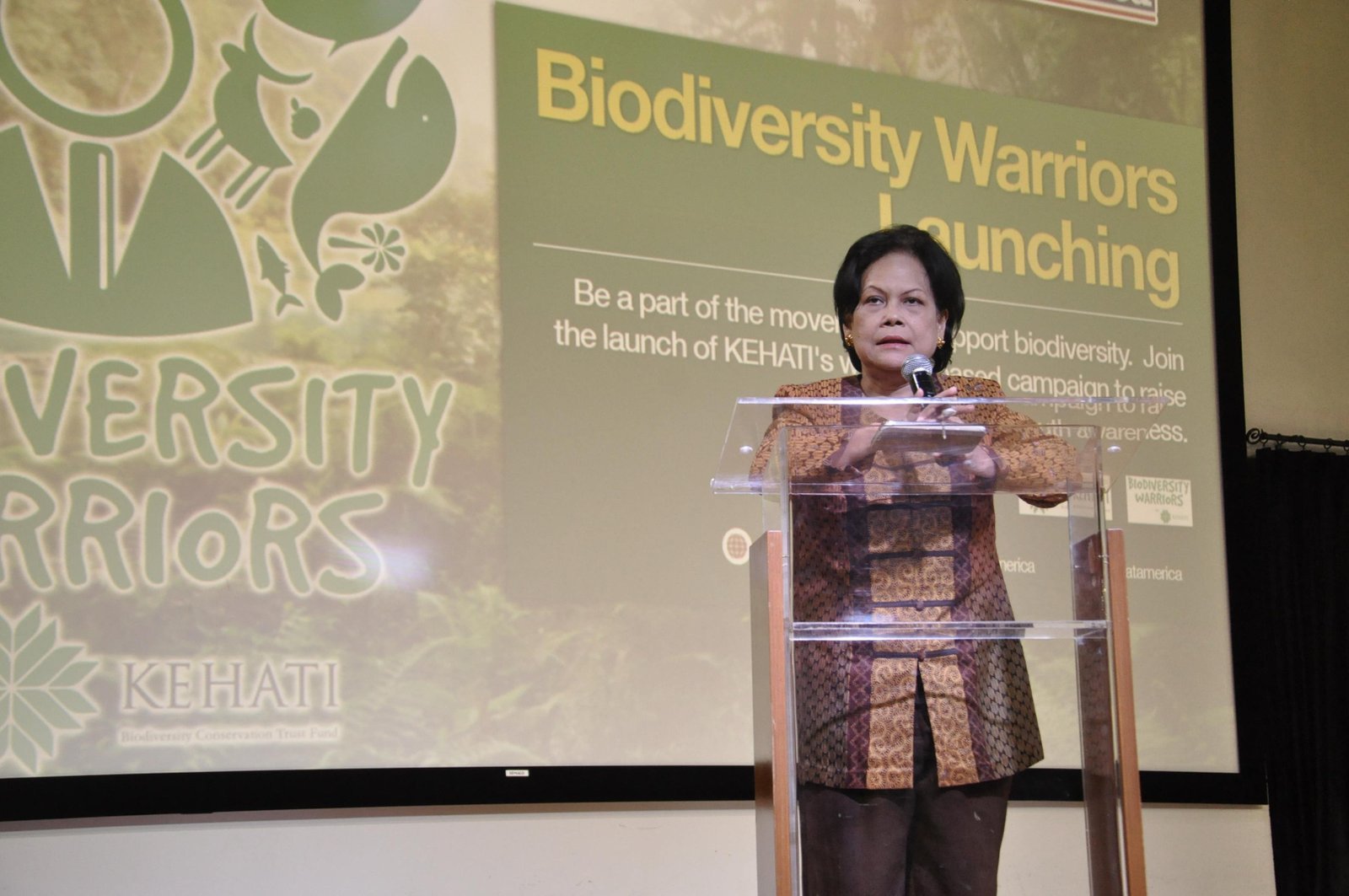
Never shy of a challenge, Erna continues to sit on several NGO boards, including chairing KEHATI and co-chairing Filantropi Indonesia. And she sees no reason to stop. “I do see hope for the future,” she remarks. “My whole life has been devoted to encouraging women and young people to take the lead. I was never happier than when my efforts to nurture this came to fruition. Now there are so many more of them taking up the challenges of the future, I believe there is good reason for hope. Our children are so much better than us. Their thinking is so completely different to previous generations. And our children’s children will carry this on. They care, they are passionate, they are articulate, they communicate, and they are increasingly influential.  Yes, I have hope.”

svg+xml;charset=utf — APRIL Asia
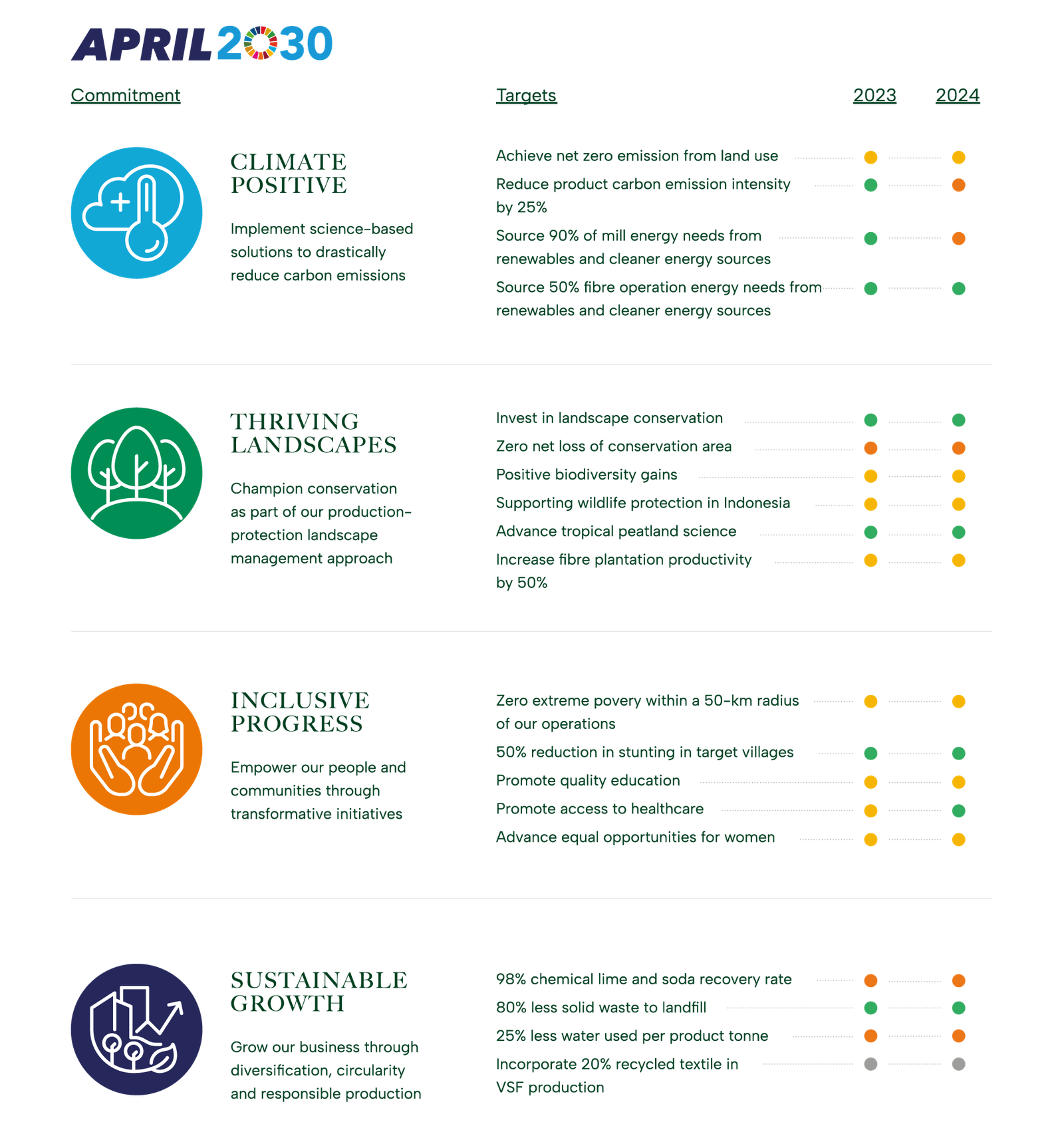
sustainable growth — APRIL Asia

Method

Waste disposed is recorded through various means of measurement including estimation of weight by waste type. Particular waste types as described above are measured as a wet waste and converted to a bone dry (BD) weight. The wet waste weight is multiplied by the consistency of each waste type to determine the BD. The consistency is predetermined by the lab.

Baseline
71kg/T

Performance 2022

On Track

sustainable growth — APRIL Asia

Method

The DPTW utilisation rate and % of textile waste per tonne of product will be based on R&D lab/pilot/demo procedures.

Baseline
0%

Performance 2022

In Development

sustainable growth — APRIL Asia

Method

Water consumption per tonne of product is calculated based on water consumed in the production of saleable pulp, paper, viscose staple fiber and viscose yarn measured by flow meters, via calculation and water balances divided by the production figures for saleable pulp, paper, viscose staple fibre and viscose yarn.

Baseline
28 m3/T

Performance 2022

Not Progressing

sustainable growth — APRIL Asia

Method

Soda content within the liquor cycle and losses are determined by means of mass balance based on daily lab analysis.

Lime volume in the lime kiln and losses are determined by means of lime make-up.

The recovery rate is calculated net of the percentage of make-up amounts added. The annual figure is based on the average monthly recovery rate.

Baseline
96%

Performance 2022

Not Progressing

inclusive progress — APRIL Asia

Method

Number of Mill and Nursery contractor calculated based on Man Power data which grouped by gender level calculated as a monthly average.

Baseline
2571

inclusive progress — APRIL Asia

Method

The number of own and supply partners employees is calculated based on year-end Man Power data which is grouped by gender. The identification of leadership position refer to employees’ grade D2 or Manager level and above.

Baseline
55 women employees in leadership positions

Performance 2022

Progressing

inclusive progress — APRIL Asia

Method

Women’s effective participation is identified from the participation list for each program. Percentage of female participation is calculated by the number of women participating divided by the total participants.

Baseline
34%

Performance 2022

Progressing

inclusive progress — APRIL Asia

Method

In development

Baseline
In development

Performance 2022

Progressing

inclusive progress — APRIL Asia

Method

In development

Baseline
In development

Performance 2022

Progressing

inclusive progress — APRIL Asia

Method

In development

Baseline
In development

Performance 2022

Progressing

inclusive progress — APRIL Asia

Method

We engaged third party to conduct assessment in APRIL-supported schools using the framework that was developed by Research Triangle Institute (RTI) and USAID.

Baseline
In development

Performance 2022

Progressing

inclusive progress — APRIL Asia

Method

Poverty mapping is identified through:

  1. Desktop analysis using National Statistics, Village Potential Statistics, SMERU Poverty Map.
  2. On-the-ground verification through FGD, village transect walk, interview with community.

Baseline
3%

Performance 2022

Progressing

thriving landscapes — APRIL Asia

Method

Peer-reviewed scientific journal publication standards

Baseline
1

Performance 2022

On Track

thriving landscapes — APRIL Asia

Method

Documentation of Participation (presentation of papers or posters) in national and international dialogues, workshops and conferences

Baseline
6

Performance 2022

On Track

thriving landscapes — APRIL Asia

Method

Number of scientists from universities and research institutions that have collaborated with APRIL on peatland management during the calendar year

Baseline
9

Performance 2022

On Track

thriving landscapes — APRIL Asia

Method

Wood deliveries (excluding open market supply) to the mill are used as a basis to calculate MAI (Tonnes/ Ha/Yr). The MAI is based on the 3 year area weighted rolling average growth for all closed compartments.

Baseline
20T/ha/yr

Performance 2022

On Track

thriving landscapes — APRIL Asia

Method

Methodology to be developed specific to animal species and does not include plants. Qualifying initiatives may vary widely in nature but must have the animal protection as the primary objective.

Partnerships will be developed and documented in line with an overarching strategy prioritizing stakeholders and threats specific to the country of Indonesia assessed.

Performance 2022

Progressing

thriving landscapes — APRIL Asia

Method

May include various initiatives relating to conservation of RTE species to be defined in a priority list, initiatives may be conducted solely or in collaboration with other stakeholders.

Baseline
2

thriving landscapes — APRIL Asia

Method

Methodology to be developed to measure change in ecosystem services and values over time (carbon sequestration, water provision, resource provision including fish and honey)

Baseline
not yet developed

thriving landscapes — APRIL Asia

Method

Reports for reforestation of previously encroached and degraded area including all areas where assisted natural regeneration, planting or enrichment planting of species that improve habitat value have taken place during the year but excludes natural regeneration.

Baseline
275 ha

Performance 2022

Progressing

thriving landscapes — APRIL Asia

Method

Area within conservation is derived from land bank which is based on land cover analysis and is updated annually to capture any boundary changes, land use changes or measurement data.

Baseline
0 ha Net loss

Performance 2022

Not Progressing

thriving landscapes — APRIL Asia

Method

Landscape conservation funding includes restoration and conservation costs associated with the RER as well as the allocation of a proportion of the costs related to APRIL’s maintenance of conservation values under its production-protection model. The allocation is based on proportionate amount of each cost that is related to conservation and restoration.

The wood volume is based on wood delivered to the Mill.

Baseline
USD$0.7 per tonne of plantation fiber

Performance 2022

On Track

climate positive 1 — APRIL Asia

Method

Mill

Calculate from the records of fuel types used the amount consumed in boilers to generate power, heat and steam including energy use for mobile & including transportation. Each of the fuel types are converted to energy expressed by Giga Joule Lower Heating Value (GJ LHV) following the IPCC guidelines.

Baseline: 87%

Performance 2022

On Track

Forest Operations

Calculate from the records of fuel types the quantity consumed by major categories of forest management activities by Fiber operations.

This covers energy used for Forest operations, infrastructure including wood transport from estate to mill; When a blend of fuel types is used (such as B20) the contribution to renewable and cleaner energy targets is calculated separately for each fuel rather than considering the blend as a cleaner fuel type.

Baseline: 19%

Performance 2022

Progressing

climate positive 1 — APRIL Asia

Method

APRIL follows the international GHG protocol as developed by WRI/WBCSD to develop its emissions profile. The total emissions measured as emissions intensity is calculated based on tonnes of Scope 1 and 2 Mill Greenhouse Gas Emissions per tonne of product (paper, pulp and viscose). The emissions boundary scope covers gate-to-gate (wood processing in wood yard until pulp, paper and viscose production) of the three main GHGs: CO2, CH4, and N2O.

Baseline
0.55 tCO2e/product tonne

Performance 2022

On Track

climate positive 1 — APRIL Asia

Method

To quantify the total GHG emission and removals across APRIL’s land bank from land use, APRIL follows the GHG Protocol Agricultural Guidance and IPCC Guidelines for Agricultural, Forestry, and Other Land Use. To detect the land cover change within the look-back period, i.e. 20 years APRIL utilized the remotely sensed data.

The GHG emission will be calculated as the total of carbon stock changes in woody biomass and soil organic carbon and include all major carbon fluxes such as peat decomposition, plantation growth and harvesting, and fires.

To quantify the amount of carbon unit to balance the emission, the Verified Carbon Standard (VCS), the Climate, Community and Biodiversity Standards (CCB), or other internationally accepted standard will be used.

Performance 2022

Progressing

This site is registered on wpml.org as a development site. Switch to a production site key to remove this banner.