
Cari

What happens when a sporting event merges with a cultural treasure that dates back hundreds of years yet is still relevant today? That is Pacu Jalur. The rowing competition is traditional to the Kuantan Singingi Regency of Riau, Indonesia.

After a two-year break due to the pandemic, this tradition, conducted along the Batang Kuantan River, returned as a sign of the distinctiveness and peace of the Riau people. Let’s dig deeper into this cultural heritage!
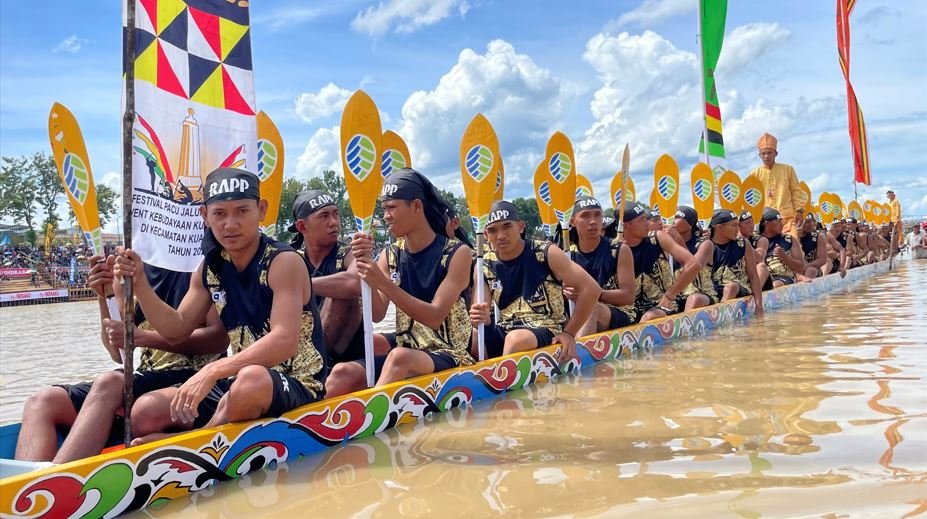
pacu jalur rapp 01 — APRIL Asia

Pacu Jalur’s History

Pacu Jalur was first established as a significant mode of transportation for residents of Rantau Kuantan, a region located near the Kuantan River, in the seventeenth century. The Kuantan River was the lifeblood of the area, and the people had little idea about land transportation. It was used for everything, from transporting goods to fishing, washing clothes, and even taking baths.

Jalur literally means “boat” in the native language of Riau. Many people used the boat to carry goods like bananas and sugar cane, due to its capacity to hold 40 to 60 passengers. Different boats emerged throughout time, each adorned with its own unique combination of decorative elements, including intricate carvings, colourful scarves, intricate rigging, and pretty accoutrements.

Over time, Jalur came to represent more than just a mode of transportation; it also became a symbol of the wealth and rank of its owners. This was because only nobles and regional authorities were allowed to ride the adorned Jalur.The boat’s exclusivity increased in proportion to the splendour of its furnishings.

It wasn’t until the 18th century that locals started holding speed competitions, which are now known as Pacu Jalur.

pacu jalur rapp 02 — APRIL Asia

The process of making Jalur

The primary component used in the construction of a Pacu Jalur boat is one of its distinguishing features. The planks used to construct the walkway all came from trees that were harvested under controlled circumstances. There are also several stages that must be reached before making a Jalur, those are:

  1. Rapek village/banjar or village meeting
    Pak Tuo, also known as a village elder, plans to organise a group to build the path. The village shaman also provides guidance at this time, telling people where to locate forests to cut wood.
  2. Looking for the right wood
    When selecting a tree to use as a Jalur, care must be taken to choose one with significant spiritual significance. Balau tree, Mersawa tree, Meranti tree, Red Balam tree, Banio tree, Kure tree, Trembesi tree, and Kruing tree are only a few of the tree species that have been used by the community as route materials.
  3. Manobang or cut down a tree
    Pak Tuo will perform a worship ritual, including the making of gifts, to beg permission from the guardian of a tree with a trunk diameter of around 45 metres and a length of between 25 and 40 meters.
  4. Chopping the wood
    After the wood has been cut, the ends are trimmed off. All areas of the raw wood that will be shaped are cleaned throughout this procedure.
  5. Measuring the wood
    At this point in the process, the hull of the boat is determined after the wood is measured with a thread. This is accomplished by smoothing off the wood’s surface from its base to its tip. The process usually takes around three days.
  6. Scrapping the wood
    Once the wood has been leveled, the next step is to dredge it to create holes of uniform thickness. This procedure usually takes three to seven days to complete.
  7. Grinding or manggaliak
    Grinding is the process of polishing the outside of the future track in order to give it a sleek, boat-like profile. Meanwhile, “manggaliak” denotes a concerted effort on the part of the community to bend the boat. After being turned upside down, the boat will have a sweeping arc from its bow to its stern.
  8. Making holes
    The boat will be drilled in order to create holes in it. The carpenter may use these holes as guides to ensure he gets an accurate measurement of the hull. The sleeve vents help keep the boat from bursting while being put in a hot environment. Later, hardwood would be used to patch up the openings.
  9. Making seats
    After the boat is a bit slim and light, the boat is stretched back to make lumps that serve as seats.
  10. Forming the bow or rudder
    After the bow has been shaped to a length of 1-1.5 meters, the rudder is made to a length of 2-2.5 meters.
  11. Maelo Jalur or drawing Jalur back to the village
    As soon as the Jalur’s bow and rudder are in place, it may be transported back to the village and declared halfway complete. Once again, numerous people will need to pull it together to complete this task. Up to five or six weeks may pass during this phase.
  12. Maelo Jalur or drawing
    When they get to the settlement, they’ll smoke the Jalur for five hours while lying flat to make it seem nicer. After much planning and discussion, the villagers finally settle on a name for the boat, which will be used for the motif that will be carved into the side of the boat.

Pacu Jalur as sustainable tourism

APRIL was pleased to provide its support to the Pacu Jalur Festival once again, ensuring that it would be an exciting occasion for everybody. This is because Pacu Jalur is an example of sustainable tourism in action in Riau.

Sustainable tourism, as defined by the United Nations’ World Tourism Organization (UNWTO), is “tourism that actually takes into consideration the economic, social, and environmental implications not only for the now but also for the future in order to fulfil the demands of tourists, industry, the environment, and the local community.”

If we examine the defining features of Pacu Jalur as a cultural practice, we’ll see that it’s more than simply a race or a test of rowing prowess. Pacu Jalur is an important part of the history and culture of the Riau people. It shows how they work together and respect nature, history, and tradition.

Wan Mohd Jakh Anza, General Manager of Stakeholder Relations at PT RAPP, said that the company strongly supports this oldest tradition in Riau: “Pacu Jalur allows us to let go of our yearning by reinvigorating the tourist business, which was hampered by the pandemic, so that it may flourish in a sustainable way. The Pacul Jalur Festival is one of Riau’s cultural heritages; hence, we are pleased to be able to promote it to tourists.”

Not only does the festival draw in visitors from all over the globe, which boosts the local economy, but it also gives people a chance to deepen their ties to their cultural heritage and pass it on to the next generation.

svg+xml;charset=utf — APRIL Asia
sustainable growth — APRIL Asia

Method

Waste disposed is recorded through various means of measurement including estimation of weight by waste type. Particular waste types as described above are measured as a wet waste and converted to a bone dry (BD) weight. The wet waste weight is multiplied by the consistency of each waste type to determine the BD. The consistency is predetermined by the lab.

Baseline
71kg/T

Performance 2022

On Track

sustainable growth — APRIL Asia

Method

The DPTW utilisation rate and % of textile waste per tonne of product will be based on R&D lab/pilot/demo procedures.

Baseline
0%

Performance 2022

In Development

sustainable growth — APRIL Asia

Method

Water consumption per tonne of product is calculated based on water consumed in the production of saleable pulp, paper, viscose staple fiber and viscose yarn measured by flow meters, via calculation and water balances divided by the production figures for saleable pulp, paper, viscose staple fibre and viscose yarn.

Baseline
28 m3/T

Performance 2022

Not Progressing

sustainable growth — APRIL Asia

Method

Soda content within the liquor cycle and losses are determined by means of mass balance based on daily lab analysis.

Lime volume in the lime kiln and losses are determined by means of lime make-up.

The recovery rate is calculated net of the percentage of make-up amounts added. The annual figure is based on the average monthly recovery rate.

Baseline
96%

Performance 2022

Not Progressing

inclusive progress — APRIL Asia

Method

Number of Mill and Nursery contractor calculated based on Man Power data which grouped by gender level calculated as a monthly average.

Baseline
2571

inclusive progress — APRIL Asia

Method

The number of own and supply partners employees is calculated based on year-end Man Power data which is grouped by gender. The identification of leadership position refer to employees’ grade D2 or Manager level and above.

Baseline
55 women employees in leadership positions

Performance 2022

Progressing

inclusive progress — APRIL Asia

Method

Women’s effective participation is identified from the participation list for each program. Percentage of female participation is calculated by the number of women participating divided by the total participants.

Baseline
34%

Performance 2022

Progressing

inclusive progress — APRIL Asia

Method

In development

Baseline
In development

Performance 2022

Progressing

inclusive progress — APRIL Asia

Method

In development

Baseline
In development

Performance 2022

Progressing

inclusive progress — APRIL Asia

Method

In development

Baseline
In development

Performance 2022

Progressing

inclusive progress — APRIL Asia

Method

We engaged third party to conduct assessment in APRIL-supported schools using the framework that was developed by Research Triangle Institute (RTI) and USAID.

Baseline
In development

Performance 2022

Progressing

inclusive progress — APRIL Asia

Method

Poverty mapping is identified through:

  1. Desktop analysis using National Statistics, Village Potential Statistics, SMERU Poverty Map.
  2. On-the-ground verification through FGD, village transect walk, interview with community.

Baseline
3%

Performance 2022

Progressing

thriving landscapes — APRIL Asia

Method

Peer-reviewed scientific journal publication standards

Baseline
1

Performance 2022

On Track

thriving landscapes — APRIL Asia

Method

Documentation of Participation (presentation of papers or posters) in national and international dialogues, workshops and conferences

Baseline
6

Performance 2022

On Track

thriving landscapes — APRIL Asia

Method

Number of scientists from universities and research institutions that have collaborated with APRIL on peatland management during the calendar year

Baseline
9

Performance 2022

On Track

thriving landscapes — APRIL Asia

Method

Wood deliveries (excluding open market supply) to the mill are used as a basis to calculate MAI (Tonnes/ Ha/Yr). The MAI is based on the 3 year area weighted rolling average growth for all closed compartments.

Baseline
20T/ha/yr

Performance 2022

On Track

thriving landscapes — APRIL Asia

Method

Methodology to be developed specific to animal species and does not include plants. Qualifying initiatives may vary widely in nature but must have the animal protection as the primary objective.

Partnerships will be developed and documented in line with an overarching strategy prioritizing stakeholders and threats specific to the country of Indonesia assessed.

Performance 2022

Progressing

thriving landscapes — APRIL Asia

Method

May include various initiatives relating to conservation of RTE species to be defined in a priority list, initiatives may be conducted solely or in collaboration with other stakeholders.

Baseline
2

thriving landscapes — APRIL Asia

Method

Methodology to be developed to measure change in ecosystem services and values over time (carbon sequestration, water provision, resource provision including fish and honey)

Baseline
not yet developed

thriving landscapes — APRIL Asia

Method

Reports for reforestation of previously encroached and degraded area including all areas where assisted natural regeneration, planting or enrichment planting of species that improve habitat value have taken place during the year but excludes natural regeneration.

Baseline
275 ha

Performance 2022

Progressing

thriving landscapes — APRIL Asia

Method

Area within conservation is derived from land bank which is based on land cover analysis and is updated annually to capture any boundary changes, land use changes or measurement data.

Baseline
0 ha Net loss

Performance 2022

Not Progressing

thriving landscapes — APRIL Asia

Method

Landscape conservation funding includes restoration and conservation costs associated with the RER as well as the allocation of a proportion of the costs related to APRIL’s maintenance of conservation values under its production-protection model. The allocation is based on proportionate amount of each cost that is related to conservation and restoration.

The wood volume is based on wood delivered to the Mill.

Baseline
USD$0.7 per tonne of plantation fiber

Performance 2022

On Track

climate positive 1 — APRIL Asia

Method

Mill

Calculate from the records of fuel types used the amount consumed in boilers to generate power, heat and steam including energy use for mobile & including transportation. Each of the fuel types are converted to energy expressed by Giga Joule Lower Heating Value (GJ LHV) following the IPCC guidelines.

Baseline: 87%

Performance 2022

On Track

Forest Operations

Calculate from the records of fuel types the quantity consumed by major categories of forest management activities by Fiber operations.

This covers energy used for Forest operations, infrastructure including wood transport from estate to mill; When a blend of fuel types is used (such as B20) the contribution to renewable and cleaner energy targets is calculated separately for each fuel rather than considering the blend as a cleaner fuel type.

Baseline: 19%

Performance 2022

Progressing

climate positive 1 — APRIL Asia

Method

APRIL follows the international GHG protocol as developed by WRI/WBCSD to develop its emissions profile. The total emissions measured as emissions intensity is calculated based on tonnes of Scope 1 and 2 Mill Greenhouse Gas Emissions per tonne of product (paper, pulp and viscose). The emissions boundary scope covers gate-to-gate (wood processing in wood yard until pulp, paper and viscose production) of the three main GHGs: CO2, CH4, and N2O.

Baseline
0.55 tCO2e/product tonne

Performance 2022

On Track

climate positive 1 — APRIL Asia

Method

To quantify the total GHG emission and removals across APRIL’s land bank from land use, APRIL follows the GHG Protocol Agricultural Guidance and IPCC Guidelines for Agricultural, Forestry, and Other Land Use. To detect the land cover change within the look-back period, i.e. 20 years APRIL utilized the remotely sensed data.

The GHG emission will be calculated as the total of carbon stock changes in woody biomass and soil organic carbon and include all major carbon fluxes such as peat decomposition, plantation growth and harvesting, and fires.

To quantify the amount of carbon unit to balance the emission, the Verified Carbon Standard (VCS), the Climate, Community and Biodiversity Standards (CCB), or other internationally accepted standard will be used.

Performance 2022

Progressing

This site is registered on wpml.org as a development site. Switch to a production site key to remove this banner.