
Cari

Established in 2014, APRIL’s Fire Free Village Programme (FFVP) stands as a cornerstone of APRIL’s Strategic Fire Management approach. This comprehensive initiative cultivates strong partnerships with local communities, actively engaging them in fire prevention and awareness initiatives. These efforts promote a deep understanding of the environmental and social consequences of fire, empowering communities to become active participants in fire prevention efforts.

The programme’s five-pronged approach encompasses incentivizing communities to avoid burning land, training community fire crew leaders, promoting sustainable agricultural alternatives, monitoring air quality, and conducting a community awareness campaign.

As of June 2023, 42 villages in five districts in Riau Provice are participating in the program, covering a total area of more than 900,000 ha.

aprils fire free village programme fostering a fire resilient community 01 — APRIL Asia

FFVP fire awareness campaign to elementary school students

A Catalyst for Change

While the programme was established in 2014, it was the 2015 fire and haze crisis that ignited the call for action and lasting change. The memory of this disaster serves as a stark reminder of the devastating consequences that occur when fires are allowed to spread unchecked.

As Indonesia faced similar dry conditions due to El Niño weather patterns this year, community leaders and those at the forefront of fire prevention emphasized that the hardships of 2015 helped to reinforce the message that using fire for land clearing can have catastrophic consequences.

“We’re ready,” said Suherpan, who as a crew leader under APRIL’s FFVP, has been working with communities to discourage residents from using fire for land clearing and waste disposal.

The Frontline Warriors

At the heart of APRIL’s FFVP lies the unwavering dedication of crew leaders like Suherpan, who has been safeguarding the forests of Teluk Meranti since 2019. These individuals form the backbone of the FFVP, tirelessly advocating for fire prevention and actively engaging with communities to build knowledge and capability. They stand on the frontline for fire suppression during the fire period.

Crew leaders are hand-picked by the village leadership and undergo extensive training by APRIL on forest and land protection, fire monitoring, and fire suppression skills. They are also equipped with knowledge on sustainable agriculture practices to help communities shift their livelihood practice from harvesting commodities such as palm oil and rubber to vegetables, chili and other food crops, aimed at developing community self-sufficiency.

aprils fire free village programme fostering a fire resilient community 02 — APRIL Asia

Agricultural assistance plot as part of Fire Free Village Programme (FFVP)

As experienced crew leaders progress in their roles, they may transition into forest protection rangers, taking on even greater responsibilities. Rangers are tasked with detecting illegal logging and wildlife trade, ensuring the comprehensive protection of our forest.

“We are banding together with the police and other agencies to prevent forest and land fires here in Riau,” Mr. Suherpan says, as APRIL announced the declaration of its annual Fire Danger Period in June 2023. During each fire period, a coordination meeting is held at the provincial, regency, and village levels bringing together government leaders, representatives from the private sector, police, armed forces, disaster management agency, frontliners, and fire brigades. This collaborative approach ensures that all stakeholders are aligned in their efforts to prevent and combat forest fires.

aprils fire free village programme fostering a fire resilient community 03 — APRIL Asia

One of FFVP Crew Leaders raising awareness to children on the risk of fire

Leaders of the Community

Elsewhere, Mr. Musa, Pelalawan village head, shares insights into the transformation brought about by the FFVP. The village spans 21,000 hectares, and its primary livelihood activities involve the cultivation of palm oil plantations and fishing. These livelihoods have historically been prone to fires due to the traditional slash-and-burn method for clearing and preparing land for planting palm and fish smoking.

Mr. Musa recalled the harrowing memories of children unable to play outside coupled with economic losses due to damaged crops in 2015. ”People were restricted from many outdoor activities. You couldn’t see very far, and breathing was difficult,” says Mr. Musa. “The damage to crops and the long wait for new ones to mature was devastating, to the point that these experiences have made people extremely cautious about starting fires, especially for land clearing,” he adds.

The commitment to FFVP was not a difficult sell to the people of Pelalawan. As a bonus, FFVP offered a reward that benefited every member of the community. The village has been successful in keeping zero fire, and they received prize money to build the infrastructure such as an administrative office and a public toilet. Today, village leaders say open and widespread use of fire in their areas is almost unthinkable. “There is a prevention mindset now, especially among the younger generation,” said Mr. Musa.

In Teluk Meranti, Mr. Tengku Said Yusmar, the village head, shares a similar sentiment. Teluk Meranti is a 16,000-hectare, riverside village surrounded by forests and is home to the famous Bono wave, a surfing attraction that draws tourists from far and wide. He said that with main livelihood on fishing and tourism, widespread use of fire to clear land was uncommon. It is close in proximity to APRIL’s Meranti estate by 3 kilometers, making it highly important to educate the community about fire prevention.

Nevertheless, the village suffered from the widespread fires in 2015. “The fire that year was frustrating,” Mr. Said recalls. “It needed three water helicopters, the National Disaster Mitigation Agency (BNPB), and the local fire brigades (MPA) as well as APRIL’s own firefighting equipment, waterbombs, helicopters, and firefighters.”

The massive fire outbreak was a stark reminder of the risks they faced, which included fires resulting from cigarette butts, cooking smoke, and new settlers’ campfires. The introduction of the FFVP prompted an increased focus on fire prevention and awareness, he says. It has empowered the community to cultivate degraded land to prevent drought fires and engage newcomers in fire prevention efforts. Mr. Said recalls a massive effort to raise awareness, including in social gatherings and announcements at Friday prayer. Teluk Meranti has successfully maintained its zero-fire status and received an FFVP infrastructure reward, which was deployed to build an access road.

aprils fire free village programme fostering a fire resilient community 04 — APRIL Asia

FFVP Crew Leader socialising to local communities on fire risk and prevention

Mr. Said is confident in the new generation’s ability to maintain a focus on zero-burning. During the Bono River Festival, usually held in November, restaurants and hotels in the area can make in a day what they would typically earn in two months, drawing in tourists and media coverage. The surge in events and activities further solidifies the community’s commitment to keeping the regency green and clean.

FFVP’s Lasting Impact

Fire incidents within the areas covered by the FFVP have been reduced by up to 90% since the program began.The programme has made a lasting impact, changing mindsets and behaviors and supporting a culture of fire prevention that continues to hold firm against the continued threat of fire. For more information on the best practices in forest fire prevention and mitigation from the FFA’s member companies, visit https://www.firefreealliance.org/case-study/

svg+xml;charset=utf — APRIL Asia
sustainable growth — APRIL Asia

Method

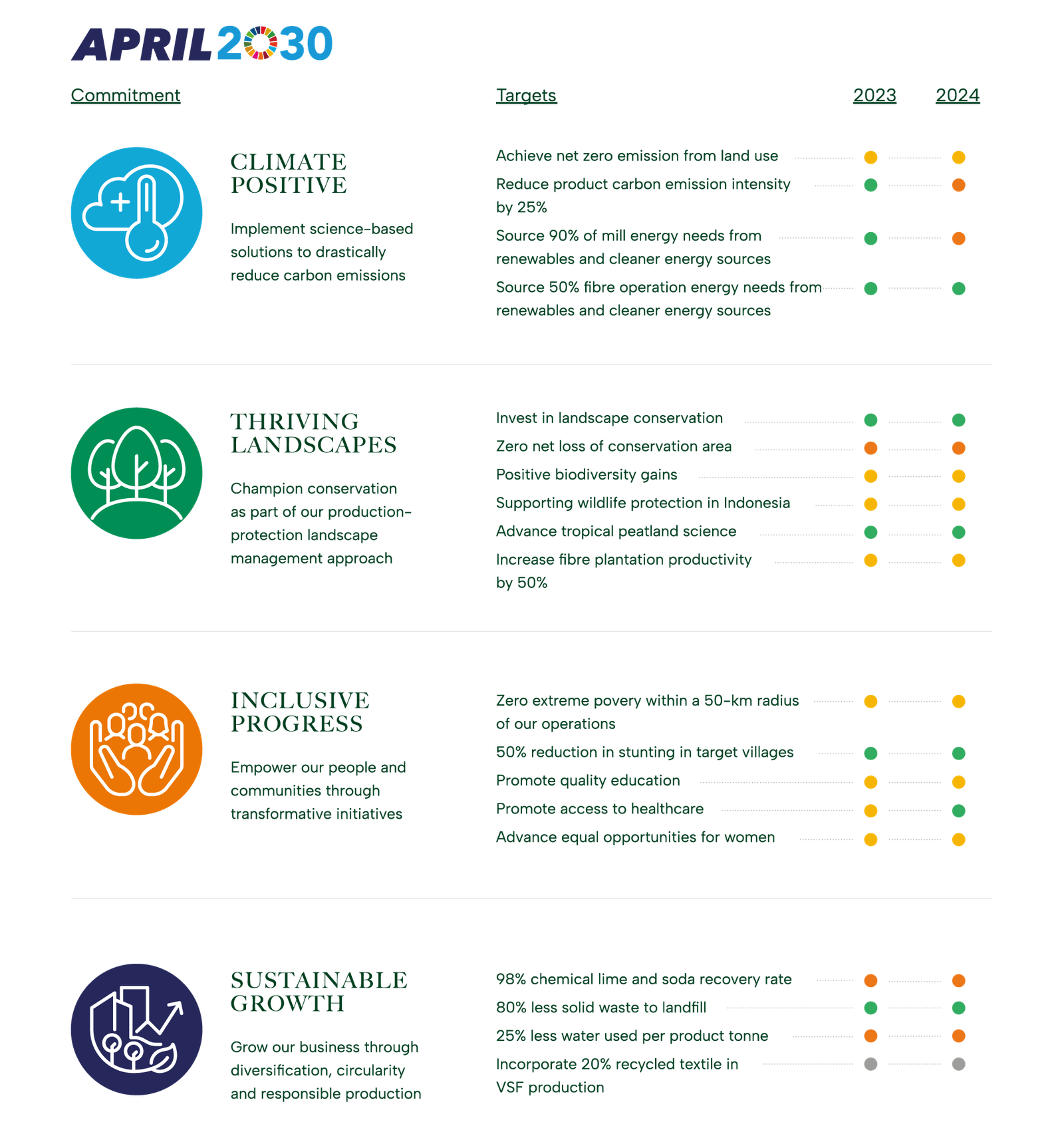
Waste disposed is recorded through various means of measurement including estimation of weight by waste type. Particular waste types as described above are measured as a wet waste and converted to a bone dry (BD) weight. The wet waste weight is multiplied by the consistency of each waste type to determine the BD. The consistency is predetermined by the lab.

Baseline
71kg/T

Performance 2022

On Track

sustainable growth — APRIL Asia

Method

The DPTW utilisation rate and % of textile waste per tonne of product will be based on R&D lab/pilot/demo procedures.

Baseline
0%

Performance 2022

In Development

sustainable growth — APRIL Asia

Method

Water consumption per tonne of product is calculated based on water consumed in the production of saleable pulp, paper, viscose staple fiber and viscose yarn measured by flow meters, via calculation and water balances divided by the production figures for saleable pulp, paper, viscose staple fibre and viscose yarn.

Baseline
28 m3/T

Performance 2022

Not Progressing

sustainable growth — APRIL Asia

Method

Soda content within the liquor cycle and losses are determined by means of mass balance based on daily lab analysis.

Lime volume in the lime kiln and losses are determined by means of lime make-up.

The recovery rate is calculated net of the percentage of make-up amounts added. The annual figure is based on the average monthly recovery rate.

Baseline
96%

Performance 2022

Not Progressing

inclusive progress — APRIL Asia

Method

Number of Mill and Nursery contractor calculated based on Man Power data which grouped by gender level calculated as a monthly average.

Baseline
2571

inclusive progress — APRIL Asia

Method

The number of own and supply partners employees is calculated based on year-end Man Power data which is grouped by gender. The identification of leadership position refer to employees’ grade D2 or Manager level and above.

Baseline
55 women employees in leadership positions

Performance 2022

Progressing

inclusive progress — APRIL Asia

Method

Women’s effective participation is identified from the participation list for each program. Percentage of female participation is calculated by the number of women participating divided by the total participants.

Baseline
34%

Performance 2022

Progressing

inclusive progress — APRIL Asia

Method

In development

Baseline
In development

Performance 2022

Progressing

inclusive progress — APRIL Asia

Method

In development

Baseline
In development

Performance 2022

Progressing

inclusive progress — APRIL Asia

Method

In development

Baseline
In development

Performance 2022

Progressing

inclusive progress — APRIL Asia

Method

We engaged third party to conduct assessment in APRIL-supported schools using the framework that was developed by Research Triangle Institute (RTI) and USAID.

Baseline
In development

Performance 2022

Progressing

inclusive progress — APRIL Asia

Method

Poverty mapping is identified through:

  1. Desktop analysis using National Statistics, Village Potential Statistics, SMERU Poverty Map.
  2. On-the-ground verification through FGD, village transect walk, interview with community.

Baseline
3%

Performance 2022

Progressing

thriving landscapes — APRIL Asia

Method

Peer-reviewed scientific journal publication standards

Baseline
1

Performance 2022

On Track

thriving landscapes — APRIL Asia

Method

Documentation of Participation (presentation of papers or posters) in national and international dialogues, workshops and conferences

Baseline
6

Performance 2022

On Track

thriving landscapes — APRIL Asia

Method

Number of scientists from universities and research institutions that have collaborated with APRIL on peatland management during the calendar year

Baseline
9

Performance 2022

On Track

thriving landscapes — APRIL Asia

Method

Wood deliveries (excluding open market supply) to the mill are used as a basis to calculate MAI (Tonnes/ Ha/Yr). The MAI is based on the 3 year area weighted rolling average growth for all closed compartments.

Baseline
20T/ha/yr

Performance 2022

On Track

thriving landscapes — APRIL Asia

Method

Methodology to be developed specific to animal species and does not include plants. Qualifying initiatives may vary widely in nature but must have the animal protection as the primary objective.

Partnerships will be developed and documented in line with an overarching strategy prioritizing stakeholders and threats specific to the country of Indonesia assessed.

Performance 2022

Progressing

thriving landscapes — APRIL Asia

Method

May include various initiatives relating to conservation of RTE species to be defined in a priority list, initiatives may be conducted solely or in collaboration with other stakeholders.

Baseline
2

thriving landscapes — APRIL Asia

Method

Methodology to be developed to measure change in ecosystem services and values over time (carbon sequestration, water provision, resource provision including fish and honey)

Baseline
not yet developed

thriving landscapes — APRIL Asia

Method

Reports for reforestation of previously encroached and degraded area including all areas where assisted natural regeneration, planting or enrichment planting of species that improve habitat value have taken place during the year but excludes natural regeneration.

Baseline
275 ha

Performance 2022

Progressing

thriving landscapes — APRIL Asia

Method

Area within conservation is derived from land bank which is based on land cover analysis and is updated annually to capture any boundary changes, land use changes or measurement data.

Baseline
0 ha Net loss

Performance 2022

Not Progressing

thriving landscapes — APRIL Asia

Method

Landscape conservation funding includes restoration and conservation costs associated with the RER as well as the allocation of a proportion of the costs related to APRIL’s maintenance of conservation values under its production-protection model. The allocation is based on proportionate amount of each cost that is related to conservation and restoration.

The wood volume is based on wood delivered to the Mill.

Baseline
USD$0.7 per tonne of plantation fiber

Performance 2022

On Track

climate positive 1 — APRIL Asia

Method

Mill

Calculate from the records of fuel types used the amount consumed in boilers to generate power, heat and steam including energy use for mobile & including transportation. Each of the fuel types are converted to energy expressed by Giga Joule Lower Heating Value (GJ LHV) following the IPCC guidelines.

Baseline: 87%

Performance 2022

On Track

Forest Operations

Calculate from the records of fuel types the quantity consumed by major categories of forest management activities by Fiber operations.

This covers energy used for Forest operations, infrastructure including wood transport from estate to mill; When a blend of fuel types is used (such as B20) the contribution to renewable and cleaner energy targets is calculated separately for each fuel rather than considering the blend as a cleaner fuel type.

Baseline: 19%

Performance 2022

Progressing

climate positive 1 — APRIL Asia

Method

APRIL follows the international GHG protocol as developed by WRI/WBCSD to develop its emissions profile. The total emissions measured as emissions intensity is calculated based on tonnes of Scope 1 and 2 Mill Greenhouse Gas Emissions per tonne of product (paper, pulp and viscose). The emissions boundary scope covers gate-to-gate (wood processing in wood yard until pulp, paper and viscose production) of the three main GHGs: CO2, CH4, and N2O.

Baseline
0.55 tCO2e/product tonne

Performance 2022

On Track

climate positive 1 — APRIL Asia

Method

To quantify the total GHG emission and removals across APRIL’s land bank from land use, APRIL follows the GHG Protocol Agricultural Guidance and IPCC Guidelines for Agricultural, Forestry, and Other Land Use. To detect the land cover change within the look-back period, i.e. 20 years APRIL utilized the remotely sensed data.

The GHG emission will be calculated as the total of carbon stock changes in woody biomass and soil organic carbon and include all major carbon fluxes such as peat decomposition, plantation growth and harvesting, and fires.

To quantify the amount of carbon unit to balance the emission, the Verified Carbon Standard (VCS), the Climate, Community and Biodiversity Standards (CCB), or other internationally accepted standard will be used.

Performance 2022

Progressing

This site is registered on wpml.org as a development site. Switch to a production site key to remove this banner.